Citrus planning board hears hundreds of objections over Holder Industrial Park expansion and votes to continue
March 06, 2026 | Citrus County, Florida
This article was created by AI summarizing key points discussed. AI makes mistakes, so for full details and context, please refer to the video of the full meeting. Please report any errors so we can fix them. Report an error »
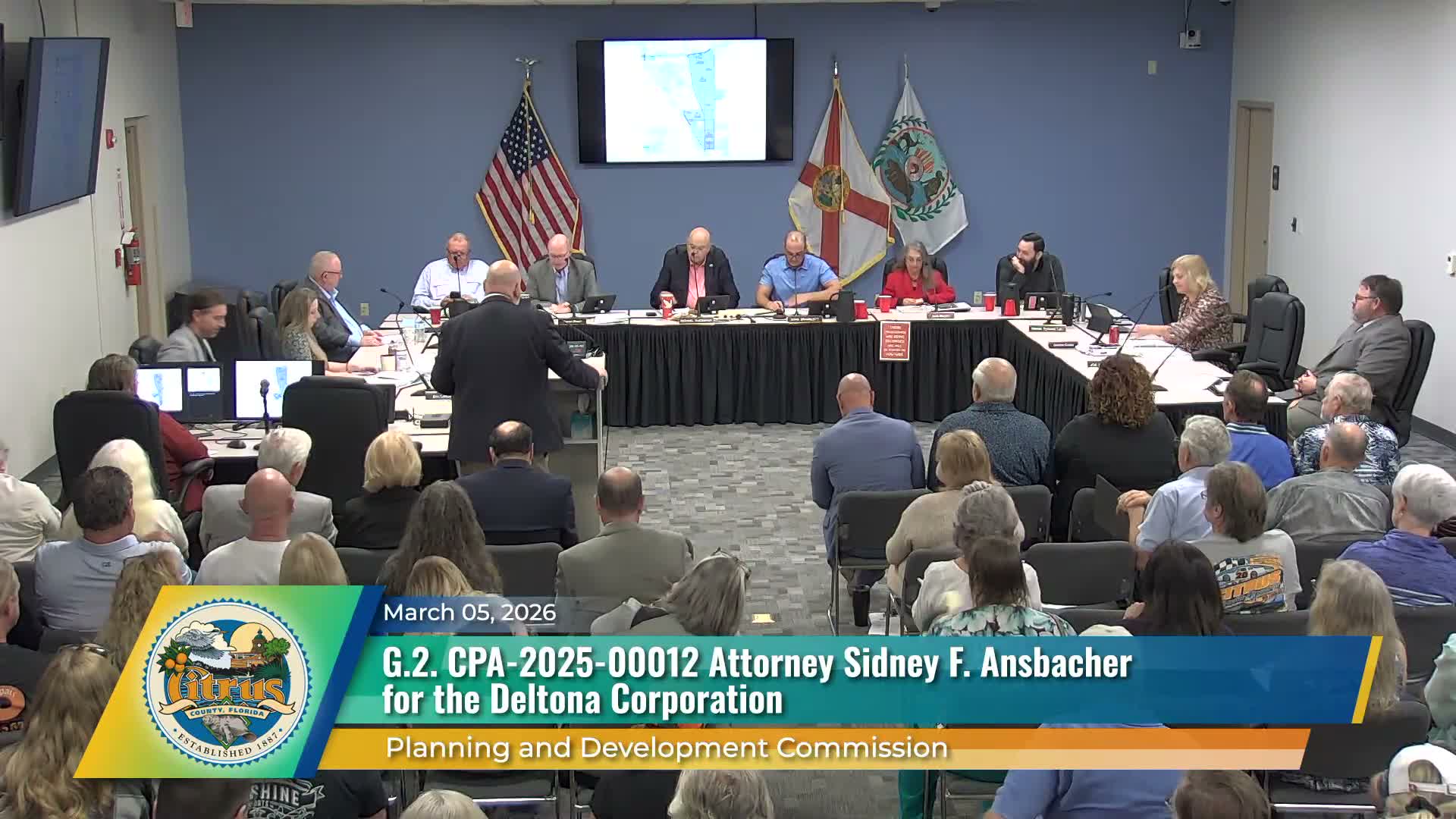
The Citrus County Planning & Development Commission on March 12 heard hours of staff presentation, developer testimony and extended public comment on a proposed comprehensive-plan amendment to expand the Holder Industrial Park and add heavy-industrial uses, including data centers; after debate the commission voted 4–3 to continue the application to allow additional technical studies and to await pending state legislation that could change how data centers are regulated.
The hearing focused on whether the county should add roughly 1,300 acres to the existing Holder Industrial Park and allow a range of heavy industrial uses by right in the expanded area. Staff described the request as an amendment to the comprehensive plan and sub-area plan that would permit a list of tier 1 and tier 2 uses; several commissioners and speakers noted the application is conceptual and does not identify specific end users.
“Why is it you identify the useful life of the facility as 10 years?” a commissioner asked during the staff and applicant question period, pressing the applicant about assumptions carried from a 2019 filing. The applicant representative responded that the 10‑year figure reflected an earlier assumption used in 2019 and in current materials. Commissioners said the number, and other planning assumptions, lacked sufficient detail for them to judge long-term impacts.
Water demand, noise and traffic dominated both board questions and public comment. Several speakers cited a figure discussed at the hearing — 100,000 gallons per day — as an example of the kind of water use that alarms residents. Brian Dilmore, the county’s utility planning and engineering director, told the commission the utility department could only assess actual water impacts once a concrete, site‑level proposal and an identified end user were submitted. “I have no knowledge of that,” Dilmore said when asked for an order‑of‑magnitude figure for daily losses from a closed‑loop cooling system.
Numerous residents told the commissioners the expansion would threaten local wells, wildlife and the county’s groundwater recharge areas. “We sit Citrus County sits on top of the outcroppings for the Bridal aquifer,” one resident told the commission, citing concerns about regional water resources and the county’s drought status. Several speakers also raised low‑frequency noise and the emissions and fuel‑storage risks associated with backup generators.
Supporters of the expansion, including the Chamber of Commerce and a former economic‑development official, urged the board to forward the application to the Board of County Commissioners so the county could pursue jobs and a broader tax base. Josh Wooten, CEO of the Chamber of Commerce, said the county needs more industrial land and guardrails that can be applied at later permitting stages; Don Taylor, a former economic development director, said prior environmental testing and utility analyses had been completed across the acreage.
Applicant counsel told the commission pending state bills and forthcoming LDC (land‑development code) language will create “guardrails” for noise, water allocation and electric‑rate protections. Counsel also explained that closed‑loop systems without human occupancy would typically seek consumptive‑use permits from the water‑management district rather than tie into county potable water systems, which generally serve buildings with human occupancy.
After public comment, Commissioner Barmez moved to continue the application so staff and the applicant could complete outstanding technical studies and provide a fuller administrative record. The motion was seconded and, after discussion, carried on a roll‑call vote: four in favor, three opposed. The commission recorded the yes votes as Facemeyer, Barmez, Bozeman and Sherra; the no votes as Chair Bramblett, Gilbert and Murphy. The continuance means the panel will consider the matter again after additional information and/or legislative changes are available.
The commission’s action is procedural: the PDC issues a recommendation; the Board of County Commissioners will make the final decision. Staff said pending state legislation addressing data centers’ noise, RF and water permitting could be enacted soon and would affect how the BOCC and county staff review any future site‑level applications.
The hearing record included dozens of public exhibits and more than three hours of public comment; the commission set the next hearings for follow‑up and warned of a heavy agenda in April. The planning board closed the record and directed staff and the applicant to provide outstanding technical details in advance of the next hearing.
The hearing focused on whether the county should add roughly 1,300 acres to the existing Holder Industrial Park and allow a range of heavy industrial uses by right in the expanded area. Staff described the request as an amendment to the comprehensive plan and sub-area plan that would permit a list of tier 1 and tier 2 uses; several commissioners and speakers noted the application is conceptual and does not identify specific end users.
“Why is it you identify the useful life of the facility as 10 years?” a commissioner asked during the staff and applicant question period, pressing the applicant about assumptions carried from a 2019 filing. The applicant representative responded that the 10‑year figure reflected an earlier assumption used in 2019 and in current materials. Commissioners said the number, and other planning assumptions, lacked sufficient detail for them to judge long-term impacts.
Water demand, noise and traffic dominated both board questions and public comment. Several speakers cited a figure discussed at the hearing — 100,000 gallons per day — as an example of the kind of water use that alarms residents. Brian Dilmore, the county’s utility planning and engineering director, told the commission the utility department could only assess actual water impacts once a concrete, site‑level proposal and an identified end user were submitted. “I have no knowledge of that,” Dilmore said when asked for an order‑of‑magnitude figure for daily losses from a closed‑loop cooling system.
Numerous residents told the commissioners the expansion would threaten local wells, wildlife and the county’s groundwater recharge areas. “We sit Citrus County sits on top of the outcroppings for the Bridal aquifer,” one resident told the commission, citing concerns about regional water resources and the county’s drought status. Several speakers also raised low‑frequency noise and the emissions and fuel‑storage risks associated with backup generators.
Supporters of the expansion, including the Chamber of Commerce and a former economic‑development official, urged the board to forward the application to the Board of County Commissioners so the county could pursue jobs and a broader tax base. Josh Wooten, CEO of the Chamber of Commerce, said the county needs more industrial land and guardrails that can be applied at later permitting stages; Don Taylor, a former economic development director, said prior environmental testing and utility analyses had been completed across the acreage.
Applicant counsel told the commission pending state bills and forthcoming LDC (land‑development code) language will create “guardrails” for noise, water allocation and electric‑rate protections. Counsel also explained that closed‑loop systems without human occupancy would typically seek consumptive‑use permits from the water‑management district rather than tie into county potable water systems, which generally serve buildings with human occupancy.
After public comment, Commissioner Barmez moved to continue the application so staff and the applicant could complete outstanding technical studies and provide a fuller administrative record. The motion was seconded and, after discussion, carried on a roll‑call vote: four in favor, three opposed. The commission recorded the yes votes as Facemeyer, Barmez, Bozeman and Sherra; the no votes as Chair Bramblett, Gilbert and Murphy. The continuance means the panel will consider the matter again after additional information and/or legislative changes are available.
The commission’s action is procedural: the PDC issues a recommendation; the Board of County Commissioners will make the final decision. Staff said pending state legislation addressing data centers’ noise, RF and water permitting could be enacted soon and would affect how the BOCC and county staff review any future site‑level applications.
The hearing record included dozens of public exhibits and more than three hours of public comment; the commission set the next hearings for follow‑up and warned of a heavy agenda in April. The planning board closed the record and directed staff and the applicant to provide outstanding technical details in advance of the next hearing.
View the Full Meeting & All Its Details
This article offers just a summary. Unlock complete video, transcripts, and insights as a Founder Member.
✓
Watch full, unedited meeting videos
✓
Search every word spoken in unlimited transcripts
✓
AI summaries & real-time alerts (all government levels)
✓
Permanent access to expanding government content
30-day money-back guarantee
