University of Minnesota leaders highlight undergraduate health pathways, cite clinical‑site shortage as main barrier
May 10, 2025 | University of Minnesota, Public Universities Board of Trustees Meeting, School Boards, Minnesota
This article was created by AI summarizing key points discussed. AI makes mistakes, so for full details and context, please refer to the video of the full meeting. Please report any errors so we can fix them. Report an error »
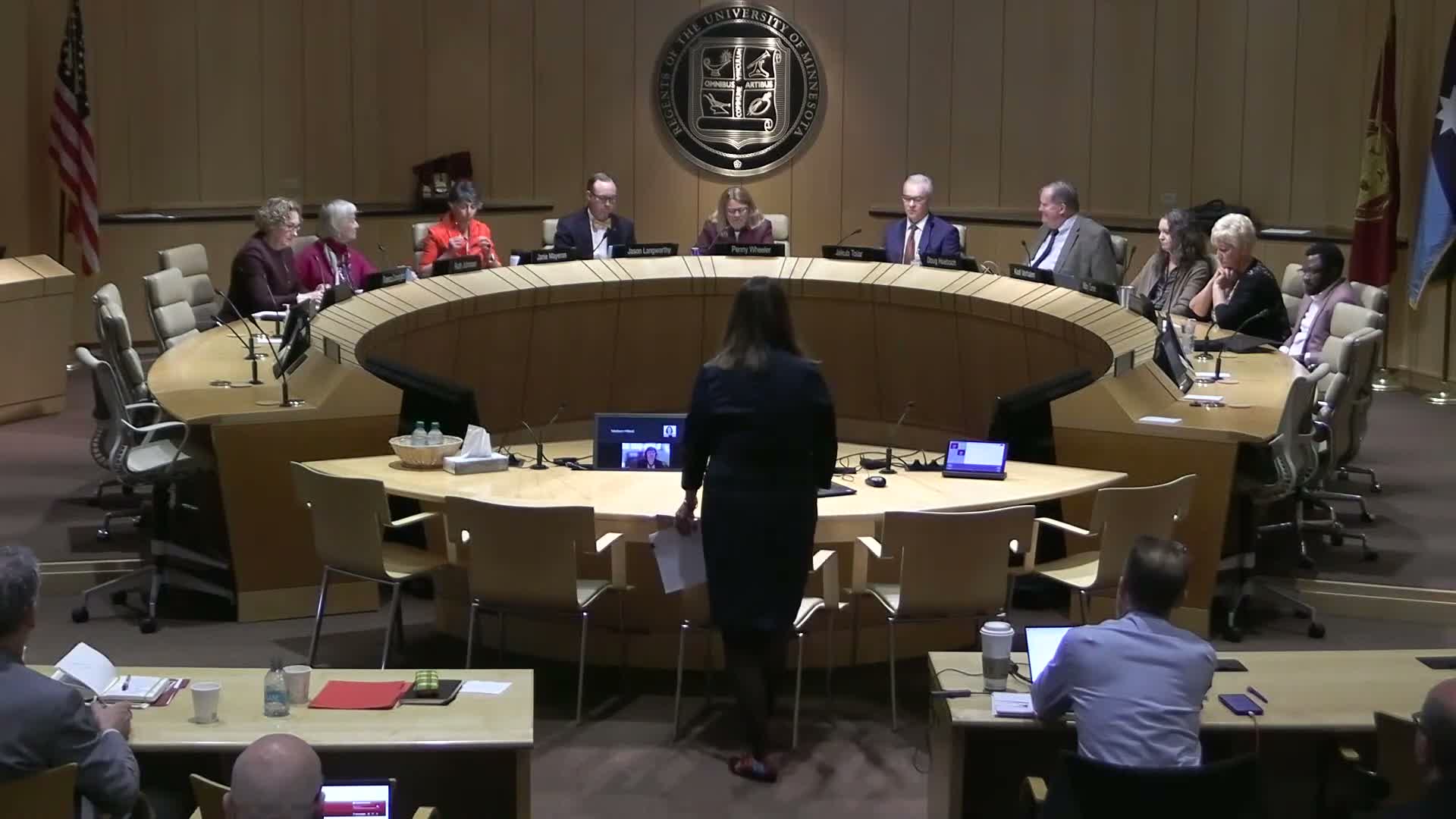
University of Minnesota leaders used a May Board of Regents health‑committee meeting to present undergraduate health‑science pathways across the system and to identify barriers to scaling the workforce pipeline.
Vice President Tolar opened the session by describing a network of training sites across the system, then campus chancellors and the dean of the School of Nursing described specific programs, early‑assurance pathways and partnerships with health systems such as Mayo Clinic. Participants highlighted programs that shorten time to credentialing, including accelerated three‑year tracks and early‑admission programs such as VetFAST for food‑animal veterinary students.
“ The number one barrier in being able to respond...is availability of clinical sites, ” Dean Connie Delaney told the committee, answering a question about constraints on expanding nursing enrollment. She also noted that the applicant pool is strong but that clinical placement capacity and financial resources limit throughput and program expansion.
Presenters offered placement statistics to underscore workforce outcomes: across campuses they reported high placement rates for several programs (for example, a 96% placement rate cited for one program and 100% placement for some recent dental hygiene classes), and speakers said roughly 80% of BSN graduates remain in Minnesota.
Board members and student representatives discussed accelerated curriculums and pathway design to reduce so‑called gateway course barriers that can impede students’ progress. Campus leaders described curricular redesign, targeted paid internships and work‑based learning as strategies to improve affordability and pipeline speed.
No votes were taken. Regents said they will follow the system optimization working group's forthcoming recommendations and watch for proposals that increase paid internships and align early‑assurance pathways with employer needs.
Vice President Tolar opened the session by describing a network of training sites across the system, then campus chancellors and the dean of the School of Nursing described specific programs, early‑assurance pathways and partnerships with health systems such as Mayo Clinic. Participants highlighted programs that shorten time to credentialing, including accelerated three‑year tracks and early‑admission programs such as VetFAST for food‑animal veterinary students.
“ The number one barrier in being able to respond...is availability of clinical sites, ” Dean Connie Delaney told the committee, answering a question about constraints on expanding nursing enrollment. She also noted that the applicant pool is strong but that clinical placement capacity and financial resources limit throughput and program expansion.
Presenters offered placement statistics to underscore workforce outcomes: across campuses they reported high placement rates for several programs (for example, a 96% placement rate cited for one program and 100% placement for some recent dental hygiene classes), and speakers said roughly 80% of BSN graduates remain in Minnesota.
Board members and student representatives discussed accelerated curriculums and pathway design to reduce so‑called gateway course barriers that can impede students’ progress. Campus leaders described curricular redesign, targeted paid internships and work‑based learning as strategies to improve affordability and pipeline speed.
No votes were taken. Regents said they will follow the system optimization working group's forthcoming recommendations and watch for proposals that increase paid internships and align early‑assurance pathways with employer needs.
Don't Miss a Word: See the Full Meeting!
Go beyond summaries. Unlock every video, transcript, and key insight with a Founder Membership.
✓
Get instant access to full meeting videos
✓
Search and clip any phrase from complete transcripts
✓
Receive AI-powered summaries & custom alerts
✓
Enjoy lifetime, unrestricted access to government data
30-day money-back guarantee
