Court hears arguments over whether Shell paid to lease Arctic containment system or to buy services
March 04, 2026 | Other Court, Judicial , Washington
This article was created by AI summarizing key points discussed. AI makes mistakes, so for full details and context, please refer to the video of the full meeting. Please report any errors so we can fix them. Report an error »
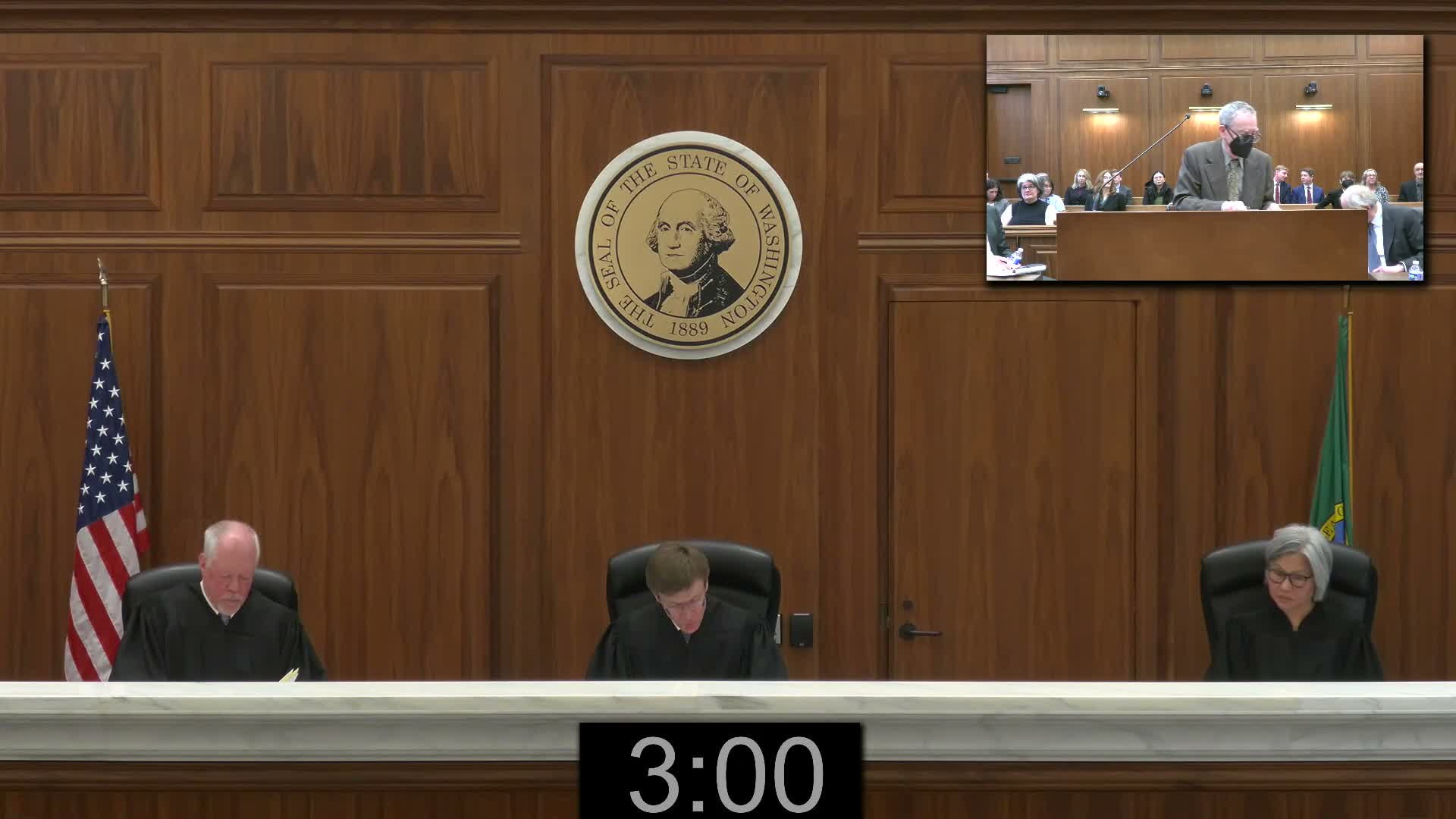
Oral argument in Superior Energy Services v. State Department of Revenue centered on whether Shell’s payments for an Arctic containment system were payments to lease equipment or payments for services that would make Superior Energy Services liable for use tax.
In opening argument, Bridal Durban, counsel for Superior Energy Services, told the court that “this case boils down to whether or not Shell paid Superior Energy Services to lease a first of its kind, equipment to satisfy its regulatory responsibilities, or whether Shell paid Superior Energy to perform an oil containment service that was never mentioned in a multi 100 page lease agreement and was never actually performed.” She emphasized that Shell exercised dominion and control over the system, had an express contractual option to purchase it after the term (subject to a termination fee), and that the response rate for deployment was never paid, arguing those facts support treating the arrangement as a lease.
Assistant Attorney General Scott Forbes, representing the Department of Revenue, urged the opposite view. “This was not a true lease,” Forbes said, arguing the parties’ true object was obtaining services: designing, building, maintaining and storing the system; hiring and training personnel; demonstrating and operating the system; and managing the project. Forbes told the court the board found documentary evidence and contract terms showing Superior’s activities went beyond mere maintenance, setup and inspection, and that Superior therefore acted as a consumer for use‑tax purposes.
The court pressed both sides on the statutory boundary for equipment “with an operator.” A judge noted the commercial reality that the asset appears to be highly depreciable and observed that many businesses would prefer a lease. The judge also probed the department’s rule language about an operator who provides “expertise beyond operating” and asked whether routine demonstrations or test deployments should convert a lease into a taxable service. Forbes distinguished ordinary demonstrations (for example, a test drive) from the situation here, saying Shell required demonstrations for federal permitting and that Superior performed multiple deployment tests in Bellingham Bay in 2012, 2013 and 2015 and kept a standby team ready to deploy during the 2015 drilling season though the system was never called into emergency use.
Bridal Durban countered that Shell supplied a barge supervisor and retained option language (c p 678, § 18.4(b)) allowing Shell, if it paid the termination fee, to buy the system or direct its disposition—facts she argued show Shell’s control and an intent to acquire equipment rather than services.
Both advocates invoked legal materials. Durban cited the Duncan Crane line of authority and subsequent statutory amendments creating the modern “lease with operator” inquiry; Forbes relied on the department’s interpretive guidance (referred to in argument as Rule 2‑11) and the board’s factual findings that the contract required operational obligations beyond mere setup and inspection.
The transcript ends with the court thanking counsel; no ruling or further scheduling information appears in the provided segments. The dispute before the court turns on whether the contract’s terms and the parties’ intent at formation demonstrate that Shell acquired dominion and control of equipment (a lease) or purchased ongoing services (a taxable use), and on how to apply the statutory test for equipment with an operator.
Ending: Oral argument concluded in the recorded segments with no decision announced; the court’s next steps or opinion are not included in the transcript.
In opening argument, Bridal Durban, counsel for Superior Energy Services, told the court that “this case boils down to whether or not Shell paid Superior Energy Services to lease a first of its kind, equipment to satisfy its regulatory responsibilities, or whether Shell paid Superior Energy to perform an oil containment service that was never mentioned in a multi 100 page lease agreement and was never actually performed.” She emphasized that Shell exercised dominion and control over the system, had an express contractual option to purchase it after the term (subject to a termination fee), and that the response rate for deployment was never paid, arguing those facts support treating the arrangement as a lease.
Assistant Attorney General Scott Forbes, representing the Department of Revenue, urged the opposite view. “This was not a true lease,” Forbes said, arguing the parties’ true object was obtaining services: designing, building, maintaining and storing the system; hiring and training personnel; demonstrating and operating the system; and managing the project. Forbes told the court the board found documentary evidence and contract terms showing Superior’s activities went beyond mere maintenance, setup and inspection, and that Superior therefore acted as a consumer for use‑tax purposes.
The court pressed both sides on the statutory boundary for equipment “with an operator.” A judge noted the commercial reality that the asset appears to be highly depreciable and observed that many businesses would prefer a lease. The judge also probed the department’s rule language about an operator who provides “expertise beyond operating” and asked whether routine demonstrations or test deployments should convert a lease into a taxable service. Forbes distinguished ordinary demonstrations (for example, a test drive) from the situation here, saying Shell required demonstrations for federal permitting and that Superior performed multiple deployment tests in Bellingham Bay in 2012, 2013 and 2015 and kept a standby team ready to deploy during the 2015 drilling season though the system was never called into emergency use.
Bridal Durban countered that Shell supplied a barge supervisor and retained option language (c p 678, § 18.4(b)) allowing Shell, if it paid the termination fee, to buy the system or direct its disposition—facts she argued show Shell’s control and an intent to acquire equipment rather than services.
Both advocates invoked legal materials. Durban cited the Duncan Crane line of authority and subsequent statutory amendments creating the modern “lease with operator” inquiry; Forbes relied on the department’s interpretive guidance (referred to in argument as Rule 2‑11) and the board’s factual findings that the contract required operational obligations beyond mere setup and inspection.
The transcript ends with the court thanking counsel; no ruling or further scheduling information appears in the provided segments. The dispute before the court turns on whether the contract’s terms and the parties’ intent at formation demonstrate that Shell acquired dominion and control of equipment (a lease) or purchased ongoing services (a taxable use), and on how to apply the statutory test for equipment with an operator.
Ending: Oral argument concluded in the recorded segments with no decision announced; the court’s next steps or opinion are not included in the transcript.
View the Full Meeting & All Its Details
This article offers just a summary. Unlock complete video, transcripts, and insights as a Founder Member.
✓
Watch full, unedited meeting videos
✓
Search every word spoken in unlimited transcripts
✓
AI summaries & real-time alerts (all government levels)
✓
Permanent access to expanding government content
30-day money-back guarantee
