Appellants ask court to review denial of SEPA appeals after hearing examiner dismissed challenges; city says statutes bar predecision appeals
March 04, 2026 | Other Court, Judicial , Washington
This article was created by AI summarizing key points discussed. AI makes mistakes, so for full details and context, please refer to the video of the full meeting. Please report any errors so we can fix them. Report an error »
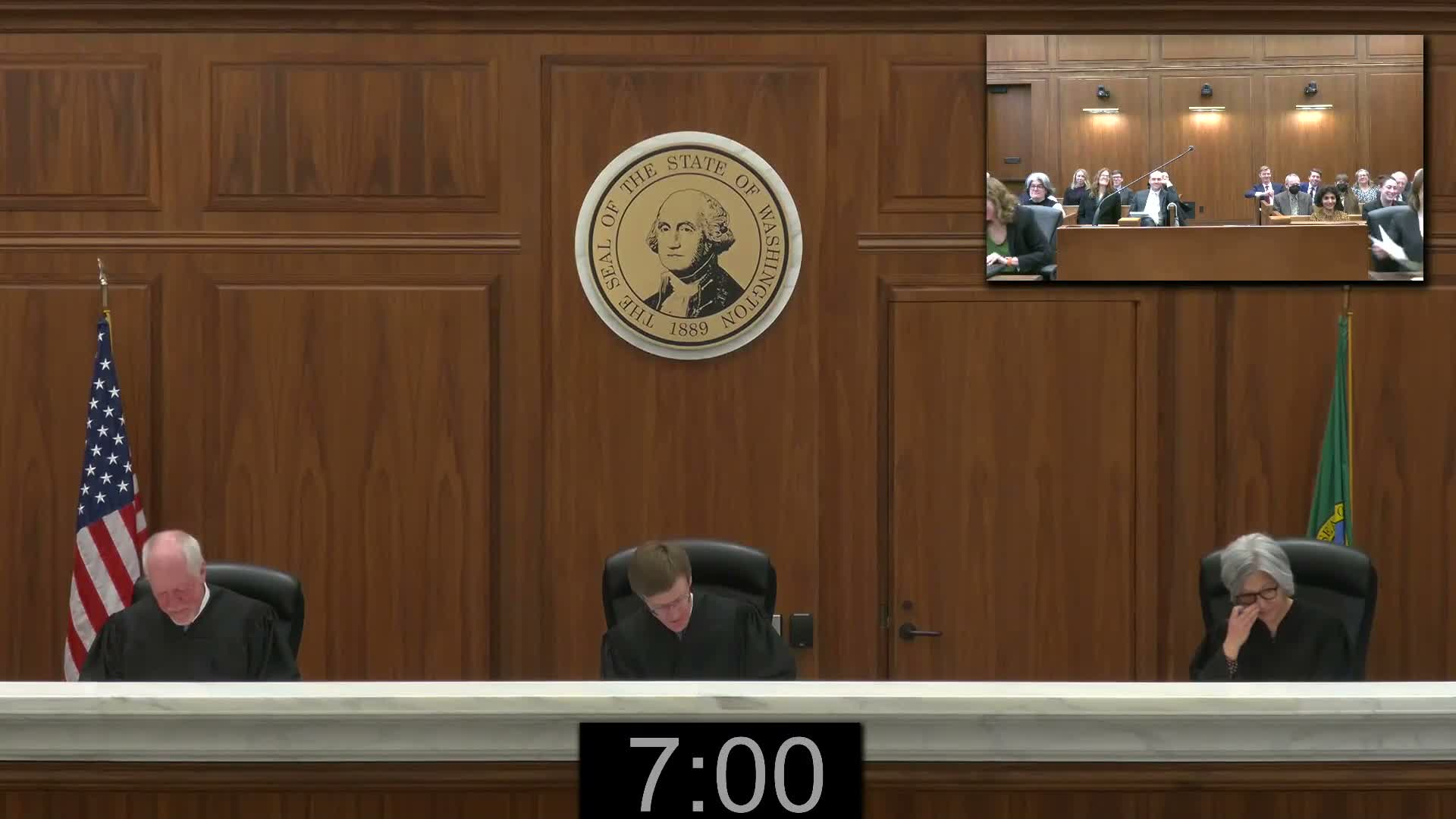
Chris Shouts, counsel for Friends of Ravenna Cowan and John Carey, told an appellate panel that the hearing examiner wrongly dismissed challenges to the adequacy of the city's final environmental impact statement. "This case concerns a review process that SEPA and Seattle's own code expressly allow, review by a hearing examiner of the adequacy of a final EIS," Shouts said, arguing the examiner improperly relied on appeal-prohibition statutes to bar the appeals and dismissed a petition by John Carey for failure to have submitted written comments on the draft EIS.
Shouts framed the issue as a jurisdictional one: "We're not here to examine the merits of the FEIS. We're not here to judge anything else other than... did the examiner make the right decision in refusing to allow the appeals to go forward?" He told the court appellants lack a "plain, speedy, and adequate remedy" if the municipal examiner's procedural denial stands and said the growth management hearings board cannot substitute for the examiner's review of an "orphan" EIS before legislative enactment.
Toby Thaler, counsel for Jennifer Godfrey, urged that at least some of Godfrey's claims remain reviewable, particularly those tied to fish habitat and critical areas. "The case is not moot because the city will continue churning out major actions that do citywide or area-wide changes that have environmental impacts," Thaler said, emphasizing that reliance on a single FEIS for phased implementation can foreclose intermediate review of important environmental issues.
Max Burke, counsel for the City of Seattle, urged the court to deny extraordinary writ relief. He said the statutory scheme and the city code reflect a legislative choice to limit SEPA appeals for certain council land-use actions in order to prioritize housing production. Burke cited a city code provision and state statutory language and told the panel the statutes "relat[e] to promoting housing construction ... limiting appeals under the State Environmental Policy Act and Growth Management Act." He argued that, taken as a whole, the statutory regime favors post-decision review and that allowing interlocutory municipal appeals would undermine that policy.
The panel repeatedly questioned both sides on whether the legislature's amendments eliminated a municipality's option to offer an internal review and whether the city's code and EIS disclosures expressly informed readers that appeals were limited. Counsel for appellants pointed to the city's procedural materials that describe how to file a hearing-examiner appeal and noted multiple petitions were filed after the FEIS notice. Counsel for the city acknowledged the statutory text and legislative materials are not a model of clarity but maintained the overall statutory purpose is to restrict these appeals.
The argument centered on three practical consequences: whether the municipal hearing examiner has authority to hear FEIS adequacy appeals before council action, whether remanding to the examiner would create parallel or duplicative proceedings, and whether some claims (for example, fish-habitat protections) remain subject to review under statutory exceptions. The panel pressed hypotheticals about subsequent ordinances that might rely on the FEIS and whether those future actions would be appealable if the examiner never evaluated the EIS.
The hearing concluded after counsel addressed the court's questions and the parties exchanged final remarks. The panel thanked counsel; no decision was announced from the bench during argument.
Shouts framed the issue as a jurisdictional one: "We're not here to examine the merits of the FEIS. We're not here to judge anything else other than... did the examiner make the right decision in refusing to allow the appeals to go forward?" He told the court appellants lack a "plain, speedy, and adequate remedy" if the municipal examiner's procedural denial stands and said the growth management hearings board cannot substitute for the examiner's review of an "orphan" EIS before legislative enactment.
Toby Thaler, counsel for Jennifer Godfrey, urged that at least some of Godfrey's claims remain reviewable, particularly those tied to fish habitat and critical areas. "The case is not moot because the city will continue churning out major actions that do citywide or area-wide changes that have environmental impacts," Thaler said, emphasizing that reliance on a single FEIS for phased implementation can foreclose intermediate review of important environmental issues.
Max Burke, counsel for the City of Seattle, urged the court to deny extraordinary writ relief. He said the statutory scheme and the city code reflect a legislative choice to limit SEPA appeals for certain council land-use actions in order to prioritize housing production. Burke cited a city code provision and state statutory language and told the panel the statutes "relat[e] to promoting housing construction ... limiting appeals under the State Environmental Policy Act and Growth Management Act." He argued that, taken as a whole, the statutory regime favors post-decision review and that allowing interlocutory municipal appeals would undermine that policy.
The panel repeatedly questioned both sides on whether the legislature's amendments eliminated a municipality's option to offer an internal review and whether the city's code and EIS disclosures expressly informed readers that appeals were limited. Counsel for appellants pointed to the city's procedural materials that describe how to file a hearing-examiner appeal and noted multiple petitions were filed after the FEIS notice. Counsel for the city acknowledged the statutory text and legislative materials are not a model of clarity but maintained the overall statutory purpose is to restrict these appeals.
The argument centered on three practical consequences: whether the municipal hearing examiner has authority to hear FEIS adequacy appeals before council action, whether remanding to the examiner would create parallel or duplicative proceedings, and whether some claims (for example, fish-habitat protections) remain subject to review under statutory exceptions. The panel pressed hypotheticals about subsequent ordinances that might rely on the FEIS and whether those future actions would be appealable if the examiner never evaluated the EIS.
The hearing concluded after counsel addressed the court's questions and the parties exchanged final remarks. The panel thanked counsel; no decision was announced from the bench during argument.
View the Full Meeting & All Its Details
This article offers just a summary. Unlock complete video, transcripts, and insights as a Founder Member.
✓
Watch full, unedited meeting videos
✓
Search every word spoken in unlimited transcripts
✓
AI summaries & real-time alerts (all government levels)
✓
Permanent access to expanding government content
30-day money-back guarantee
