MCPS reports modest MCAP gains, outlines instructional and evaluation steps to close persistent gaps
March 06, 2026 | Montgomery County, Maryland
This article was created by AI summarizing key points discussed. AI makes mistakes, so for full details and context, please refer to the video of the full meeting. Please report any errors so we can fix them. Report an error »
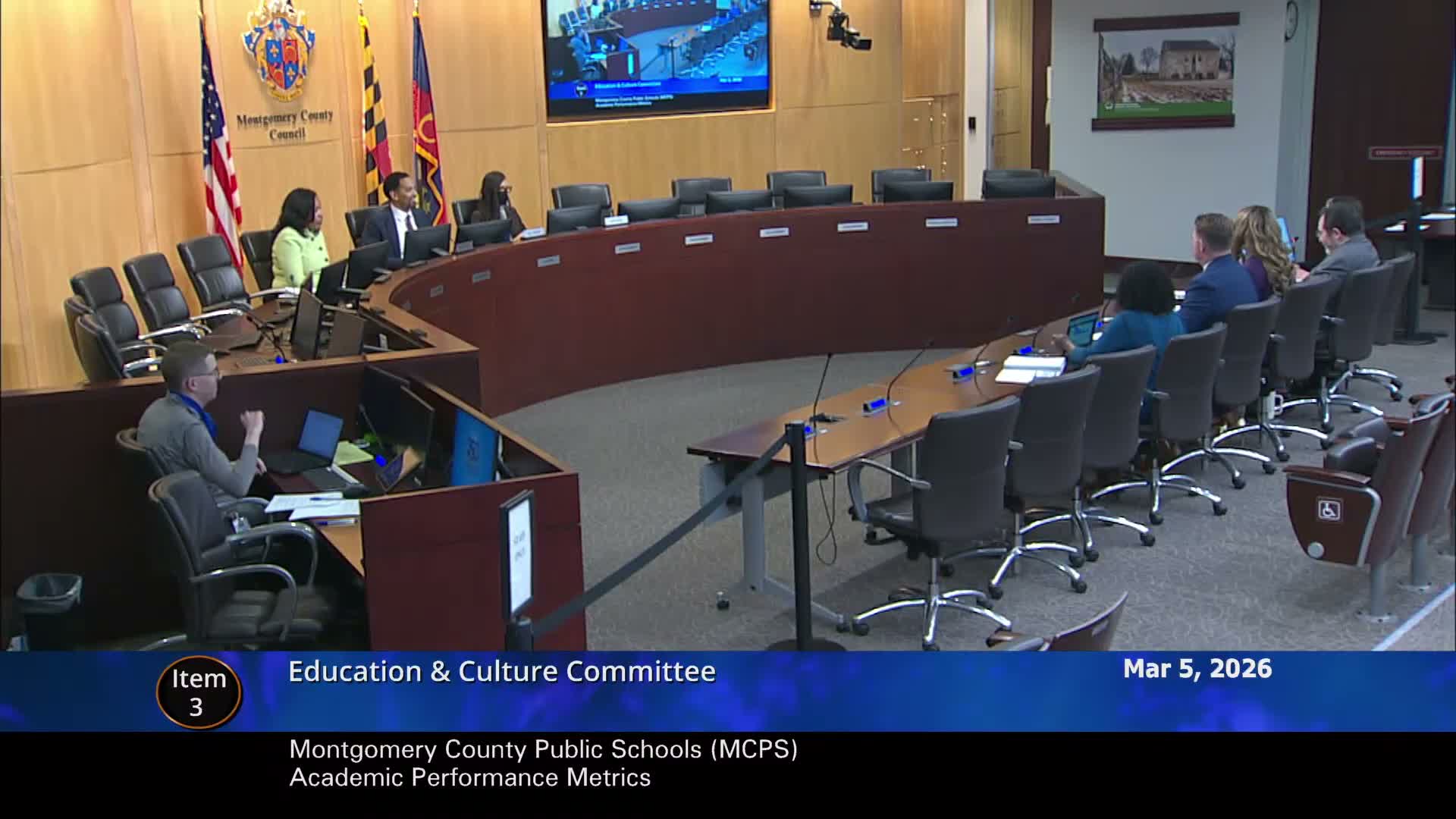
MCPS officials presented Maryland School Report Card and MCAP results to the Education & Culture Committee on March 5, reporting modest districtwide gains while stressing persistent gaps and an emphasis on tightening instructional practice, targeted interventions and program evaluation.
Doctor Anson framed the district's 2035 goal of having every school achieve a 4- or 5-star rating on the Maryland School Report Card. "By 2035, 100% of our schools will achieve a 4 or 5 star rating on the Maryland school report card," the presentation stated as the strategic anchor. MCPS reported that for school year 2024-25 combined English language arts/literacy proficiency was 57.7% (up 2.6 percentage points from 2022-23) and combined mathematics proficiency was 35.7% (up 2.9 points).
Presenters disaggregated results by race and gender and highlighted persistent disparities: for ELA, Black female students had a 54.5% proficiency rate in 2025 while Black male students were at 42.7%; in mathematics, Hispanic/Latino female students posted the lowest reported proficiency at 13.5% (the transcript lists that figure in the MCPS presentation). MCPS officials said these patterns motivate their focus on a common instructional vision, revised school improvement plans aligned to state accountability, cross-functional teams and targeted intervention time ("fit time") during the school day.
MCPS outlined concrete instructional steps: new elementary literacy curriculum (CKLA) in year two of implementation; TNTP classroom rounds and observation-based monitoring to create a baseline of instructional practice; daily focused instructional time for interventions; new student reading-improvement plans required by state reading policy; and a forthcoming request for proposals for new math curriculum. MCPS said program-evaluation studies and a return-on-investment framework will be used to verify which investments yield measurable gains.
Council members pressed for clarity on which specific interventions are demonstrably effective for the student groups with the largest gaps and requested more evidence (comparison groups or evaluation studies) tying investments to outcomes. MCPS said some partnerships and piloted supports (including community partnerships) exist but district-funded, group-specific programs are presently limited and remain an area for further budget consideration.
Doctor Anson framed the district's 2035 goal of having every school achieve a 4- or 5-star rating on the Maryland School Report Card. "By 2035, 100% of our schools will achieve a 4 or 5 star rating on the Maryland school report card," the presentation stated as the strategic anchor. MCPS reported that for school year 2024-25 combined English language arts/literacy proficiency was 57.7% (up 2.6 percentage points from 2022-23) and combined mathematics proficiency was 35.7% (up 2.9 points).
Presenters disaggregated results by race and gender and highlighted persistent disparities: for ELA, Black female students had a 54.5% proficiency rate in 2025 while Black male students were at 42.7%; in mathematics, Hispanic/Latino female students posted the lowest reported proficiency at 13.5% (the transcript lists that figure in the MCPS presentation). MCPS officials said these patterns motivate their focus on a common instructional vision, revised school improvement plans aligned to state accountability, cross-functional teams and targeted intervention time ("fit time") during the school day.
MCPS outlined concrete instructional steps: new elementary literacy curriculum (CKLA) in year two of implementation; TNTP classroom rounds and observation-based monitoring to create a baseline of instructional practice; daily focused instructional time for interventions; new student reading-improvement plans required by state reading policy; and a forthcoming request for proposals for new math curriculum. MCPS said program-evaluation studies and a return-on-investment framework will be used to verify which investments yield measurable gains.
Council members pressed for clarity on which specific interventions are demonstrably effective for the student groups with the largest gaps and requested more evidence (comparison groups or evaluation studies) tying investments to outcomes. MCPS said some partnerships and piloted supports (including community partnerships) exist but district-funded, group-specific programs are presently limited and remain an area for further budget consideration.
Don't Miss a Word: See the Full Meeting!
Go beyond summaries. Unlock every video, transcript, and key insight with a Founder Membership.
✓
Get instant access to full meeting videos
✓
Search and clip any phrase from complete transcripts
✓
Receive AI-powered summaries & custom alerts
✓
Enjoy lifetime, unrestricted access to government data
30-day money-back guarantee
