Montgomery County health leaders defend culturally tailored initiatives, council presses for disaggregated performance metrics
March 06, 2026 | Montgomery County, Maryland
This article was created by AI summarizing key points discussed. AI makes mistakes, so for full details and context, please refer to the video of the full meeting. Please report any errors so we can fix them. Report an error »
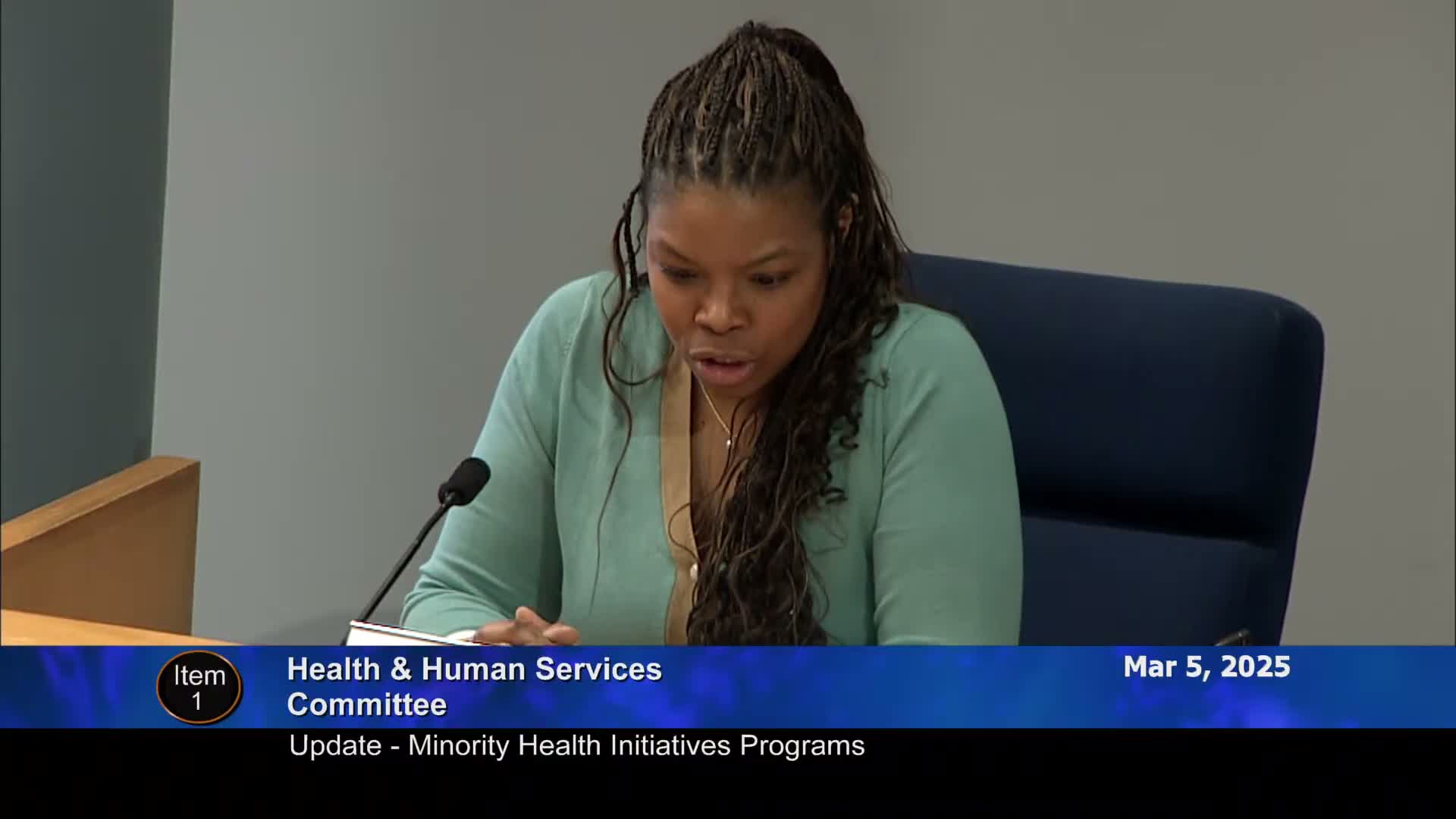
Montgomery County health officials on Monday reviewed year-to-date activity, budgets and recent outcomes for three culturally focused programs and faced council members’ requests for clearer, disaggregated performance measures as the FY27 budget season approaches.
The update to the county council included short presentations from Mariana Serani, senior manager for the Latino Health Initiative; Waina Dixon, program manager for the African American Health Program (AHP); and Mohammed Hassan, program manager for the Asian American Health Initiative (AHI). The county’s chief health officer framed the discussion by describing the initiatives as community-driven bridges between residents and the Department of Health and Human Services.
Why it matters: The initiatives aim to address persistent disparities in access and outcomes for large population groups in Montgomery County, which county staff said is now majority people of color when considered collectively. Council members said they want program goals and evaluation metrics spelled out in advance so taxpayers can see how public funds are being judged.
Officials reviewed fiscal-year 2026 appropriations and program spending. The chief health officer reported AHP was appropriated $4,300,000, AHI $3,700,000 and LHI $6,200,000; the Black Physicians Health Network (BPHN), administered through public health services, was appropriated $3,600,000. On utilization, LHI reported having spent roughly 50–60% of its allocations to date, AHP reported about 41% of its contract budget remaining, and AHI said it had committed around 90% of its funding through grants and microgrants.
Serani and her team described the Latino Health Initiative’s 10-year blueprint (set to expire this year), a 14-program portfolio across five service areas and a slate of community-driven efforts including a parent-focused substance-use curriculum and an expanded Welcome Back Center that will graduate a cohort of nurse graduates. "Our blueprint is set to expire at the end of this year. We are in the process of conducting a needs assessment, community conversations, and in-depth interviews," Serani said.
Dixon said AHP focuses on prevention and navigation to care and highlighted SMILE, the maternal-infant program, and chronic-disease work including diabetes prevention and remote patient monitoring. She listed five disparities AHP is prioritizing — economic instability, barriers to primary care, high chronic-disease burden, maternal and infant health gaps and homeownership differences that shape health — and said the program serves all African American, African and Caribbean residents without insurance or citizenship requirements.
Hassan outlined AHI’s capacity-building work through the Asian American Center of Excellence (ACE) and a microgrant program (per-category grants up to $5,000; per-organization up to $15,000; $101,000 total pool). He also described the Healthy Communities Fund, for which $1,500,000 was available in the current solicitation; FY26 saw 37 applicants requesting more than $4 million, with 16 awards made.
Council members pressed the presenters on evaluation and accountability. One council member asked what data the county will use to evaluate grantee outcomes and whether that information will be available before large solicitations are launched. Councilmember Friedson urged the department to define performance metrics at the outset: "I would love to see disaggregated metrics, not just data, but metrics, to say this is how we are judging, this is how we are evaluating each of these programs specifically," he said.
Responding, the chief health officer said the department is working to build closer connections among the initiatives, to improve access to epidemiologists and to create both program-level and countywide targets that reflect the diversity of needs.
Presenters also emphasized qualitative successes: higher vaccination rates during COVID, awards for outreach and examples of weight-loss and breastfeeding outcomes among program participants. Officials cautioned that the initiatives often produce strong results for participants but that their current staffing and infrastructure limit the programs’ ability to move countywide indicators without sustained investments.
The briefing closed with council members thanking staff and awaiting the county executive’s recommended FY27 budget next week. No formal vote was taken during the session.
The update to the county council included short presentations from Mariana Serani, senior manager for the Latino Health Initiative; Waina Dixon, program manager for the African American Health Program (AHP); and Mohammed Hassan, program manager for the Asian American Health Initiative (AHI). The county’s chief health officer framed the discussion by describing the initiatives as community-driven bridges between residents and the Department of Health and Human Services.
Why it matters: The initiatives aim to address persistent disparities in access and outcomes for large population groups in Montgomery County, which county staff said is now majority people of color when considered collectively. Council members said they want program goals and evaluation metrics spelled out in advance so taxpayers can see how public funds are being judged.
Officials reviewed fiscal-year 2026 appropriations and program spending. The chief health officer reported AHP was appropriated $4,300,000, AHI $3,700,000 and LHI $6,200,000; the Black Physicians Health Network (BPHN), administered through public health services, was appropriated $3,600,000. On utilization, LHI reported having spent roughly 50–60% of its allocations to date, AHP reported about 41% of its contract budget remaining, and AHI said it had committed around 90% of its funding through grants and microgrants.
Serani and her team described the Latino Health Initiative’s 10-year blueprint (set to expire this year), a 14-program portfolio across five service areas and a slate of community-driven efforts including a parent-focused substance-use curriculum and an expanded Welcome Back Center that will graduate a cohort of nurse graduates. "Our blueprint is set to expire at the end of this year. We are in the process of conducting a needs assessment, community conversations, and in-depth interviews," Serani said.
Dixon said AHP focuses on prevention and navigation to care and highlighted SMILE, the maternal-infant program, and chronic-disease work including diabetes prevention and remote patient monitoring. She listed five disparities AHP is prioritizing — economic instability, barriers to primary care, high chronic-disease burden, maternal and infant health gaps and homeownership differences that shape health — and said the program serves all African American, African and Caribbean residents without insurance or citizenship requirements.
Hassan outlined AHI’s capacity-building work through the Asian American Center of Excellence (ACE) and a microgrant program (per-category grants up to $5,000; per-organization up to $15,000; $101,000 total pool). He also described the Healthy Communities Fund, for which $1,500,000 was available in the current solicitation; FY26 saw 37 applicants requesting more than $4 million, with 16 awards made.
Council members pressed the presenters on evaluation and accountability. One council member asked what data the county will use to evaluate grantee outcomes and whether that information will be available before large solicitations are launched. Councilmember Friedson urged the department to define performance metrics at the outset: "I would love to see disaggregated metrics, not just data, but metrics, to say this is how we are judging, this is how we are evaluating each of these programs specifically," he said.
Responding, the chief health officer said the department is working to build closer connections among the initiatives, to improve access to epidemiologists and to create both program-level and countywide targets that reflect the diversity of needs.
Presenters also emphasized qualitative successes: higher vaccination rates during COVID, awards for outreach and examples of weight-loss and breastfeeding outcomes among program participants. Officials cautioned that the initiatives often produce strong results for participants but that their current staffing and infrastructure limit the programs’ ability to move countywide indicators without sustained investments.
The briefing closed with council members thanking staff and awaiting the county executive’s recommended FY27 budget next week. No formal vote was taken during the session.
Don't Miss a Word: See the Full Meeting!
Go beyond summaries. Unlock every video, transcript, and key insight with a Founder Membership.
✓
Get instant access to full meeting videos
✓
Search and clip any phrase from complete transcripts
✓
Receive AI-powered summaries & custom alerts
✓
Enjoy lifetime, unrestricted access to government data
30-day money-back guarantee
