HHS and dozens of medical schools pledge 40 hours of nutrition education; NIH to fund pilot work
March 06, 2026 | Department of Health and Human Services (HHS), Executive, Federal
This article was created by AI summarizing key points discussed. AI makes mistakes, so for full details and context, please refer to the video of the full meeting. Please report any errors so we can fix them. Report an error »
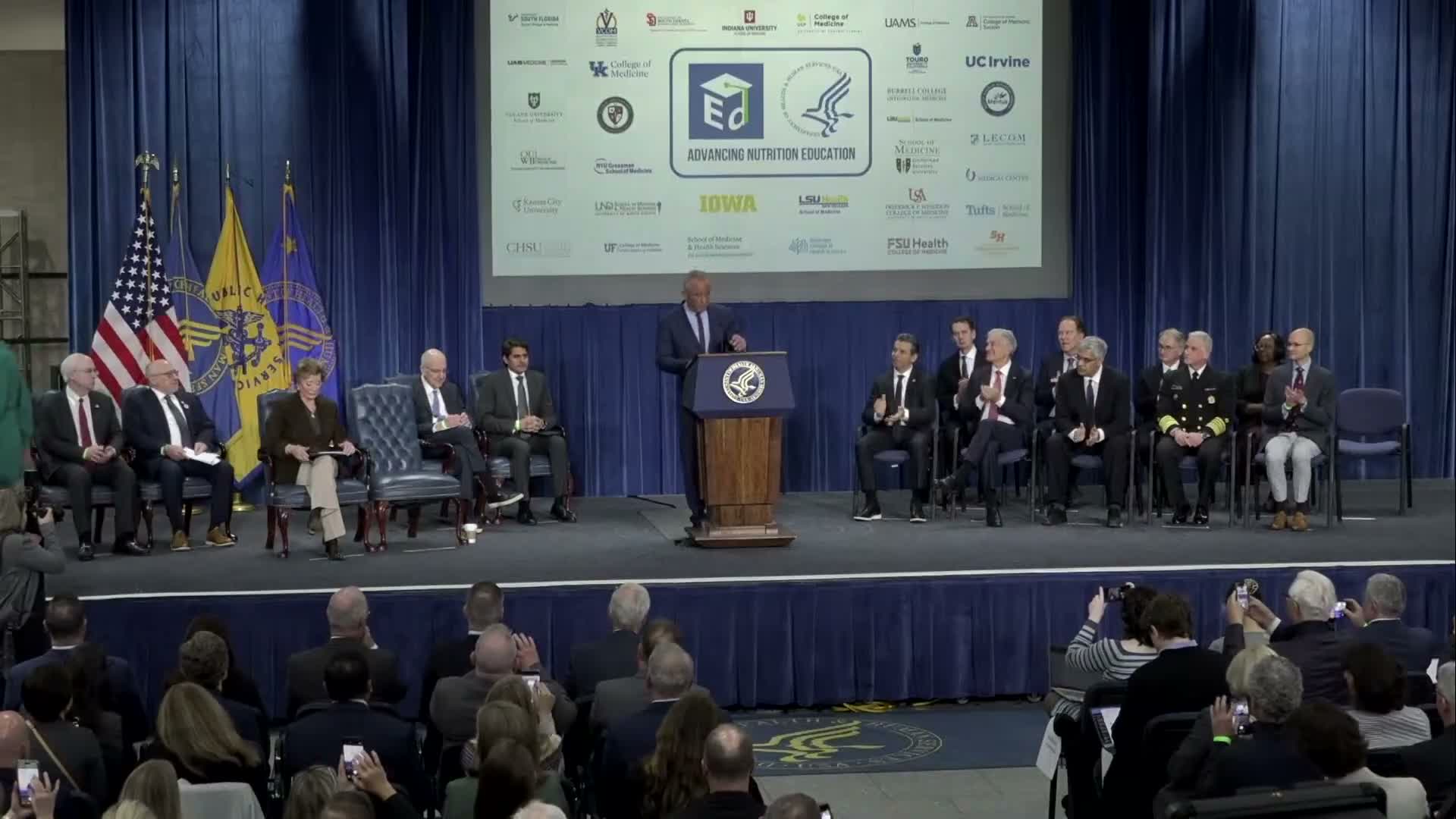
Secretary Robert F. Kennedy Jr., secretary of Health and Human Services, announced a coordinated effort on medical nutrition education, saying 53 medical schools in 31 states have pledged to require 40 hours — or an equivalent competency — of nutrition education for medical students beginning this fall. “Beginning this fall, these schools will require every medical student to complete 40 hours of comprehensive nutrition education or competency equivalent before graduating,” Kennedy said.
Kennedy framed the initiative as a response to the rise in diet‑related chronic disease, citing that “6 in 10 American adults live with at least one chronic disease” and that the average medical student receives “less than 2 hours of nutrition education” today. To support curriculum development and clinical training, Kennedy said HHS will invest $5,000,000 through a multi‑phase NIH nutrition‑education challenge and unveiled a public website, hhs.gov/nutrition-education, listing participating schools and their plans.
Linda McMahon, secretary of Education, said the Department of Education will spotlight promising, school‑driven examples but “will never mandate curriculum.” McMahon emphasized respect for institutional independence and accrediting bodies while supporting evidence‑based models and celebrations of institutional leadership. The AMA president at the briefing welcomed the change, saying it will help physicians have productive conversations with patients about nutrition without turning doctors into dietitians.
Speakers from the Association of American Medical Colleges and the American Association of Colleges of Osteopathic Medicine described the initiative as the result of collaboration between academic medicine and government, and urged careful integration, measurement and the involvement of accrediting organizations so competencies can be assessed and scaled. Jeff Gold, introduced as a university president and former accreditor, stressed that competency‑based education requires measurement of individual and institutional outcomes.
Reporters asked whether the change would be mandatory or tied to funding. Kennedy and McMahon said the announcement is voluntary and designed to amplify schools that have chosen to adapt curricula; they said it is not an HHS‑mandated curriculum. When asked whether NIH funding supporting the effort comes from taxpayer dollars, an HHS official confirmed the NIH commitment involves taxpayer‑appropriated funds and described the investment as aimed at spurring research and implementation of curriculum and training.
The event also included commitments to extend nutrition training beyond undergraduate medical education to residency programs, nursing and dietetics, and a plan to require continuing nutrition education for the more than 5,000 officers in the U.S. Public Health Service Commissioned Corps. Kennedy said the initiative will be public and accountable through the HHS website so students and the public can see school commitments and plans. The briefing concluded with a question‑and‑answer session and a group photo.
Kennedy framed the initiative as a response to the rise in diet‑related chronic disease, citing that “6 in 10 American adults live with at least one chronic disease” and that the average medical student receives “less than 2 hours of nutrition education” today. To support curriculum development and clinical training, Kennedy said HHS will invest $5,000,000 through a multi‑phase NIH nutrition‑education challenge and unveiled a public website, hhs.gov/nutrition-education, listing participating schools and their plans.
Linda McMahon, secretary of Education, said the Department of Education will spotlight promising, school‑driven examples but “will never mandate curriculum.” McMahon emphasized respect for institutional independence and accrediting bodies while supporting evidence‑based models and celebrations of institutional leadership. The AMA president at the briefing welcomed the change, saying it will help physicians have productive conversations with patients about nutrition without turning doctors into dietitians.
Speakers from the Association of American Medical Colleges and the American Association of Colleges of Osteopathic Medicine described the initiative as the result of collaboration between academic medicine and government, and urged careful integration, measurement and the involvement of accrediting organizations so competencies can be assessed and scaled. Jeff Gold, introduced as a university president and former accreditor, stressed that competency‑based education requires measurement of individual and institutional outcomes.
Reporters asked whether the change would be mandatory or tied to funding. Kennedy and McMahon said the announcement is voluntary and designed to amplify schools that have chosen to adapt curricula; they said it is not an HHS‑mandated curriculum. When asked whether NIH funding supporting the effort comes from taxpayer dollars, an HHS official confirmed the NIH commitment involves taxpayer‑appropriated funds and described the investment as aimed at spurring research and implementation of curriculum and training.
The event also included commitments to extend nutrition training beyond undergraduate medical education to residency programs, nursing and dietetics, and a plan to require continuing nutrition education for the more than 5,000 officers in the U.S. Public Health Service Commissioned Corps. Kennedy said the initiative will be public and accountable through the HHS website so students and the public can see school commitments and plans. The briefing concluded with a question‑and‑answer session and a group photo.
View the Full Meeting & All Its Details
This article offers just a summary. Unlock complete video, transcripts, and insights as a Founder Member.
✓
Watch full, unedited meeting videos
✓
Search every word spoken in unlimited transcripts
✓
AI summaries & real-time alerts (all government levels)
✓
Permanent access to expanding government content
30-day money-back guarantee
