HHS announces national push for nutrition education; 53 medical schools pledge 40 hours
March 06, 2026 | Department of Health and Human Services (HHS), Executive, Federal
This article was created by AI summarizing key points discussed. AI makes mistakes, so for full details and context, please refer to the video of the full meeting. Please report any errors so we can fix them. Report an error »
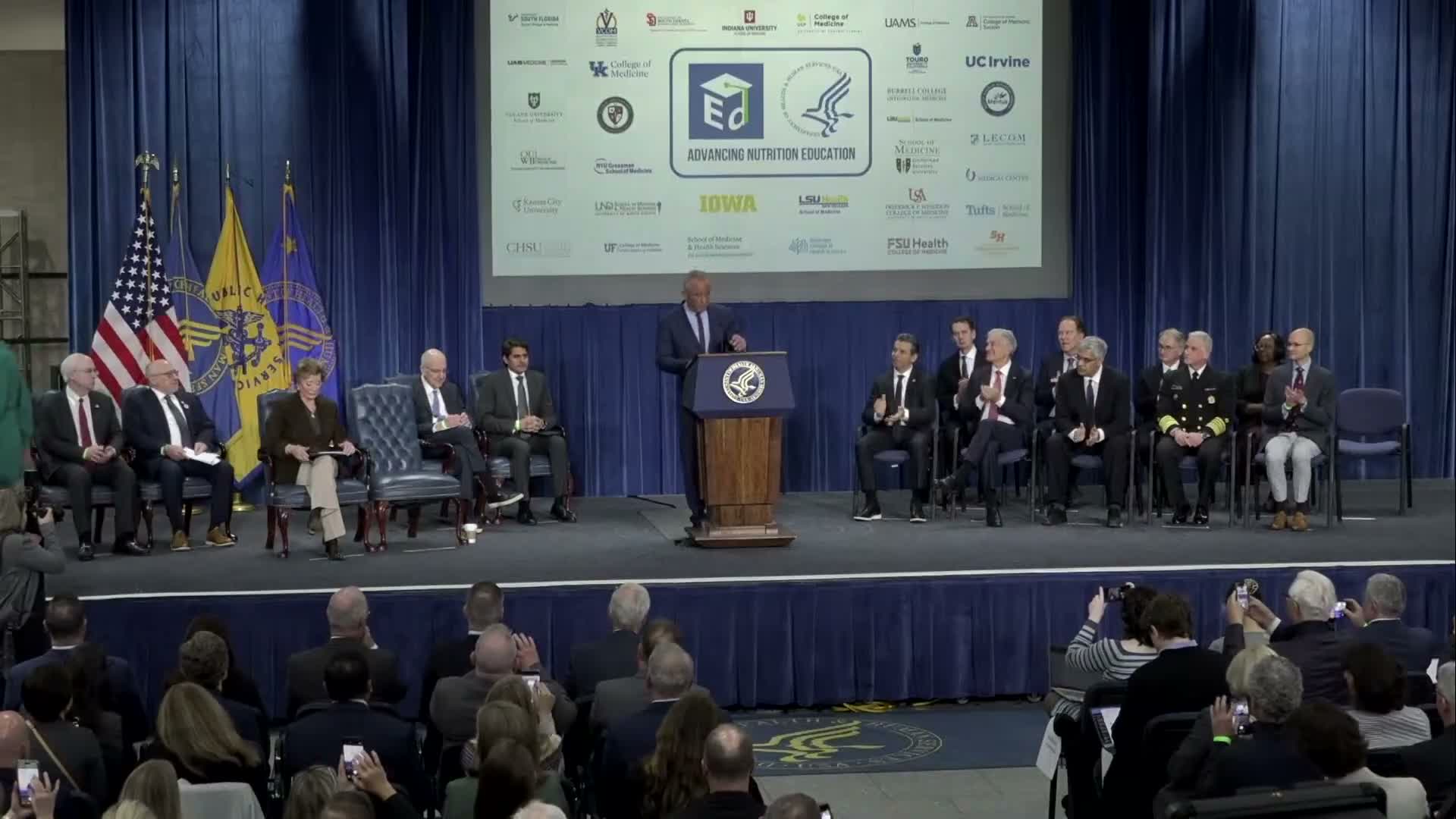
Secretary Robert F. Kennedy Jr. announced at a Department of Health and Human Services event that 53 medical schools in 31 states have pledged to require 40 hours of nutrition education — or demonstrate equivalent competency — for medical students beginning this fall, and that HHS will back the effort with a multi‑phase NIH nutrition education challenge.
“This is how we implement the Maha agenda. This is how we make America healthy again,” Kennedy said, framing the initiative as part of a broader effort to prevent and reverse chronic disease through stronger training for physicians.
Kennedy and other speakers described the announcement as a partnership among HHS, medical schools and national medical organizations. The administration said the initiative includes a public website, hhs.gov/nutrition-education, listing participating schools and their plans, and that the NIH‑backed challenge will support curriculum development, clinical training and research. The transcript records the NIH commitment as “5,000,000.”
The secretary emphasized that the 40‑hour figure is a minimum standard or that schools may use competency‑based alternatives. “A minimum of 40 hours [of nutrition education] across all four years of undergraduate medical education,” he said, adding that the initiative includes 71 evidence‑based competencies across 10 domains described as a resource, not a mandate.
Department of Education Secretary Linda McMahon, introduced at the event, echoed the voluntary framing and said federal education officials would spotlight promising models rather than mandate curricula. “The Department of Education will never mandate curriculum,” she said, while describing plans to convene leaders and highlight institution‑driven reforms.
Representatives of major medical organizations welcomed the commitments. Dr. Bobby Mukamala, identified as president of the American Medical Association, said nutrition should be foundational training and described the moment as a paradigm shift for physician preparation. David Skorton, president and CEO of the Association of American Medical Colleges, and Dr. Robert Kane of the American Association of Colleges of Osteopathic Medicine also praised alignment between HHS and academic medicine.
Reporters asked whether the plan includes physical activity components, whether curriculum changes could be coercive, and how taxpayer dollars would be used. On physical activity, Kennedy said some schools may include activity in curricular approaches and that the administration is also pursuing physical fitness initiatives through a presidential council. On coercion, an agency spokesperson characterized the announcement as celebratory and voluntary: “There’s no coercion coming from here,” the official said.
On funding, the event referenced NIH funding for the education challenge; organizers described NIH commitments as taxpayer‑appropriated dollars directed to prevention and curriculum support. The transcript records the NIH commitment language and attributes oversight to NIH leadership present at the event.
The event concluded with a short question‑and‑answer session and a group photograph. Organizers did not announce regulatory changes or new statutory mandates during the event; speakers described the initiative as partnership‑driven and institution‑led, with public reporting via the HHS website.
“This is how we implement the Maha agenda. This is how we make America healthy again,” Kennedy said, framing the initiative as part of a broader effort to prevent and reverse chronic disease through stronger training for physicians.
Kennedy and other speakers described the announcement as a partnership among HHS, medical schools and national medical organizations. The administration said the initiative includes a public website, hhs.gov/nutrition-education, listing participating schools and their plans, and that the NIH‑backed challenge will support curriculum development, clinical training and research. The transcript records the NIH commitment as “5,000,000.”
The secretary emphasized that the 40‑hour figure is a minimum standard or that schools may use competency‑based alternatives. “A minimum of 40 hours [of nutrition education] across all four years of undergraduate medical education,” he said, adding that the initiative includes 71 evidence‑based competencies across 10 domains described as a resource, not a mandate.
Department of Education Secretary Linda McMahon, introduced at the event, echoed the voluntary framing and said federal education officials would spotlight promising models rather than mandate curricula. “The Department of Education will never mandate curriculum,” she said, while describing plans to convene leaders and highlight institution‑driven reforms.
Representatives of major medical organizations welcomed the commitments. Dr. Bobby Mukamala, identified as president of the American Medical Association, said nutrition should be foundational training and described the moment as a paradigm shift for physician preparation. David Skorton, president and CEO of the Association of American Medical Colleges, and Dr. Robert Kane of the American Association of Colleges of Osteopathic Medicine also praised alignment between HHS and academic medicine.
Reporters asked whether the plan includes physical activity components, whether curriculum changes could be coercive, and how taxpayer dollars would be used. On physical activity, Kennedy said some schools may include activity in curricular approaches and that the administration is also pursuing physical fitness initiatives through a presidential council. On coercion, an agency spokesperson characterized the announcement as celebratory and voluntary: “There’s no coercion coming from here,” the official said.
On funding, the event referenced NIH funding for the education challenge; organizers described NIH commitments as taxpayer‑appropriated dollars directed to prevention and curriculum support. The transcript records the NIH commitment language and attributes oversight to NIH leadership present at the event.
The event concluded with a short question‑and‑answer session and a group photograph. Organizers did not announce regulatory changes or new statutory mandates during the event; speakers described the initiative as partnership‑driven and institution‑led, with public reporting via the HHS website.
View the Full Meeting & All Its Details
This article offers just a summary. Unlock complete video, transcripts, and insights as a Founder Member.
✓
Watch full, unedited meeting videos
✓
Search every word spoken in unlimited transcripts
✓
AI summaries & real-time alerts (all government levels)
✓
Permanent access to expanding government content
30-day money-back guarantee
