Lawmakers hear push for veterans dental-access program as agency flags funding concerns
March 04, 2026 | Veterans' Affairs, House of Representatives, Committees, Legislative, Connecticut
This article was created by AI summarizing key points discussed. AI makes mistakes, so for full details and context, please refer to the video of the full meeting. Please report any errors so we can fix them. Report an error »
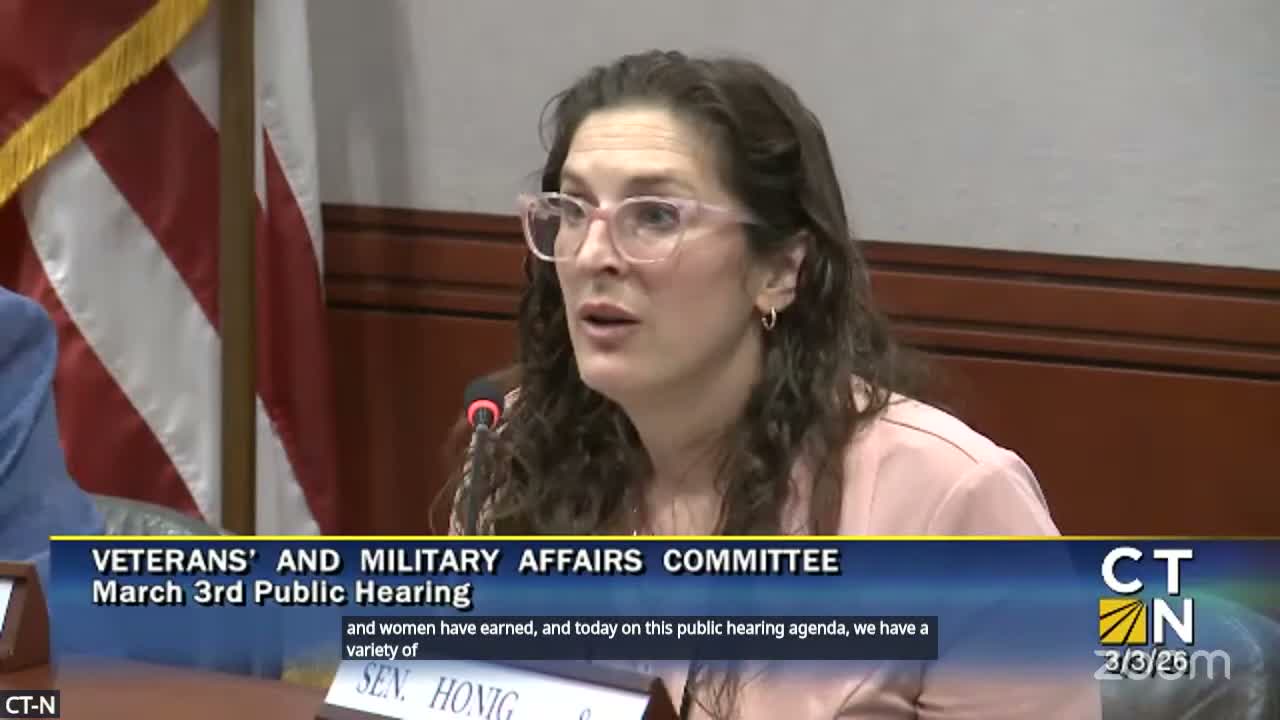
Supporters and state officials sparred over how to provide dental care to Connecticut veterans during a Veterans and Military Affairs Committee public hearing.
John Carriger, deputy commissioner of Connecticut Veterans Affairs, told the committee he appreciates the intent of HB 5413 but that the department cannot support the bill as written because it is not in the governor’s budget and the agency lacks clinical staff and technical expertise to operate a dental-access program. "This program is not included in the governor's budget, and Connecticut Veterans Affairs does not have the resources in terms of both personnel and expertise to operate this program," Carriger said, adding that the department would execute any mission that is appropriately funded.
The hearing featured repeated, detailed testimony from veterans, advocates and dentists who said gaps in dental coverage leave thousands of veterans without routine or medically necessary care. "I'm speaking to you today not to ask you for charity, but to ask you to compensate Connecticut veterans for their honorable service," Chris Poole Sr., a retired Army veteran and member of the Southington veterans committee, told lawmakers in supporting HB 5413.
Advocates described a patchwork of limited programs today: the Connecticut Oral Health Initiative received a $25,000 Delta Dental Foundation grant to pilot services and has so far helped a few dozen veterans, but the work is temporary and geographically constrained. "That $25,000 pilot expanded availability but is not a systemic solution," Sandra Ferreira Molina, COHAI's policy and advocacy director, said, noting the grant had served 28 veterans to date. COHAI urged the committee to pair policy with sustained funding.
The Connecticut State Dental Association backed HB 5413's design as a public-private approach that leverages licensed dentists rather than creating a wholly new state clinical system. Kathleen Garrity, the association's executive director, said a model with a defined annual cap (the draft contemplates a $3,500 annual cap per enrollee) and clinical decisions staying with providers could preserve clinical standards while using DVA to vet eligibility and coordinate benefits.
Witnesses and lawmakers also questioned whether existing resources could be stretched to cover uncovered veterans: Carriger and others cited a national study used for the bill suggesting roughly 3 percent of Connecticut's veteran population — an estimated 4,600 people — lack adequate dental coverage. Committee members asked about using the Soldier, Sailor and Marine Relief Fund or partnerships with the Connecticut Dental Association to provide clinical capacity.
The hearing produced no vote. Committee members signaled they will continue to weigh the bill's intent against practical implementation questions, including staffing, clinical review capacity, eligibility criteria and where state funding would come from. Several witnesses urged the Appropriations Committee to identify dedicated funding if lawmakers want a durable program rather than time-limited pilot grants.
The committee is expected to continue reviewing the proposal and possible amendments to address agency capacity and funding concerns.
John Carriger, deputy commissioner of Connecticut Veterans Affairs, told the committee he appreciates the intent of HB 5413 but that the department cannot support the bill as written because it is not in the governor’s budget and the agency lacks clinical staff and technical expertise to operate a dental-access program. "This program is not included in the governor's budget, and Connecticut Veterans Affairs does not have the resources in terms of both personnel and expertise to operate this program," Carriger said, adding that the department would execute any mission that is appropriately funded.
The hearing featured repeated, detailed testimony from veterans, advocates and dentists who said gaps in dental coverage leave thousands of veterans without routine or medically necessary care. "I'm speaking to you today not to ask you for charity, but to ask you to compensate Connecticut veterans for their honorable service," Chris Poole Sr., a retired Army veteran and member of the Southington veterans committee, told lawmakers in supporting HB 5413.
Advocates described a patchwork of limited programs today: the Connecticut Oral Health Initiative received a $25,000 Delta Dental Foundation grant to pilot services and has so far helped a few dozen veterans, but the work is temporary and geographically constrained. "That $25,000 pilot expanded availability but is not a systemic solution," Sandra Ferreira Molina, COHAI's policy and advocacy director, said, noting the grant had served 28 veterans to date. COHAI urged the committee to pair policy with sustained funding.
The Connecticut State Dental Association backed HB 5413's design as a public-private approach that leverages licensed dentists rather than creating a wholly new state clinical system. Kathleen Garrity, the association's executive director, said a model with a defined annual cap (the draft contemplates a $3,500 annual cap per enrollee) and clinical decisions staying with providers could preserve clinical standards while using DVA to vet eligibility and coordinate benefits.
Witnesses and lawmakers also questioned whether existing resources could be stretched to cover uncovered veterans: Carriger and others cited a national study used for the bill suggesting roughly 3 percent of Connecticut's veteran population — an estimated 4,600 people — lack adequate dental coverage. Committee members asked about using the Soldier, Sailor and Marine Relief Fund or partnerships with the Connecticut Dental Association to provide clinical capacity.
The hearing produced no vote. Committee members signaled they will continue to weigh the bill's intent against practical implementation questions, including staffing, clinical review capacity, eligibility criteria and where state funding would come from. Several witnesses urged the Appropriations Committee to identify dedicated funding if lawmakers want a durable program rather than time-limited pilot grants.
The committee is expected to continue reviewing the proposal and possible amendments to address agency capacity and funding concerns.
View the Full Meeting & All Its Details
This article offers just a summary. Unlock complete video, transcripts, and insights as a Founder Member.
✓
Watch full, unedited meeting videos
✓
Search every word spoken in unlimited transcripts
✓
AI summaries & real-time alerts (all government levels)
✓
Permanent access to expanding government content
30-day money-back guarantee
