Partnership staff outline budget tradeoffs, CCA swaps and priority bills as session nears finish
March 05, 2026 | Board Council Commission Agencies , Executive, Washington
This article was created by AI summarizing key points discussed. AI makes mistakes, so for full details and context, please refer to the video of the full meeting. Please report any errors so we can fix them. Report an error »
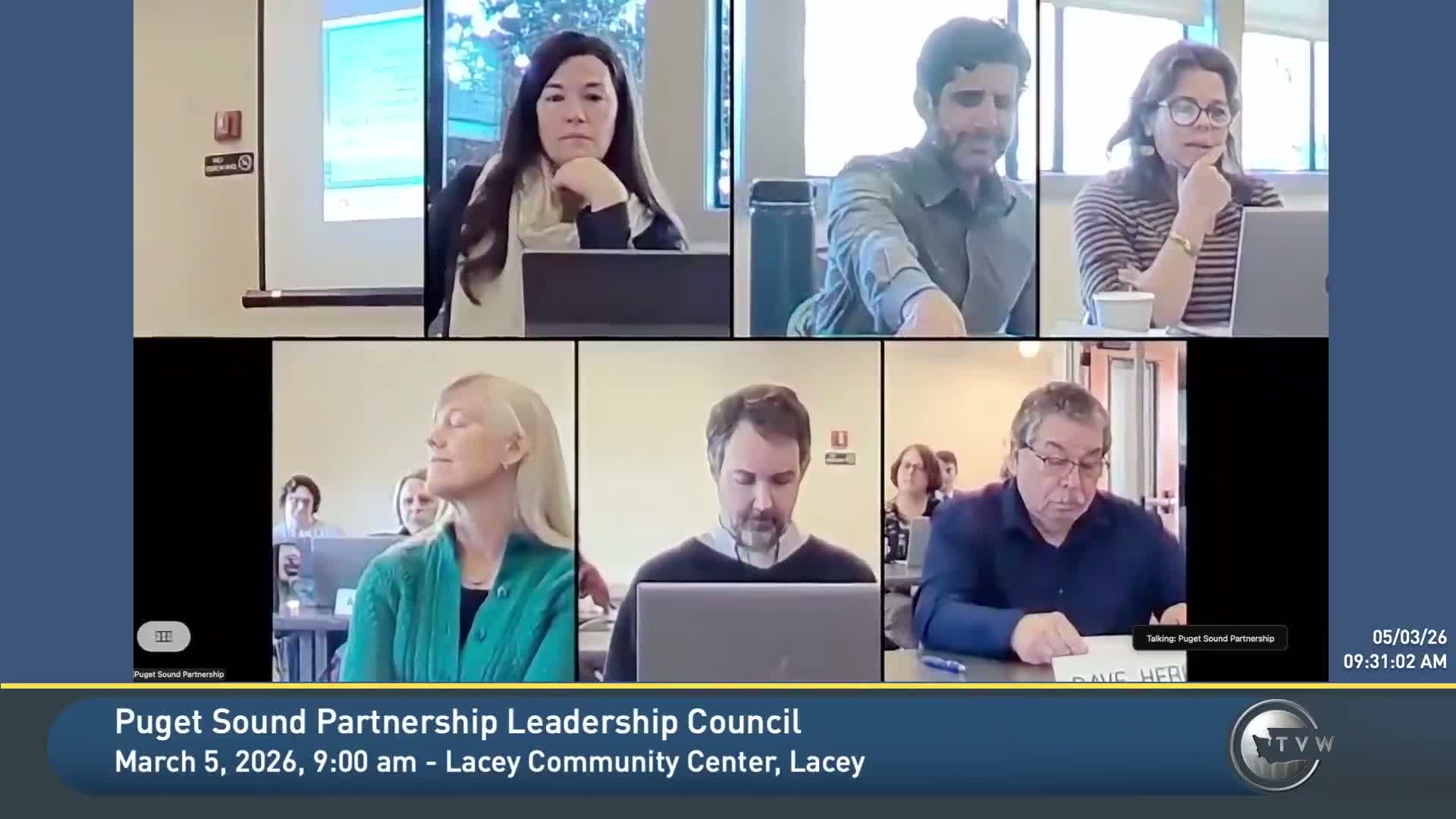
Partnership policy staff briefed the Leadership Council on March 5 about the 2026 short legislative session and where Puget Sound recovery priorities stand as lawmakers approach final negotiations.
Staff framed the session as a revenue‑constrained, short session driven largely by the need to close a budget deficit. They emphasized that both chambers propose shifting several natural‑resource capital programs’ funding sources — notably increased use of Climate Commitment Act (CCA) revenue — and that this change creates tradeoffs and procedural constraints for some programs.
"The total amount of CCA revenue that's available that wasn't anticipated in the 25–27 budget is, over $700,000,000," a staff presenter said, underscoring why CCA money is central to negotiations and why legislative choices about how to spend it matter for Puget Sound projects. Staff warned that employing CCA in place of bonds or other capital funding can make near‑term investments feasible but leaves long‑term funding challenges because CCA revenue is diminishing over time.
On the capital side, staff highlighted proposals such as a House increase of $37 million for floodplains by design projects and Senate proposals that direct funds through different buckets — including a $13 million Nooksack integrated floodplain project in Whatcom County. The Salmon Recovery Funding Board request of $20 million was noted as partially funded in some proposals: "The governor provided $11,000,000; the House also provided $11,000,000; the Senate did not include it," staff said.
Staff also enumerated operating reductions in the House proposal that would affect implementation capacity for DNR, Department of Ecology and other agencies: potential elimination of certain operating funds and removal of positions that would affect kelp and eelgrass work, riparian coordinators, and local government assistance for integrating salmon recovery into land‑use planning.
On bills, staff pointed to several priorities still alive or notable in the tracker: House Bill 1923 (Mosquito Fleet Act) addressing passenger ferry expansion linked to Southern Resident orca protections; House Bill 2199 (derelict vessels), reported as having passed both chambers; House Bill 2554 (repeal of an outdated voter‑passed statute to better respect tribal co‑management); and Senate Bill 6097 (allowing federally recognized tribes to participate in Conservation Futures levies in some counties).
Council members asked how the Partnership should engage during the last week of session and whether the board should try to provide additional legislative guidance. Staff advised close coordination with the governor’s office and partner groups, and said an updated legislative recap would follow after the session ends.
The briefing underscored two themes: near‑term tradeoffs driven by short session timing and mid‑term concerns about dependability of funding when one‑time sources such as CCA are used to replace bond or other capital authority. Staff recommended continued advocacy for nimble funding to get projects into construction and for protecting long‑term grant programs that support Puget Sound recovery.
Staff framed the session as a revenue‑constrained, short session driven largely by the need to close a budget deficit. They emphasized that both chambers propose shifting several natural‑resource capital programs’ funding sources — notably increased use of Climate Commitment Act (CCA) revenue — and that this change creates tradeoffs and procedural constraints for some programs.
"The total amount of CCA revenue that's available that wasn't anticipated in the 25–27 budget is, over $700,000,000," a staff presenter said, underscoring why CCA money is central to negotiations and why legislative choices about how to spend it matter for Puget Sound projects. Staff warned that employing CCA in place of bonds or other capital funding can make near‑term investments feasible but leaves long‑term funding challenges because CCA revenue is diminishing over time.
On the capital side, staff highlighted proposals such as a House increase of $37 million for floodplains by design projects and Senate proposals that direct funds through different buckets — including a $13 million Nooksack integrated floodplain project in Whatcom County. The Salmon Recovery Funding Board request of $20 million was noted as partially funded in some proposals: "The governor provided $11,000,000; the House also provided $11,000,000; the Senate did not include it," staff said.
Staff also enumerated operating reductions in the House proposal that would affect implementation capacity for DNR, Department of Ecology and other agencies: potential elimination of certain operating funds and removal of positions that would affect kelp and eelgrass work, riparian coordinators, and local government assistance for integrating salmon recovery into land‑use planning.
On bills, staff pointed to several priorities still alive or notable in the tracker: House Bill 1923 (Mosquito Fleet Act) addressing passenger ferry expansion linked to Southern Resident orca protections; House Bill 2199 (derelict vessels), reported as having passed both chambers; House Bill 2554 (repeal of an outdated voter‑passed statute to better respect tribal co‑management); and Senate Bill 6097 (allowing federally recognized tribes to participate in Conservation Futures levies in some counties).
Council members asked how the Partnership should engage during the last week of session and whether the board should try to provide additional legislative guidance. Staff advised close coordination with the governor’s office and partner groups, and said an updated legislative recap would follow after the session ends.
The briefing underscored two themes: near‑term tradeoffs driven by short session timing and mid‑term concerns about dependability of funding when one‑time sources such as CCA are used to replace bond or other capital authority. Staff recommended continued advocacy for nimble funding to get projects into construction and for protecting long‑term grant programs that support Puget Sound recovery.
Don't Miss a Word: See the Full Meeting!
Go beyond summaries. Unlock every video, transcript, and key insight with a Founder Membership.
✓
Get instant access to full meeting videos
✓
Search and clip any phrase from complete transcripts
✓
Receive AI-powered summaries & custom alerts
✓
Enjoy lifetime, unrestricted access to government data
30-day money-back guarantee
