Fairfax County unveils 35% design for Rabbit Branch stream restoration in Hickory Farms
March 04, 2026 | Fairfax County, Virginia
This article was created by AI summarizing key points discussed. AI makes mistakes, so for full details and context, please refer to the video of the full meeting. Please report any errors so we can fix them. Report an error »
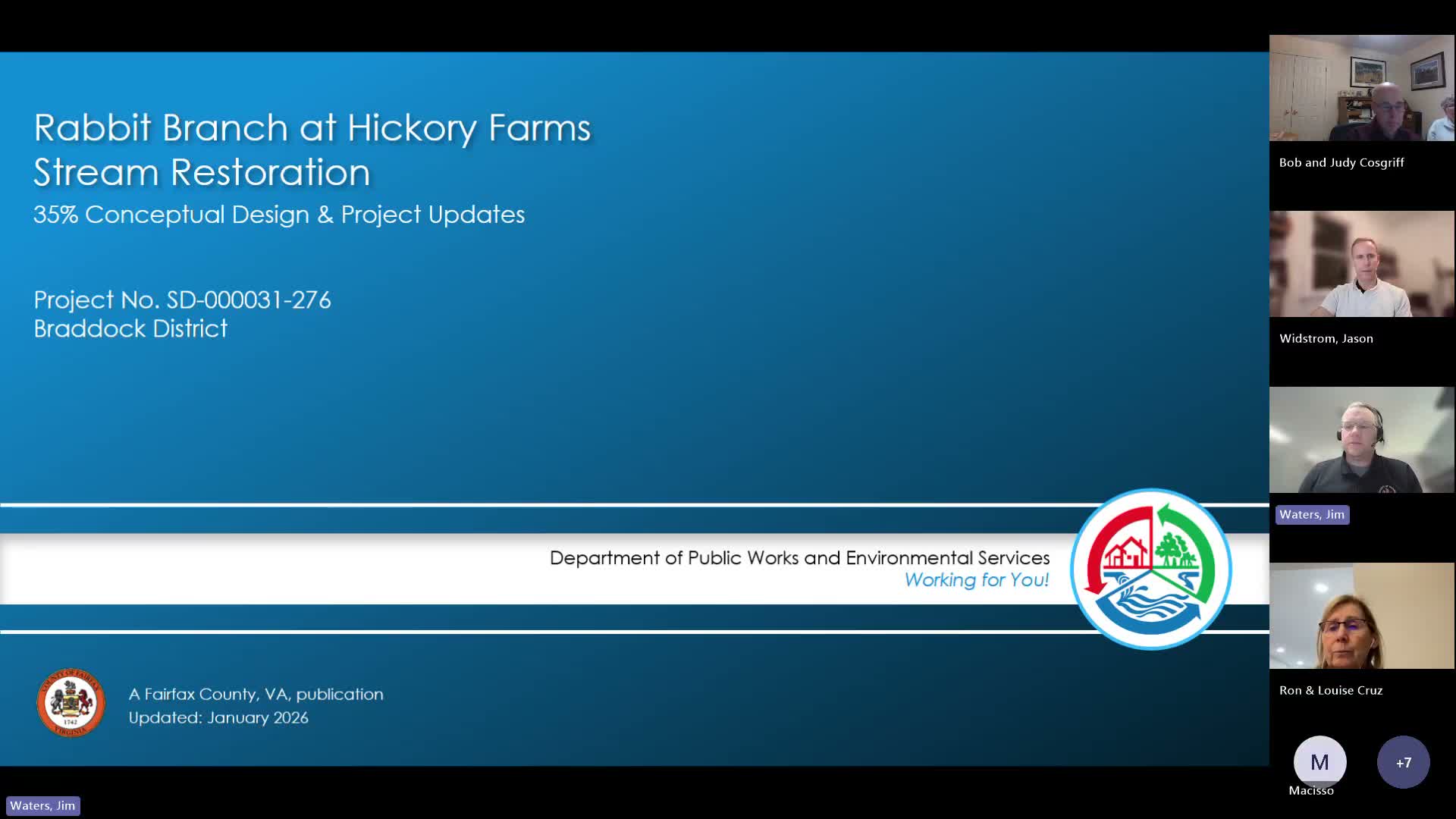
Fairfax County planning staff presented a 35% design for a stream restoration project on the Rabbit Branch Tributary in the Hickory Farms neighborhood, saying the work aims to stabilize eroded, near-vertical banks, protect exposed private sewer connections and re-establish a walking trail closed for safety.
"We're currently at the 35% design phase," Kelly Cervantes, identified in the presentation as Director of Planning, told residents, adding that the presentation was being recorded and would be posted on the project website. Staff emphasized the design remains subject to change as easement negotiations and later design milestones proceed.
The design area runs north from Cotton Farm Road toward the City of Fairfax boundary. County staff said the outfall just downstream of Cotton Farm Road was evaluated and found to be in stable condition; the restoration focuses on upstream and midstream reaches where incision and bank erosion have created near-vertical banks that threaten vegetation, trees and some privately connected sanitary pipes that the presenter said are partially exposed.
County engineers described a riffle–pool pattern in the proposed channel, log-sill grade controls and a planned wetland pocket at the confluence of two tributaries to increase habitat diversity and provide stormwater storage. Staff noted the culvert under Cotton Farm Road is a 72-inch (6-foot) pipe that controls throughflow and constrains the system; county modeling, they said, aims to ensure the design will not expand the 100-year floodplain toward residences.
As part of the 35% evaluation, staff reported surveying 601 trees 12 inches or greater in diameter and proposed the removal of 50 trees. County staff said removed wood and brush would be reused in channel structures where feasible; two large trees were shown on plans as marked for removal and additional understory clearing is expected within the limit of disturbance. Construction access will primarily use the existing walking trail footprint, which will be closed during construction and reopened and replanted afterward.
Staff described temporary stockpile locations and tree-protection pockets to limit impacts to forest canopy and said they would refine stockpile siting in the 65% design with input from the construction division and the Hickory Farms HOA. The presentation also covered typical traffic-control measures (signs, flaggers, one-way traffic controls) for the stabilized construction entrance on Cotton Farm Road and noted that the construction entrance currently crosses a small portion of private property and could require additional homeowner agreements.
County staff said gaps exist in current stormwater easement language and extent; to proceed, the design team has proposed new or expanded easements and will negotiate access and maintenance rights with affected homeowners and the HOA. Staff described easement acquisition as the critical next step before moving the design to 65% and later 95%, and noted that permitting and bidding will determine the eventual construction timeline.
Examples from other Fairfax County restorations, including Difficult Run and Dead Run, were shown to illustrate how riffle–pool channels and native plantings can mature over months and years into stable riparian corridors. Staff closed by giving contact details and the project website where the recording and slides will be posted, and said the county will host additional community meetings at the 65% and 95% milestones.
Next steps: county staff will pursue easement negotiations with homeowners and the HOA, incorporate input into a 65% design, continue permitting, and return to the community with updated plans before construction is scheduled.
"We're currently at the 35% design phase," Kelly Cervantes, identified in the presentation as Director of Planning, told residents, adding that the presentation was being recorded and would be posted on the project website. Staff emphasized the design remains subject to change as easement negotiations and later design milestones proceed.
The design area runs north from Cotton Farm Road toward the City of Fairfax boundary. County staff said the outfall just downstream of Cotton Farm Road was evaluated and found to be in stable condition; the restoration focuses on upstream and midstream reaches where incision and bank erosion have created near-vertical banks that threaten vegetation, trees and some privately connected sanitary pipes that the presenter said are partially exposed.
County engineers described a riffle–pool pattern in the proposed channel, log-sill grade controls and a planned wetland pocket at the confluence of two tributaries to increase habitat diversity and provide stormwater storage. Staff noted the culvert under Cotton Farm Road is a 72-inch (6-foot) pipe that controls throughflow and constrains the system; county modeling, they said, aims to ensure the design will not expand the 100-year floodplain toward residences.
As part of the 35% evaluation, staff reported surveying 601 trees 12 inches or greater in diameter and proposed the removal of 50 trees. County staff said removed wood and brush would be reused in channel structures where feasible; two large trees were shown on plans as marked for removal and additional understory clearing is expected within the limit of disturbance. Construction access will primarily use the existing walking trail footprint, which will be closed during construction and reopened and replanted afterward.
Staff described temporary stockpile locations and tree-protection pockets to limit impacts to forest canopy and said they would refine stockpile siting in the 65% design with input from the construction division and the Hickory Farms HOA. The presentation also covered typical traffic-control measures (signs, flaggers, one-way traffic controls) for the stabilized construction entrance on Cotton Farm Road and noted that the construction entrance currently crosses a small portion of private property and could require additional homeowner agreements.
County staff said gaps exist in current stormwater easement language and extent; to proceed, the design team has proposed new or expanded easements and will negotiate access and maintenance rights with affected homeowners and the HOA. Staff described easement acquisition as the critical next step before moving the design to 65% and later 95%, and noted that permitting and bidding will determine the eventual construction timeline.
Examples from other Fairfax County restorations, including Difficult Run and Dead Run, were shown to illustrate how riffle–pool channels and native plantings can mature over months and years into stable riparian corridors. Staff closed by giving contact details and the project website where the recording and slides will be posted, and said the county will host additional community meetings at the 65% and 95% milestones.
Next steps: county staff will pursue easement negotiations with homeowners and the HOA, incorporate input into a 65% design, continue permitting, and return to the community with updated plans before construction is scheduled.
View the Full Meeting & All Its Details
This article offers just a summary. Unlock complete video, transcripts, and insights as a Founder Member.
✓
Watch full, unedited meeting videos
✓
Search every word spoken in unlimited transcripts
✓
AI summaries & real-time alerts (all government levels)
✓
Permanent access to expanding government content
30-day money-back guarantee
