Committee advances broad campaign-data privacy package after adopting amendments
March 04, 2026 | 2026 Legislature MN, Minnesota
This article was created by AI summarizing key points discussed. AI makes mistakes, so for full details and context, please refer to the video of the full meeting. Please report any errors so we can fix them. Report an error »
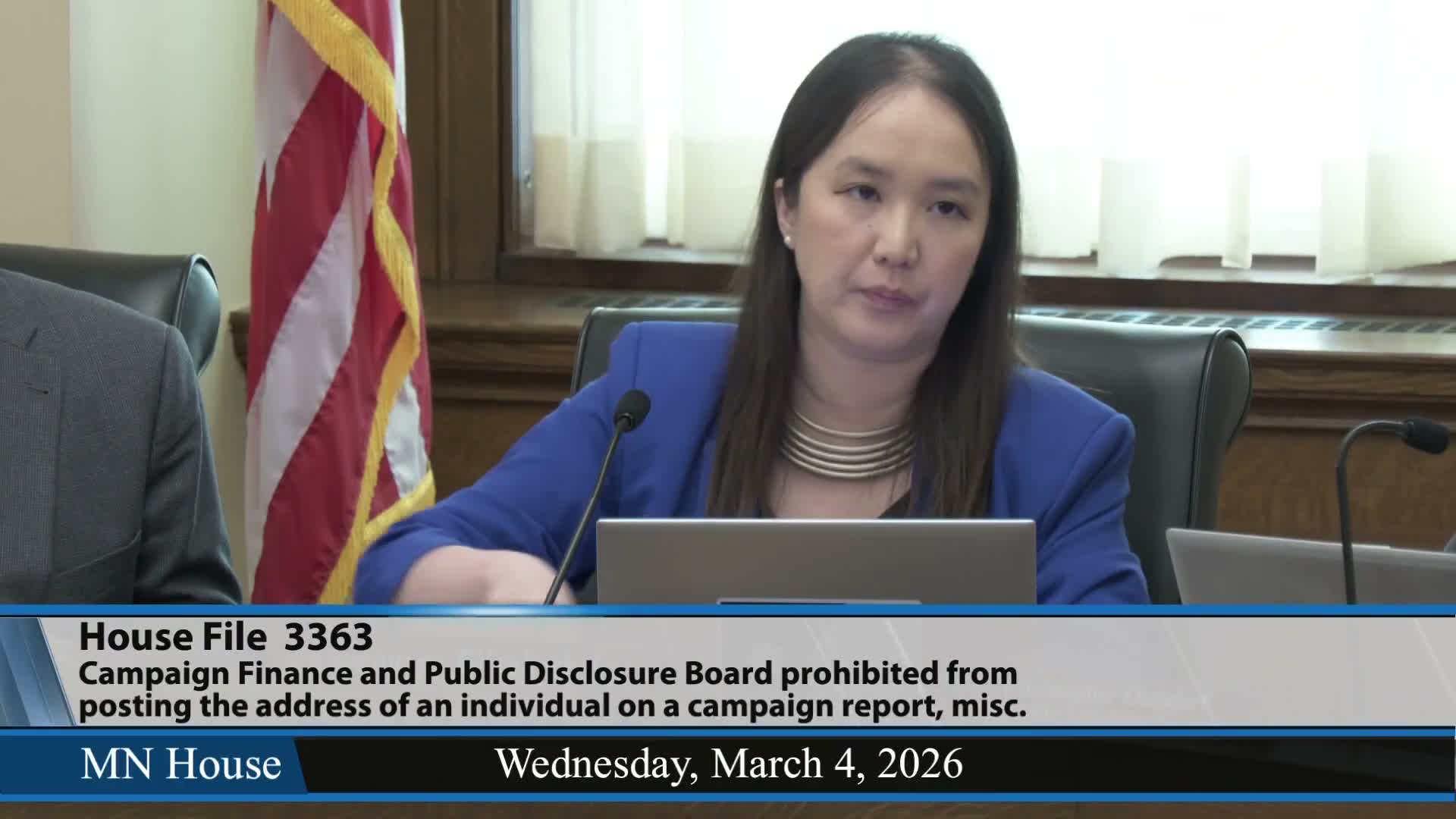
The House Elections, Finance and Government Operations Committee voted March 4 to re-refer House File 3363, a campaign-data privacy package, to the Judiciary, Finance and Civil Law Committee after adopting a sequence of amendments that reshape how addresses and certain report data are classified and redacted.
Chair Freiberg, who introduced the bill, framed it as a response to safety concerns after public posting of legislators' home addresses last summer: "I certainly don't wanna platform a murderer," he said, explaining the bill's narrower focus on the Campaign Finance Board (CFB) data and related reporting. Committee members then considered more than a dozen amendments that the author and staff split into smaller votes so each change could be debated.
Key provisions adopted in committee include: adding security devices and security services as allowable noncampaign disbursements with limits on related family-provider reporting (A1); classifying street addresses filed with the Campaign Finance Board and other local reports to reduce public exposure (A2, A7); allowing candidates to request privacy classification for their affidavits of candidacy and nominating petitions (A5, A6); and creating windows for retroactive redaction of existing local and CFB reports (A8, A9). The committee also adopted an amendment (A14) that narrows a proposed caucus-leader access provision so caucus leaders can see addresses for members of their own chamber under defined limits.
Nonpartisan staff counsel described technical differences between the House and Senate versions: Mr. Gehring (nonpartisan staff) explained, for example, that some language was intended to harmonize which reports and statements are covered by data-classification rules and to create practical priorities for the Campaign Finance Board to handle redaction work.
Members debated potential side effects, including whether limiting address visibility would hinder challenges to residency or civic oversight. Representative Davis asked whether the changes would have prevented a 2024 residency investigation; staff replied the bill would not change complaint or court processes about residency, only the availability of certain report data. Representative McDonald raised concerns about family providers being excluded from the noncampaign disbursement classification in some cases. Where disagreement arose, the committee pared back language and left some points for further drafting at later committee stops.
What happens next: With amendments adopted, the committee re-referred HF 3363 as amended to the Judiciary, Finance and Civil Law Committee for additional review and potential further changes.
Chair Freiberg, who introduced the bill, framed it as a response to safety concerns after public posting of legislators' home addresses last summer: "I certainly don't wanna platform a murderer," he said, explaining the bill's narrower focus on the Campaign Finance Board (CFB) data and related reporting. Committee members then considered more than a dozen amendments that the author and staff split into smaller votes so each change could be debated.
Key provisions adopted in committee include: adding security devices and security services as allowable noncampaign disbursements with limits on related family-provider reporting (A1); classifying street addresses filed with the Campaign Finance Board and other local reports to reduce public exposure (A2, A7); allowing candidates to request privacy classification for their affidavits of candidacy and nominating petitions (A5, A6); and creating windows for retroactive redaction of existing local and CFB reports (A8, A9). The committee also adopted an amendment (A14) that narrows a proposed caucus-leader access provision so caucus leaders can see addresses for members of their own chamber under defined limits.
Nonpartisan staff counsel described technical differences between the House and Senate versions: Mr. Gehring (nonpartisan staff) explained, for example, that some language was intended to harmonize which reports and statements are covered by data-classification rules and to create practical priorities for the Campaign Finance Board to handle redaction work.
Members debated potential side effects, including whether limiting address visibility would hinder challenges to residency or civic oversight. Representative Davis asked whether the changes would have prevented a 2024 residency investigation; staff replied the bill would not change complaint or court processes about residency, only the availability of certain report data. Representative McDonald raised concerns about family providers being excluded from the noncampaign disbursement classification in some cases. Where disagreement arose, the committee pared back language and left some points for further drafting at later committee stops.
What happens next: With amendments adopted, the committee re-referred HF 3363 as amended to the Judiciary, Finance and Civil Law Committee for additional review and potential further changes.
View the Full Meeting & All Its Details
This article offers just a summary. Unlock complete video, transcripts, and insights as a Founder Member.
✓
Watch full, unedited meeting videos
✓
Search every word spoken in unlimited transcripts
✓
AI summaries & real-time alerts (all government levels)
✓
Permanent access to expanding government content
30-day money-back guarantee
