Commission on Higher Education reviews proposed residency, ACT scoring and scholarship eligibility changes
March 04, 2026 | 2026 Legislative Meetings, South Carolina
This article was created by AI summarizing key points discussed. AI makes mistakes, so for full details and context, please refer to the video of the full meeting. Please report any errors so we can fix them. Report an error »
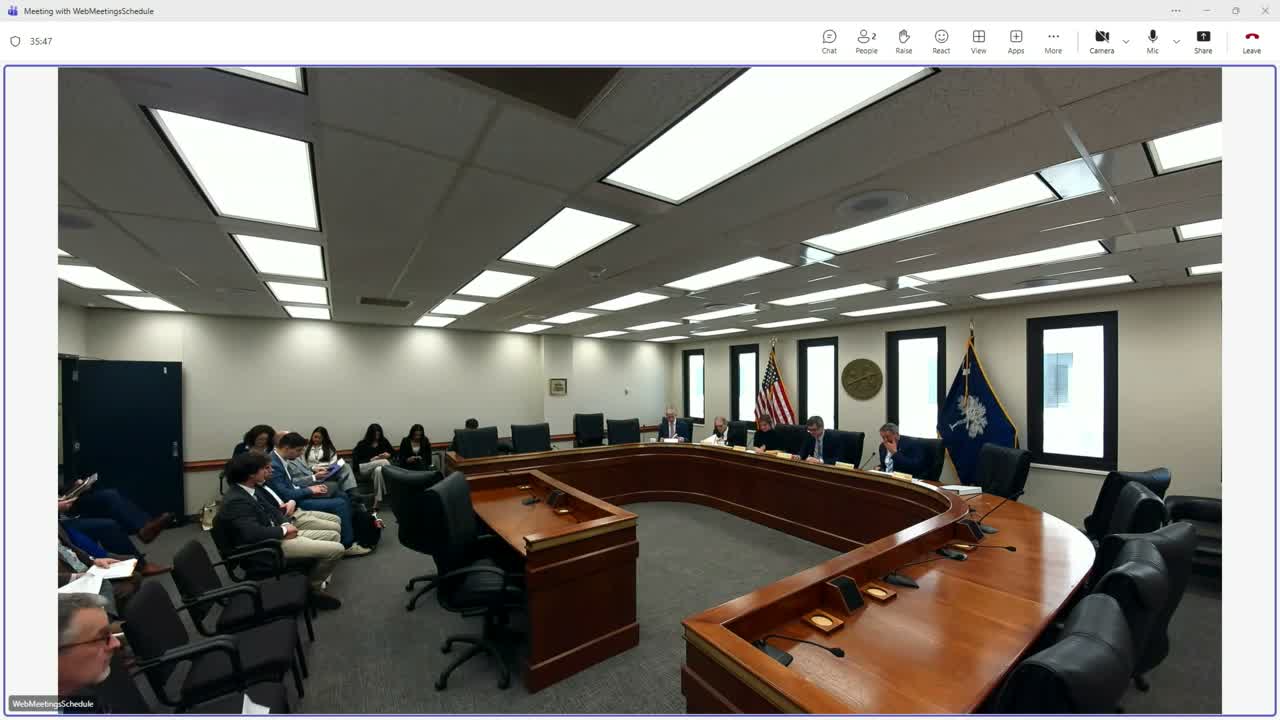
The Commission on Higher Education presented multiple proposed regulatory changes that would affect how in-state residency is determined for tuition and how ACT scores count toward state scholarships.
CHE staff told the committee the package would require four documents for initial residency evaluation — a South Carolina driver’s license, vehicle registration, proof of domicile and state income-tax filings — and would give institutions the authority to request additional documentation and to run a campus-level appeal process. An Agency official said the goal is to make residency rules simpler and more consistent across campuses while preserving rigor.
Members pressed CHE about how the rules would treat students with split-family situations or unusual circumstances. ‘‘If a child lives in a house in South Carolina, graduates from a South Carolina high school, and just so happens to get a car at a random time, that should not disqualify them,’’ a Committee member said, citing a case in which a student temporarily lost in-state treatment over a vehicle registration. The Agency official responded that the regs are intended to address such unique circumstances and that follow-up paperwork could resolve those cases.
The package also would clarify scholarship scoring by allowing students to use their highest ACT sub-scores from different test administrations (for example, best math from one test and best reading from another) and permit an optional science score to improve composite calculations. CHE staff said the sub-score combination practice has been part of the scholarship program since 2001.
Members raised a separate question about teaching-fellow scholarship enhancements and whether students who committed to teaching but were not in a formal education major would be eligible. CHE officials said statute requires enrollment in a teacher-certification program to qualify for the enhancement and agreed to review the issue and report back.
Procedure: The committee agreed to send the proposed CHE regulations to the full committee for further review. The committee asked CHE to provide clarifying examples and to examine edge cases for teaching-fellow eligibility before final action.
CHE staff told the committee the package would require four documents for initial residency evaluation — a South Carolina driver’s license, vehicle registration, proof of domicile and state income-tax filings — and would give institutions the authority to request additional documentation and to run a campus-level appeal process. An Agency official said the goal is to make residency rules simpler and more consistent across campuses while preserving rigor.
Members pressed CHE about how the rules would treat students with split-family situations or unusual circumstances. ‘‘If a child lives in a house in South Carolina, graduates from a South Carolina high school, and just so happens to get a car at a random time, that should not disqualify them,’’ a Committee member said, citing a case in which a student temporarily lost in-state treatment over a vehicle registration. The Agency official responded that the regs are intended to address such unique circumstances and that follow-up paperwork could resolve those cases.
The package also would clarify scholarship scoring by allowing students to use their highest ACT sub-scores from different test administrations (for example, best math from one test and best reading from another) and permit an optional science score to improve composite calculations. CHE staff said the sub-score combination practice has been part of the scholarship program since 2001.
Members raised a separate question about teaching-fellow scholarship enhancements and whether students who committed to teaching but were not in a formal education major would be eligible. CHE officials said statute requires enrollment in a teacher-certification program to qualify for the enhancement and agreed to review the issue and report back.
Procedure: The committee agreed to send the proposed CHE regulations to the full committee for further review. The committee asked CHE to provide clarifying examples and to examine edge cases for teaching-fellow eligibility before final action.
Don't Miss a Word: See the Full Meeting!
Go beyond summaries. Unlock every video, transcript, and key insight with a Founder Membership.
✓
Get instant access to full meeting videos
✓
Search and clip any phrase from complete transcripts
✓
Receive AI-powered summaries & custom alerts
✓
Enjoy lifetime, unrestricted access to government data
30-day money-back guarantee
