House passes revised bill giving commission power to decertify sheriffs after appeal process
March 05, 2026 | Legislative Sessions, Washington
This article was created by AI summarizing key points discussed. AI makes mistakes, so for full details and context, please refer to the video of the full meeting. Please report any errors so we can fix them. Report an error »
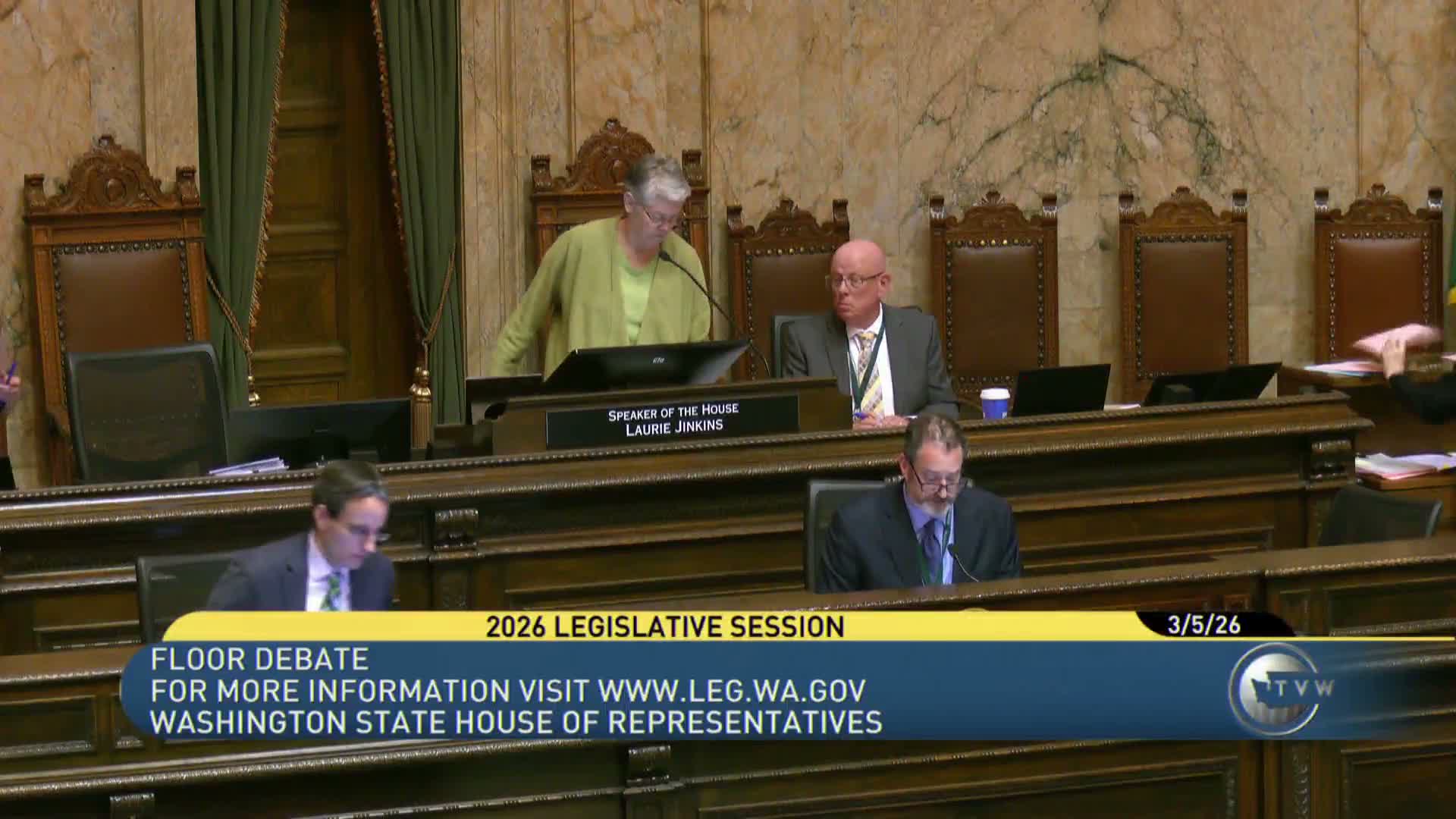
The Washington House late on a floor session approved a revised version of second substitute Senate Bill 5974, a controversial measure that sets new eligibility and certification rules for sheriffs and creates a route for the Criminal Justice Training Commission to decertify law-enforcement executives. The bill passed after sustained debate and a series of amendments, with a final vote of 54 yeas to 42 nays.
Supporters said the package strengthens oversight and clarifies how volunteers, specially commissioned officers and youth cadets can be used by local agencies. "This is a comprehensive bill, and I really do encourage its passage," Representative Goodman said in closing remarks as the House adopted the striking amendment and advanced the bill to final passage.
Opponents warned the bill gives an unelected state commission new power to strip certification from an elected sheriff — a change they said could undercut local accountability. "This bill, which would substantially, foundationally, and devastatingly change the law around how sheriffs are treated," Representative Walsh said during debate, arguing the measure risks replacing voters' judgment with state bureaucracy.
Lawmakers worked through dozens of amendments to narrow the bill's reach. Notable changes adopted on the floor included removing polygraph and psychological-examination elements from candidate eligibility checks for those seeking election as sheriff; clarifying that decertification would not create an immediate vacancy unless and until the decertification decision is final on appeal through the courts; and expanding, in limited ways, the duties volunteers and specially commissioned officers may perform under local supervision.
Several motions to constrain the commission's authority — including proposals to limit decertification to final felony convictions or to require a judicial trial before removal — were debated but not adopted. The legislature also rejected a three-year sunset amendment and multiple proposals to alter the mechanics of vacancy filling and special elections.
Sponsors framed the bill as an effort to create consistent standards across counties and to protect public trust in law enforcement leadership. Opponents countered it creates new, constitutionally dubious pathways to remove elected officials and risks political "lawfare" by better-resourced state actors against smaller counties.
The House adopted technical and policy amendments in late roll-call votes and then approved the second substitute (as amended) on final passage. The clerk recorded 54 yeas, 42 nays, with two members excused. The bill was advanced to third reading and, after the final passage vote, was declared passed by the House.
What happens next: the bill, as amended by the House, will proceed according to legislative procedure (it was advanced to third reading and final passage in the House). Where changes were adopted that substantially alter the original Senate language, supporters and critics said the next steps could include legal review and likely litigation given the constitutional questions raised on the House floor.
Sources: Floor debate and roll-call votes recorded on the House floor; direct quotes and procedural actions are taken from the House transcript.
Supporters said the package strengthens oversight and clarifies how volunteers, specially commissioned officers and youth cadets can be used by local agencies. "This is a comprehensive bill, and I really do encourage its passage," Representative Goodman said in closing remarks as the House adopted the striking amendment and advanced the bill to final passage.
Opponents warned the bill gives an unelected state commission new power to strip certification from an elected sheriff — a change they said could undercut local accountability. "This bill, which would substantially, foundationally, and devastatingly change the law around how sheriffs are treated," Representative Walsh said during debate, arguing the measure risks replacing voters' judgment with state bureaucracy.
Lawmakers worked through dozens of amendments to narrow the bill's reach. Notable changes adopted on the floor included removing polygraph and psychological-examination elements from candidate eligibility checks for those seeking election as sheriff; clarifying that decertification would not create an immediate vacancy unless and until the decertification decision is final on appeal through the courts; and expanding, in limited ways, the duties volunteers and specially commissioned officers may perform under local supervision.
Several motions to constrain the commission's authority — including proposals to limit decertification to final felony convictions or to require a judicial trial before removal — were debated but not adopted. The legislature also rejected a three-year sunset amendment and multiple proposals to alter the mechanics of vacancy filling and special elections.
Sponsors framed the bill as an effort to create consistent standards across counties and to protect public trust in law enforcement leadership. Opponents countered it creates new, constitutionally dubious pathways to remove elected officials and risks political "lawfare" by better-resourced state actors against smaller counties.
The House adopted technical and policy amendments in late roll-call votes and then approved the second substitute (as amended) on final passage. The clerk recorded 54 yeas, 42 nays, with two members excused. The bill was advanced to third reading and, after the final passage vote, was declared passed by the House.
What happens next: the bill, as amended by the House, will proceed according to legislative procedure (it was advanced to third reading and final passage in the House). Where changes were adopted that substantially alter the original Senate language, supporters and critics said the next steps could include legal review and likely litigation given the constitutional questions raised on the House floor.
Sources: Floor debate and roll-call votes recorded on the House floor; direct quotes and procedural actions are taken from the House transcript.
View the Full Meeting & All Its Details
This article offers just a summary. Unlock complete video, transcripts, and insights as a Founder Member.
✓
Watch full, unedited meeting videos
✓
Search every word spoken in unlimited transcripts
✓
AI summaries & real-time alerts (all government levels)
✓
Permanent access to expanding government content
30-day money-back guarantee
