Alaska DPS asks for new funding to sustain body cameras and shore up VPSO program in FY27
March 04, 2026 | 2026 Legislature Alaska, Alaska
This article was created by AI summarizing key points discussed. AI makes mistakes, so for full details and context, please refer to the video of the full meeting. Please report any errors so we can fix them. Report an error »
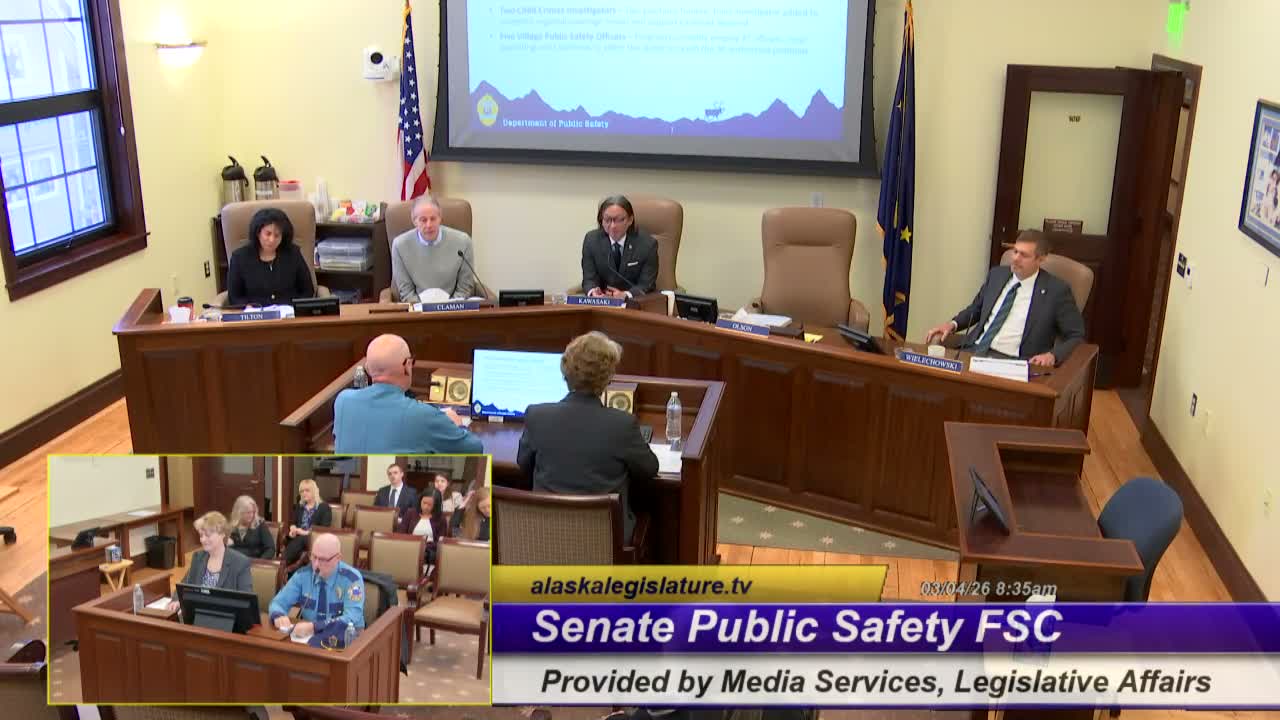
The Department of Public Safety told a Senate subcommittee on Wednesday it needs supplemental and ongoing funding to sustain recent operational changes, including a statewide rollout of body‑worn and in‑car camera systems and higher costs tied to the Village Public Safety Officer (VPSO) program.
Diana Thornton, the department's administrative services director, said the FY26 supplemental request includes $1,250,000 in unrestricted general funds "to address the operating shortfall and maintain current service levels" for village public safety operations. She told the subcommittee the VPSO program's funded positions increased to 90 and that retention has improved from about 50% in 2017 to roughly 80% last year, but that salary, travel and equipment costs have outpaced the program's base funding.
"This request stabilizes the program and maintains the coverage in rural communities," Thornton said, describing internal reallocations the department has made to reduce the funding gap.
Commissioner James Cockrell described the department's FY27 operating proposal as roughly $356.2 million, about 2% above the current year, and emphasized the department's people‑driven cost profile. Thornton told senators the FY27 request includes a $1,300,000 general fund increment "to support our body worn and in car cameras programs," covering license, storage and evidence management costs as the systems move from capital deployment to ongoing operations.
"We have more than 600 body worn cameras and nearly 400 in car camera systems deployed in Alaska," Thornton said, adding that all footage uploads to a single, cloud‑based evidence management system used to store, review and redact material for prosecutors.
Senators pressed the department on budget choices and geographic priorities. Several members asked why the governor's proposed budget does not include additional trooper presence for Anchorage and Fairbanks; Cockrell said the state routinely supports municipal policing with surge operations and specialized units but that sustained local policing requires local resources and long‑term personnel commitments.
Thornton also outlined several fund adjustments included in the department package: a $592,000 reduction in designated funds for the Violent Crimes Compensation Board to align authority with projected restorative justice fund revenue, and a roughly $169,000 reduction in restorative justice funds for the Council on Domestic Violence and Sexual Assault (CDVSA) that is paired with replacement unrestricted general funds to stabilize community grants.
The department said it will provide the committee further breakdowns on trooper and wildlife trooper funding and numbers upon request. Thornton and Cockrell closed by offering written follow‑up on detailed questions such as sexual assault kit processing times and maps of call‑for‑service concentrations.
The subcommittee recessed after the presentation; no votes were taken at the session.
Diana Thornton, the department's administrative services director, said the FY26 supplemental request includes $1,250,000 in unrestricted general funds "to address the operating shortfall and maintain current service levels" for village public safety operations. She told the subcommittee the VPSO program's funded positions increased to 90 and that retention has improved from about 50% in 2017 to roughly 80% last year, but that salary, travel and equipment costs have outpaced the program's base funding.
"This request stabilizes the program and maintains the coverage in rural communities," Thornton said, describing internal reallocations the department has made to reduce the funding gap.
Commissioner James Cockrell described the department's FY27 operating proposal as roughly $356.2 million, about 2% above the current year, and emphasized the department's people‑driven cost profile. Thornton told senators the FY27 request includes a $1,300,000 general fund increment "to support our body worn and in car cameras programs," covering license, storage and evidence management costs as the systems move from capital deployment to ongoing operations.
"We have more than 600 body worn cameras and nearly 400 in car camera systems deployed in Alaska," Thornton said, adding that all footage uploads to a single, cloud‑based evidence management system used to store, review and redact material for prosecutors.
Senators pressed the department on budget choices and geographic priorities. Several members asked why the governor's proposed budget does not include additional trooper presence for Anchorage and Fairbanks; Cockrell said the state routinely supports municipal policing with surge operations and specialized units but that sustained local policing requires local resources and long‑term personnel commitments.
Thornton also outlined several fund adjustments included in the department package: a $592,000 reduction in designated funds for the Violent Crimes Compensation Board to align authority with projected restorative justice fund revenue, and a roughly $169,000 reduction in restorative justice funds for the Council on Domestic Violence and Sexual Assault (CDVSA) that is paired with replacement unrestricted general funds to stabilize community grants.
The department said it will provide the committee further breakdowns on trooper and wildlife trooper funding and numbers upon request. Thornton and Cockrell closed by offering written follow‑up on detailed questions such as sexual assault kit processing times and maps of call‑for‑service concentrations.
The subcommittee recessed after the presentation; no votes were taken at the session.
Don't Miss a Word: See the Full Meeting!
Go beyond summaries. Unlock every video, transcript, and key insight with a Founder Membership.
✓
Get instant access to full meeting videos
✓
Search and clip any phrase from complete transcripts
✓
Receive AI-powered summaries & custom alerts
✓
Enjoy lifetime, unrestricted access to government data
30-day money-back guarantee
