Housing Authority adopts formal bad‑debt write‑off policy, delegates small write‑offs to executive director
March 04, 2026 | Washington County, Oregon
This article was created by AI summarizing key points discussed. AI makes mistakes, so for full details and context, please refer to the video of the full meeting. Please report any errors so we can fix them. Report an error »
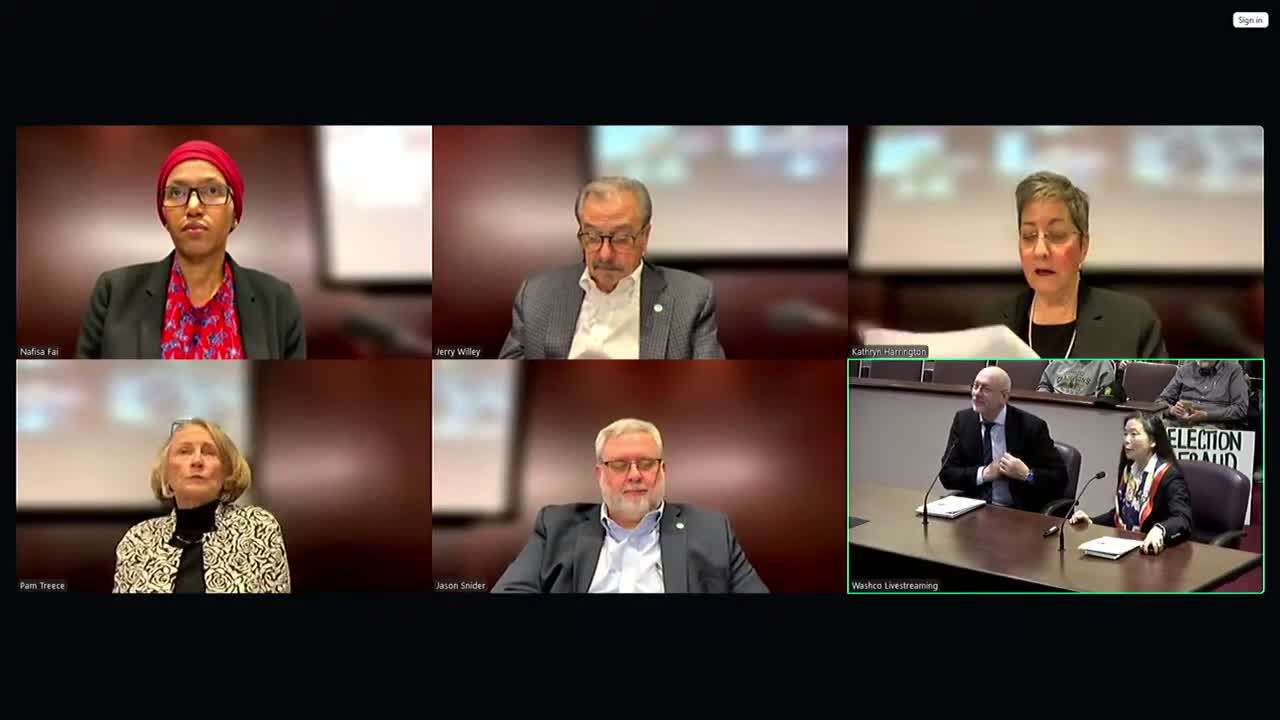
The Housing Authority of Washington County on March 3 adopted a formal bad‑debt expense and write‑off policy for federal programs it administers, including housing choice vouchers, VASH and the public housing portfolio. The policy clarifies approval authority, a semiannual cadence for reporting and an annual report of amounts expensed.
Deputy Director Jill Chen introduced the policy as an effort to strengthen internal controls and financial management. Ryan Bonsbach, deputy chief financial officer, outlined a three-step process: exhaust collection efforts, identify doubtful accounts and follow the approval process, then post accounting entries. Bonsbach told the board staff proposes delegating authority to the executive director to write off amounts below $5,000 per account and to allow up to $25,000 in aggregate on a semiannual basis; amounts above those thresholds would be brought to the board.
Bonsbach said the proposal covers only federal programs administered with funding from the U.S. Department of Housing and Urban Development and aims to improve reporting and audit readiness. On historical levels, Bonsbach said the authority expensed roughly $220,000 in fiscal year 2025 as part of activities that included identifying debts during a Section 18 disposition process.
Board members pressed staff on collection practices and whether collections agencies are used; staff said they typically work directly with participants to arrange payment plans and generally try to avoid sending accounts to outside collections where possible to preserve housing stability. Bonsbach described the operational timeline for collections and write-off consideration as typically 90 to 180 days beyond the missed payment, with early outreach to retain tenants.
Public comment raised concerns about scale and fiscal impacts. Bob Terry, a former county commissioner, said he was troubled to hear a roughly $200,000 figure and asked how a $5,000 per-account threshold and large write-offs fit with fiscal oversight: "When I hear writing off $200,000 I hear of giving somebody the permission to write off $5,000," Terry said. Staff responded that smaller amounts (late fees, surcharges) are generally lower than the threshold and that larger write-offs would return to the board.
After discussion and a motion, the board adopted the write‑off policy unanimously, 5-0. Staff committed to provide follow-up detail requested by commissioners, including historical caseload counts and the formal process for escalation to legal action when collection and retention efforts fail.
Deputy Director Jill Chen introduced the policy as an effort to strengthen internal controls and financial management. Ryan Bonsbach, deputy chief financial officer, outlined a three-step process: exhaust collection efforts, identify doubtful accounts and follow the approval process, then post accounting entries. Bonsbach told the board staff proposes delegating authority to the executive director to write off amounts below $5,000 per account and to allow up to $25,000 in aggregate on a semiannual basis; amounts above those thresholds would be brought to the board.
Bonsbach said the proposal covers only federal programs administered with funding from the U.S. Department of Housing and Urban Development and aims to improve reporting and audit readiness. On historical levels, Bonsbach said the authority expensed roughly $220,000 in fiscal year 2025 as part of activities that included identifying debts during a Section 18 disposition process.
Board members pressed staff on collection practices and whether collections agencies are used; staff said they typically work directly with participants to arrange payment plans and generally try to avoid sending accounts to outside collections where possible to preserve housing stability. Bonsbach described the operational timeline for collections and write-off consideration as typically 90 to 180 days beyond the missed payment, with early outreach to retain tenants.
Public comment raised concerns about scale and fiscal impacts. Bob Terry, a former county commissioner, said he was troubled to hear a roughly $200,000 figure and asked how a $5,000 per-account threshold and large write-offs fit with fiscal oversight: "When I hear writing off $200,000 I hear of giving somebody the permission to write off $5,000," Terry said. Staff responded that smaller amounts (late fees, surcharges) are generally lower than the threshold and that larger write-offs would return to the board.
After discussion and a motion, the board adopted the write‑off policy unanimously, 5-0. Staff committed to provide follow-up detail requested by commissioners, including historical caseload counts and the formal process for escalation to legal action when collection and retention efforts fail.
View the Full Meeting & All Its Details
This article offers just a summary. Unlock complete video, transcripts, and insights as a Founder Member.
✓
Watch full, unedited meeting videos
✓
Search every word spoken in unlimited transcripts
✓
AI summaries & real-time alerts (all government levels)
✓
Permanent access to expanding government content
30-day money-back guarantee
