Residents press Washington County commissioners on rule‑of‑law resolution and transitional housing transparency
March 04, 2026 | Washington County, Oregon
This article was created by AI summarizing key points discussed. AI makes mistakes, so for full details and context, please refer to the video of the full meeting. Please report any errors so we can fix them. Report an error »
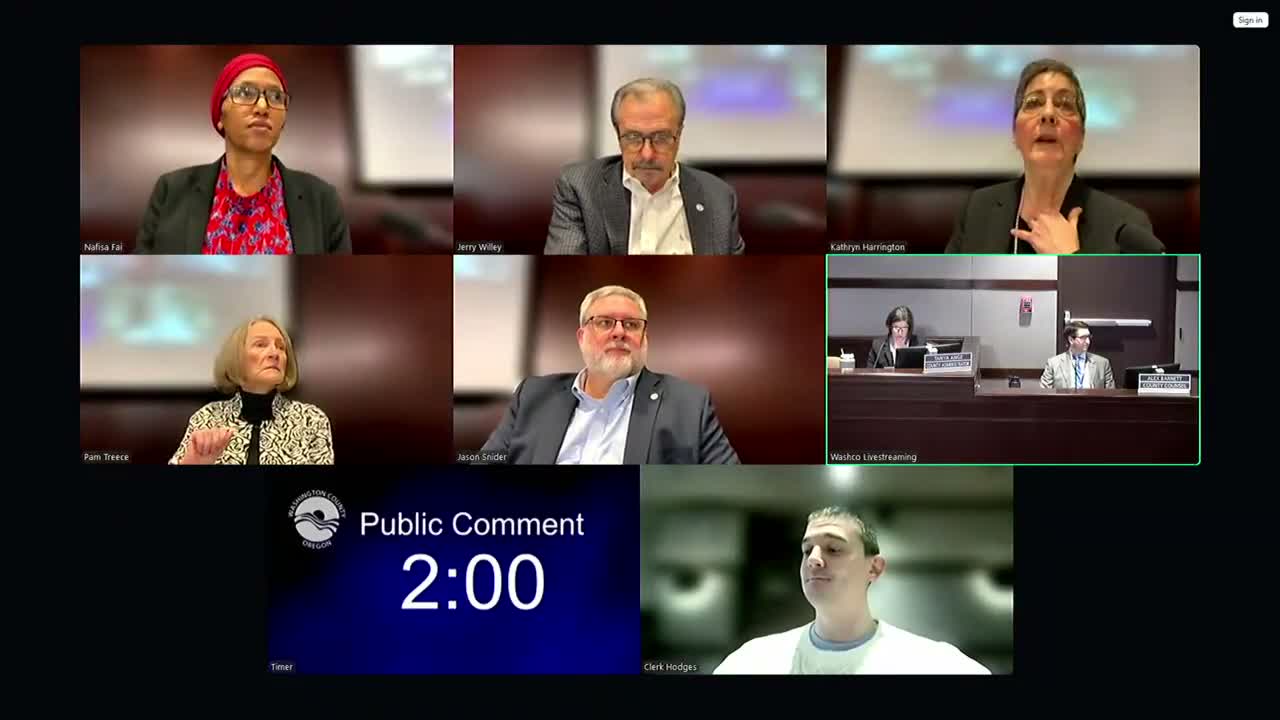
Several residents used the Board of Commissioners’ public‑comment periods on March 3 to press Washington County officials on a range of governance and transparency issues, including a proposed rule‑of‑law resolution and operational policies for transitional housing.
At the first public‑comment block, Mark Becker urged the board to adopt an amendment endorsing the Accountability for Federal Law Enforcement Act (Senate Bill 33470), saying the legislation would create a statutory right of action for civil‑rights violations by federal officers. "The legislation would amend 42 USC 1983 to include federal law enforcement agencies defined as public employers..." Becker said.
Multiple commenters addressed a rule‑of‑law resolution and related county actions. Nellie McAdams of Friends of Smart Growth criticized the county’s prior statements about an urban‑reserve designation and said the Court of Appeals found that designation illegal; she argued county support for a bill that would urbanize reserve land reverses previous commitments and raises fiscal and transparency concerns. "When the county publicly supports a bill that would reverse a designation that the county agreed to and cost the county money, the public has a right to comment to the county," McAdams said.
Separately, neighborhood leaders pressed the county for clearer transitional‑housing policies and direct board engagement. Megan Hill, president of the Oak Hills Homeowners Association, told commissioners she represents residents seeking clarity on background‑review and exclusion criteria, eligibility determinations, and who makes those decisions. "Transparency is not opposition. It builds trust," Hill said, asking the board to schedule a work session on the Cornell Road transitional housing project before continuing good‑neighbor meetings and to identify whether requested public records are already publicly available or to waive fees if they are not.
Jill Latray requested that the board follow its strategic‑plan commitments to best practices and transparency in election administration and urged further engagement with citizen groups on election‑related concerns.
Chair Harrington earlier told the meeting that agenda item g1 (related materials) had been pulled and would be taken up at the evening meeting on March 17, a scheduling decision residents cited when asking for clearer, earlier engagement. The board did not take substantive action on the rule‑of‑law resolution or the Cornell Road project during the daytime session; staff committed to follow up with requested data in at least some cases.
The public comments reflect continuing community debate over land‑use choices, governance of transitional housing projects, and how much oversight and public disclosure the board should require before projects proceed.
At the first public‑comment block, Mark Becker urged the board to adopt an amendment endorsing the Accountability for Federal Law Enforcement Act (Senate Bill 33470), saying the legislation would create a statutory right of action for civil‑rights violations by federal officers. "The legislation would amend 42 USC 1983 to include federal law enforcement agencies defined as public employers..." Becker said.
Multiple commenters addressed a rule‑of‑law resolution and related county actions. Nellie McAdams of Friends of Smart Growth criticized the county’s prior statements about an urban‑reserve designation and said the Court of Appeals found that designation illegal; she argued county support for a bill that would urbanize reserve land reverses previous commitments and raises fiscal and transparency concerns. "When the county publicly supports a bill that would reverse a designation that the county agreed to and cost the county money, the public has a right to comment to the county," McAdams said.
Separately, neighborhood leaders pressed the county for clearer transitional‑housing policies and direct board engagement. Megan Hill, president of the Oak Hills Homeowners Association, told commissioners she represents residents seeking clarity on background‑review and exclusion criteria, eligibility determinations, and who makes those decisions. "Transparency is not opposition. It builds trust," Hill said, asking the board to schedule a work session on the Cornell Road transitional housing project before continuing good‑neighbor meetings and to identify whether requested public records are already publicly available or to waive fees if they are not.
Jill Latray requested that the board follow its strategic‑plan commitments to best practices and transparency in election administration and urged further engagement with citizen groups on election‑related concerns.
Chair Harrington earlier told the meeting that agenda item g1 (related materials) had been pulled and would be taken up at the evening meeting on March 17, a scheduling decision residents cited when asking for clearer, earlier engagement. The board did not take substantive action on the rule‑of‑law resolution or the Cornell Road project during the daytime session; staff committed to follow up with requested data in at least some cases.
The public comments reflect continuing community debate over land‑use choices, governance of transitional housing projects, and how much oversight and public disclosure the board should require before projects proceed.
Don't Miss a Word: See the Full Meeting!
Go beyond summaries. Unlock every video, transcript, and key insight with a Founder Membership.
✓
Get instant access to full meeting videos
✓
Search and clip any phrase from complete transcripts
✓
Receive AI-powered summaries & custom alerts
✓
Enjoy lifetime, unrestricted access to government data
30-day money-back guarantee
