Economic Matters Committee backs higher audit thresholds for charities amid debate over oversight
March 05, 2026 | Economic Matters Committee, HOUSE OF REPRESENTATIVES, Committees, Legislative, Maryland
This article was created by AI summarizing key points discussed. AI makes mistakes, so for full details and context, please refer to the video of the full meeting. Please report any errors so we can fix them. Report an error »
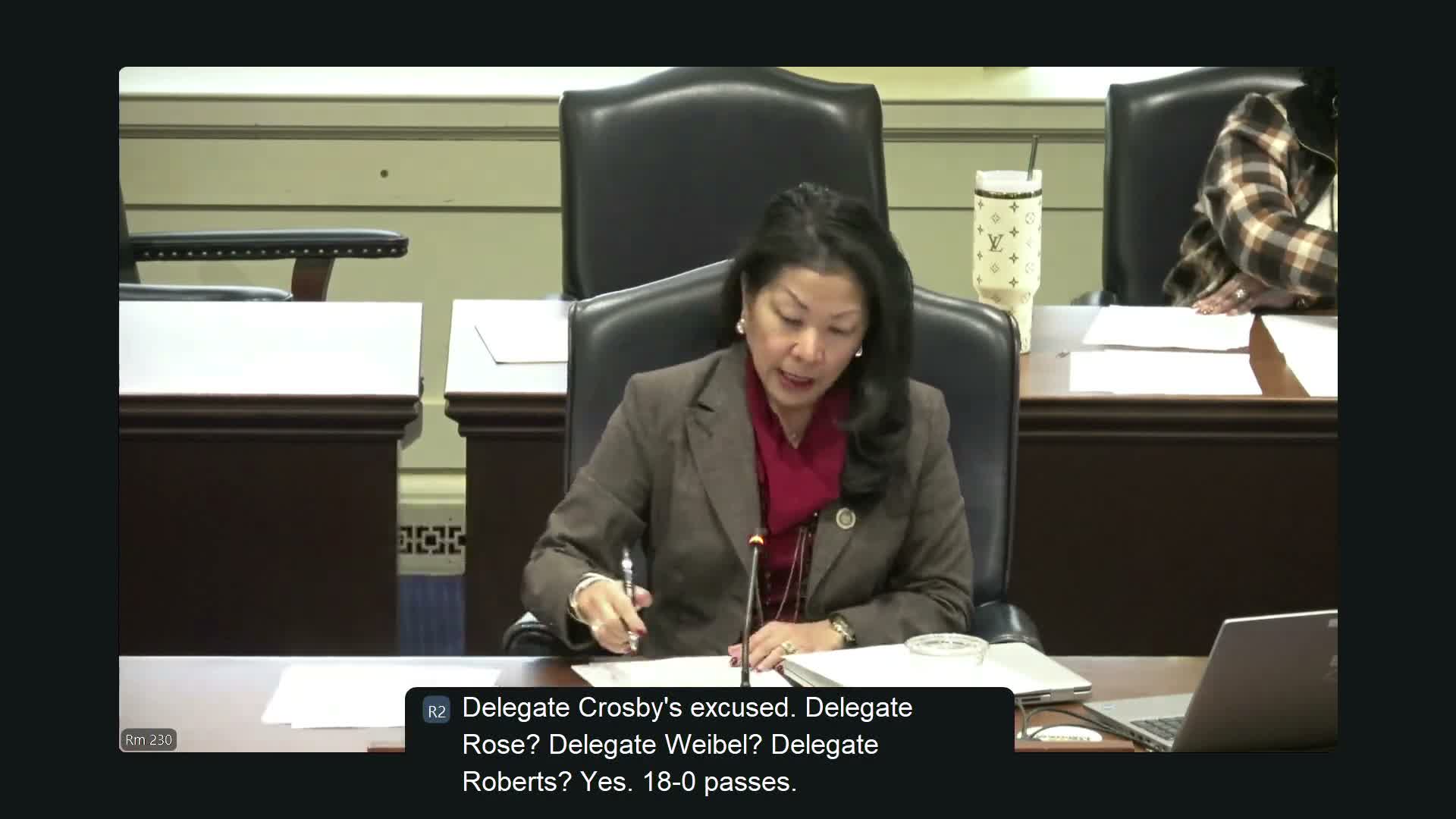
The Economic Matters Committee on March 6 voted to advance House Bill 483, which raises the income thresholds and adjusts audit requirements for charitable organizations, amid a sharp debate over whether the changes would weaken accountability for nonprofits that receive state funding.
Lawmaker (speaker 8), the bill sponsor, told the committee HB 483 increases the maximum gross-income threshold at which the secretary of state may require an audit (from $750,000 to $1,000,000) and that the subcommittee accepted an amendment adjusting the lower threshold "from 500,000 to 400,000" to reflect inflation. "There was another amendment that added some additional verbiage," the sponsor said, and the body moved the Adams amendment to adjust thresholds.
Committee member (speaker 5) delivered the session's strongest opposition. "We're essentially requiring less accountability from the 300 to $400,000 range," the member said, arguing that raising the lower-end threshold could reduce oversight of nonprofits that receive state tax dollars and pointing to high-profile cases in Maryland and elsewhere where taxpayer dollars lacked sufficient accountability. "If you're getting state tax dollars, then I think there should be robust accountability," the member said, and stated they would vote against the bill.
Committee member (speaker 4) and others responded that the audit provisions in HB 483 are not the state's primary mechanism for holding grantees accountable and that other grant oversight procedures exist. "This is a separate set of rules that's not tied to the rules that the state has in its power to hold grantees accountable," the member said, describing the subcommittee's choice to adjust thresholds for inflation.
After discussion and a roll-call vote, the committee recorded the bill as passing (tally recorded in the committee as 13–5). The record shows the Adams amendment as the adopted subcommittee change adjusting the lower threshold; full legislative text and fiscal notes will determine precise application to grants and state-funded nonprofits.
What happens next
HB 483 will move on per the committee's usual advance process; the committee did not take further action beyond the favorable vote. The committee also noted concerns raised on the record that other committees or oversight bodies could separately examine grant-accountability mechanisms.
Provenance
This article is based on the committee's introduction of HB 483 (see the record beginning with the sponsor's presentation) and the recorded debate and vote that closed that item in the voting session.
Lawmaker (speaker 8), the bill sponsor, told the committee HB 483 increases the maximum gross-income threshold at which the secretary of state may require an audit (from $750,000 to $1,000,000) and that the subcommittee accepted an amendment adjusting the lower threshold "from 500,000 to 400,000" to reflect inflation. "There was another amendment that added some additional verbiage," the sponsor said, and the body moved the Adams amendment to adjust thresholds.
Committee member (speaker 5) delivered the session's strongest opposition. "We're essentially requiring less accountability from the 300 to $400,000 range," the member said, arguing that raising the lower-end threshold could reduce oversight of nonprofits that receive state tax dollars and pointing to high-profile cases in Maryland and elsewhere where taxpayer dollars lacked sufficient accountability. "If you're getting state tax dollars, then I think there should be robust accountability," the member said, and stated they would vote against the bill.
Committee member (speaker 4) and others responded that the audit provisions in HB 483 are not the state's primary mechanism for holding grantees accountable and that other grant oversight procedures exist. "This is a separate set of rules that's not tied to the rules that the state has in its power to hold grantees accountable," the member said, describing the subcommittee's choice to adjust thresholds for inflation.
After discussion and a roll-call vote, the committee recorded the bill as passing (tally recorded in the committee as 13–5). The record shows the Adams amendment as the adopted subcommittee change adjusting the lower threshold; full legislative text and fiscal notes will determine precise application to grants and state-funded nonprofits.
What happens next
HB 483 will move on per the committee's usual advance process; the committee did not take further action beyond the favorable vote. The committee also noted concerns raised on the record that other committees or oversight bodies could separately examine grant-accountability mechanisms.
Provenance
This article is based on the committee's introduction of HB 483 (see the record beginning with the sponsor's presentation) and the recorded debate and vote that closed that item in the voting session.
Don't Miss a Word: See the Full Meeting!
Go beyond summaries. Unlock every video, transcript, and key insight with a Founder Membership.
✓
Get instant access to full meeting videos
✓
Search and clip any phrase from complete transcripts
✓
Receive AI-powered summaries & custom alerts
✓
Enjoy lifetime, unrestricted access to government data
30-day money-back guarantee
