MCPS reports small year‑to‑year gains on MCAP and report card but flags persistent racial and gender gaps
March 06, 2026 | Montgomery County, Maryland
This article was created by AI summarizing key points discussed. AI makes mistakes, so for full details and context, please refer to the video of the full meeting. Please report any errors so we can fix them. Report an error »
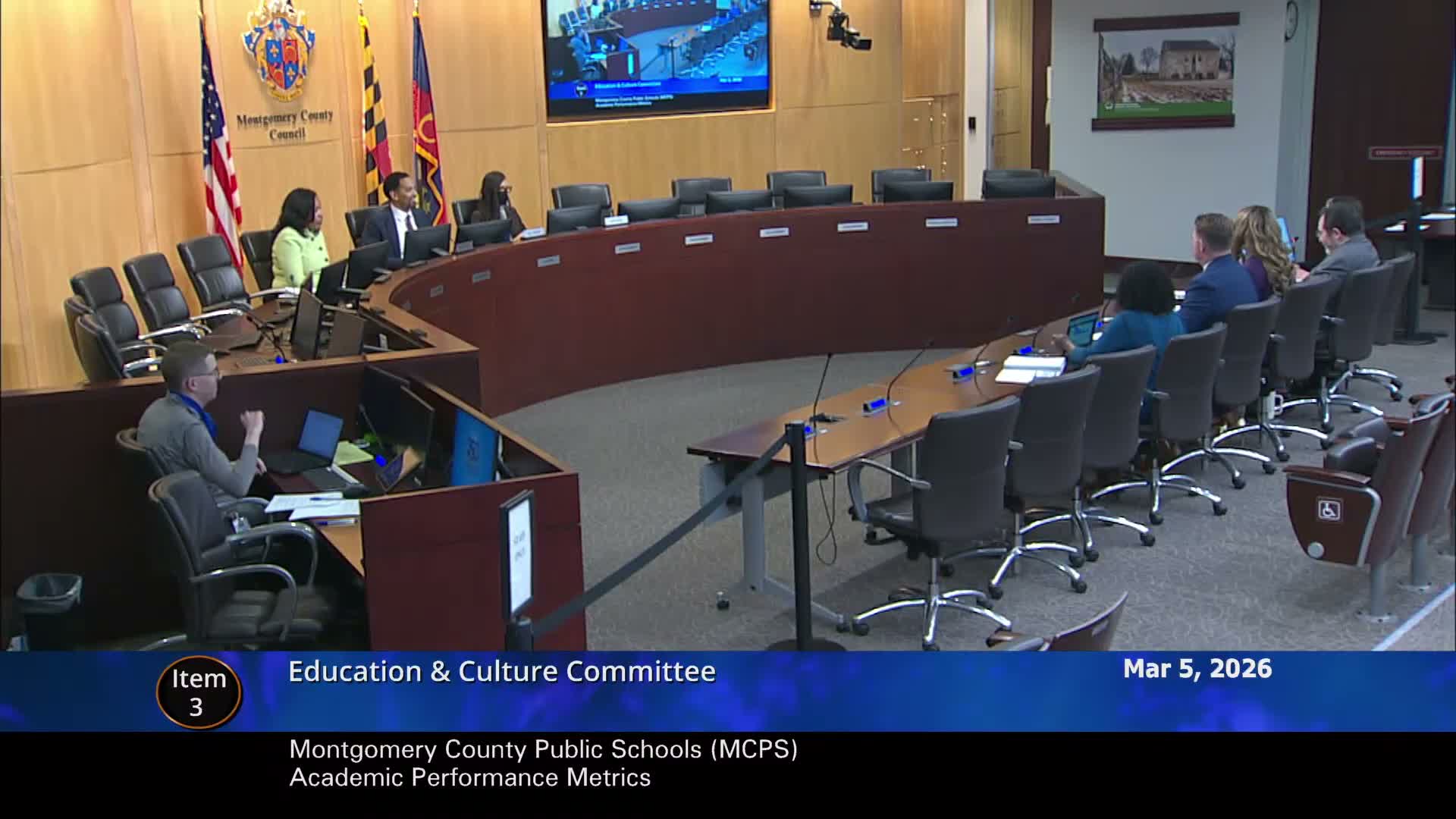
Montgomery County Public Schools presented its Maryland School Report Card and Maryland Comprehensive Assessment Program (MCAP) results to the Education & Culture Committee on March 5, reporting modest increases in proficiency alongside persistent achievement gaps by race and gender.
The district reported that 57.7% of students met proficiency in combined English language arts and literacy in 2024‑25 (an increase of 2.6 percentage points from 2022‑23) and that 35.7% of students met proficiency in combined mathematics (an increase of 2.9 points). MCPS said 53.5% of its schools currently earn a four‑ or five‑star rating on the state report card.
Presenters emphasized intersectional disaggregation of results. Peter Moran and MCPS staff showed that female students outperformed males in literacy across many race groups (for example, Black female literacy proficiency was reported at 54.5% vs Black male 42.7%), while mathematics proficiency showed a different pattern in which some male groups outperformed females (examples cited included white males and Asian males with notably higher proficiency rates). District presenters also called attention to very low proficiency rates in certain subgroups (the presentation cited particularly low math proficiency for some Hispanic/Latino groups).
MCPS described several strategies to translate the data into action: adoption of a new elementary literacy curriculum (Core Knowledge Language Arts), a district practice called FIT (focused instructional time or "win time") that sets aside about 30 minutes daily for tiered interventions or enrichment, observation rounds with The New Teacher Project to monitor curriculum implementation, and cross‑functional teams to deploy targeted supports in schools. The district said many students are close to proficiency and that targeted interventions, coaching and curriculum fidelity can drive incremental gains.
Officials warned that statewide assessment infrastructure will change in 2026‑27 with a new vendor and standard‑setting year, which may complicate year‑to‑year comparisons. MCPS said it will collect baseline instructional‑observation data by the end of the school year to track teaching practice and correlate it with student achievement.
Committee members pressed for clearer explanations of the drivers of recent star‑rating changes at individual schools (chronic absenteeism was cited as a factor behind some declines), asked how instructional changes and program evaluations will be reported publicly, and requested information on targeted programs for students most behind grade level. District staff said some community partnerships and pilot interventions exist but that district‑funded, culturally specific programs for particular racial groups are limited and remain an area for development.
MCPS said staff will return with further analyses, program evaluation results and baseline observation data that the district expects to use to guide professional development and resource allocation.
The district reported that 57.7% of students met proficiency in combined English language arts and literacy in 2024‑25 (an increase of 2.6 percentage points from 2022‑23) and that 35.7% of students met proficiency in combined mathematics (an increase of 2.9 points). MCPS said 53.5% of its schools currently earn a four‑ or five‑star rating on the state report card.
Presenters emphasized intersectional disaggregation of results. Peter Moran and MCPS staff showed that female students outperformed males in literacy across many race groups (for example, Black female literacy proficiency was reported at 54.5% vs Black male 42.7%), while mathematics proficiency showed a different pattern in which some male groups outperformed females (examples cited included white males and Asian males with notably higher proficiency rates). District presenters also called attention to very low proficiency rates in certain subgroups (the presentation cited particularly low math proficiency for some Hispanic/Latino groups).
MCPS described several strategies to translate the data into action: adoption of a new elementary literacy curriculum (Core Knowledge Language Arts), a district practice called FIT (focused instructional time or "win time") that sets aside about 30 minutes daily for tiered interventions or enrichment, observation rounds with The New Teacher Project to monitor curriculum implementation, and cross‑functional teams to deploy targeted supports in schools. The district said many students are close to proficiency and that targeted interventions, coaching and curriculum fidelity can drive incremental gains.
Officials warned that statewide assessment infrastructure will change in 2026‑27 with a new vendor and standard‑setting year, which may complicate year‑to‑year comparisons. MCPS said it will collect baseline instructional‑observation data by the end of the school year to track teaching practice and correlate it with student achievement.
Committee members pressed for clearer explanations of the drivers of recent star‑rating changes at individual schools (chronic absenteeism was cited as a factor behind some declines), asked how instructional changes and program evaluations will be reported publicly, and requested information on targeted programs for students most behind grade level. District staff said some community partnerships and pilot interventions exist but that district‑funded, culturally specific programs for particular racial groups are limited and remain an area for development.
MCPS said staff will return with further analyses, program evaluation results and baseline observation data that the district expects to use to guide professional development and resource allocation.
View the Full Meeting & All Its Details
This article offers just a summary. Unlock complete video, transcripts, and insights as a Founder Member.
✓
Watch full, unedited meeting videos
✓
Search every word spoken in unlimited transcripts
✓
AI summaries & real-time alerts (all government levels)
✓
Permanent access to expanding government content
30-day money-back guarantee
