Needham Planning Board hears hours of public comment on ‘large house’ zoning changes; hearing closed for further review
March 05, 2026 | Town of Needham, Norfolk County, Massachusetts
This article was created by AI summarizing key points discussed. AI makes mistakes, so for full details and context, please refer to the video of the full meeting. Please report any errors so we can fix them. Report an error »
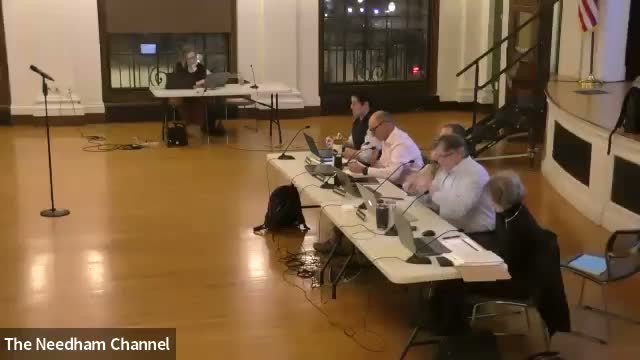
The Town of Needham Planning Board held a public hearing on March 4 on proposed "large house" zoning amendments that would change how floor-area ratio, lot coverage, height and front setbacks are calculated across single-residence districts. After a multi-part presentation from the committee and planning staff, dozens of residents spoke; the board voted to close the hearing and to continue deliberations before a final vote.
The committee presenting the draft told the board the working group met roughly 25 times and used consultants to test visual and fiscal impacts. The package includes four stand‑alone warrant articles: (1) a revised FAR definition that would count all above‑ground floor area (including attics and garages in many cases) and use a sliding FAR tied to lot size with a 15,000‑square‑foot cap (special permit required above that size); (2) a sliding lot‑coverage formula favoring smaller lots; (3) a modest reduction of standard height limits (from 35 to 33 feet and from 41 to 39 feet for certain walkout‑basement conditions) coupled with a plate‑height limit to prevent continuous three‑story sideline walls; and (4) an averaging provision for front setbacks using the average setback of structures within 200 feet on either side, with special‑permit relief for corner lots that would otherwise be constrained.
"We changed the definition to include all above‑ground areas," the presenter said, describing a 300‑square‑foot attic bonus intended to encourage use of attic space rather than expanding first and second‑floor massing. Planner Lee Newman explained that basements would remain excluded unless 50% of basement walls are exposed.
Many residents urged caution. Louise Miller, a town meeting member, warned the proposals would affect a large share of the town’s housing stock and urged careful study of both household and townwide fiscal impacts. "We are affecting everyone in town," Miller said, citing differences between SR A and SR B districts and household age distributions.
Other speakers, including former working‑group members, criticized the complexity of the rules and the inclusion of attic and garage space in FAR calculations. "Including the attic in the FAR will significantly complicate the calculation and may incentivize flat or low‑pitch roofs," said Gary Losanto, a former committee participant. Multiple speakers — including town meeting members and residents who identified themselves as long‑time homeowners — said the draft could reduce sale values, affect seniors’ retirement plans and reduce the town’s new‑growth revenue over time.
Several commenters asked for clearer guidance on how the rules would treat additions to existing homes and detached garages. Lee Newman said the draft applies FAR and coverage to existing houses and additions; however, some setback provisions provide relief for preexisting nonconforming conditions and the draft includes special‑permit paths in constrained situations.
The presenters acknowledged an error in a fiscal‑impact slide and removed the flawed slide from tonight’s presentation. Multiple residents pressed for corrected financial numbers before the matter goes to Town Meeting. Planning board members debated whether to keep the hearing open pending corrected figures.
Procedurally, the board voted on a motion to close the hearing. Justin McCullen moved to close the public hearing; the motion passed on a roll‑call vote (McCullen — aye; Adam Block — aye; Eric — aye; the chair — nay). The board said it will consider public comments, corrected fiscal analysis and committee recommendations at upcoming meetings and must act in time for an April 7 vote to place any articles on the May 11 special town meeting warrant.
The board also took brief, noncontroversial actions: it filed "no comment" on a Zoning Board of Appeals referral for 105 Chestnut Street (an acupuncture use seeking a parking waiver), adopted Feb. 3 minutes and acknowledged letters both for and against the large‑house proposals. Planning staff noted the town is evaluating acquisition of an off‑street parcel along Cartwright Road for open space. The board recessed and scheduled continued zoning discussion for its next meeting on March 17.
What happens next: the Planning Board will review the corrected fiscal analysis and public testimony, continue internal deliberations at its March meetings and, if ready, vote by April 7 on warrant language needed to send articles to the May 11 special town meeting. No final zoning changes were adopted at the March 4 meeting.
The committee presenting the draft told the board the working group met roughly 25 times and used consultants to test visual and fiscal impacts. The package includes four stand‑alone warrant articles: (1) a revised FAR definition that would count all above‑ground floor area (including attics and garages in many cases) and use a sliding FAR tied to lot size with a 15,000‑square‑foot cap (special permit required above that size); (2) a sliding lot‑coverage formula favoring smaller lots; (3) a modest reduction of standard height limits (from 35 to 33 feet and from 41 to 39 feet for certain walkout‑basement conditions) coupled with a plate‑height limit to prevent continuous three‑story sideline walls; and (4) an averaging provision for front setbacks using the average setback of structures within 200 feet on either side, with special‑permit relief for corner lots that would otherwise be constrained.
"We changed the definition to include all above‑ground areas," the presenter said, describing a 300‑square‑foot attic bonus intended to encourage use of attic space rather than expanding first and second‑floor massing. Planner Lee Newman explained that basements would remain excluded unless 50% of basement walls are exposed.
Many residents urged caution. Louise Miller, a town meeting member, warned the proposals would affect a large share of the town’s housing stock and urged careful study of both household and townwide fiscal impacts. "We are affecting everyone in town," Miller said, citing differences between SR A and SR B districts and household age distributions.
Other speakers, including former working‑group members, criticized the complexity of the rules and the inclusion of attic and garage space in FAR calculations. "Including the attic in the FAR will significantly complicate the calculation and may incentivize flat or low‑pitch roofs," said Gary Losanto, a former committee participant. Multiple speakers — including town meeting members and residents who identified themselves as long‑time homeowners — said the draft could reduce sale values, affect seniors’ retirement plans and reduce the town’s new‑growth revenue over time.
Several commenters asked for clearer guidance on how the rules would treat additions to existing homes and detached garages. Lee Newman said the draft applies FAR and coverage to existing houses and additions; however, some setback provisions provide relief for preexisting nonconforming conditions and the draft includes special‑permit paths in constrained situations.
The presenters acknowledged an error in a fiscal‑impact slide and removed the flawed slide from tonight’s presentation. Multiple residents pressed for corrected financial numbers before the matter goes to Town Meeting. Planning board members debated whether to keep the hearing open pending corrected figures.
Procedurally, the board voted on a motion to close the hearing. Justin McCullen moved to close the public hearing; the motion passed on a roll‑call vote (McCullen — aye; Adam Block — aye; Eric — aye; the chair — nay). The board said it will consider public comments, corrected fiscal analysis and committee recommendations at upcoming meetings and must act in time for an April 7 vote to place any articles on the May 11 special town meeting warrant.
The board also took brief, noncontroversial actions: it filed "no comment" on a Zoning Board of Appeals referral for 105 Chestnut Street (an acupuncture use seeking a parking waiver), adopted Feb. 3 minutes and acknowledged letters both for and against the large‑house proposals. Planning staff noted the town is evaluating acquisition of an off‑street parcel along Cartwright Road for open space. The board recessed and scheduled continued zoning discussion for its next meeting on March 17.
What happens next: the Planning Board will review the corrected fiscal analysis and public testimony, continue internal deliberations at its March meetings and, if ready, vote by April 7 on warrant language needed to send articles to the May 11 special town meeting. No final zoning changes were adopted at the March 4 meeting.
View the Full Meeting & All Its Details
This article offers just a summary. Unlock complete video, transcripts, and insights as a Founder Member.
✓
Watch full, unedited meeting videos
✓
Search every word spoken in unlimited transcripts
✓
AI summaries & real-time alerts (all government levels)
✓
Permanent access to expanding government content
30-day money-back guarantee
