Residents cite traffic and flooding as Smyrna planning commission recommends denial of KBC Advisors' Nissan Drive rezoning
March 06, 2026 | Smyrna, Rutherford County, Tennessee
This article was created by AI summarizing key points discussed. AI makes mistakes, so for full details and context, please refer to the video of the full meeting. Please report any errors so we can fix them. Report an error »
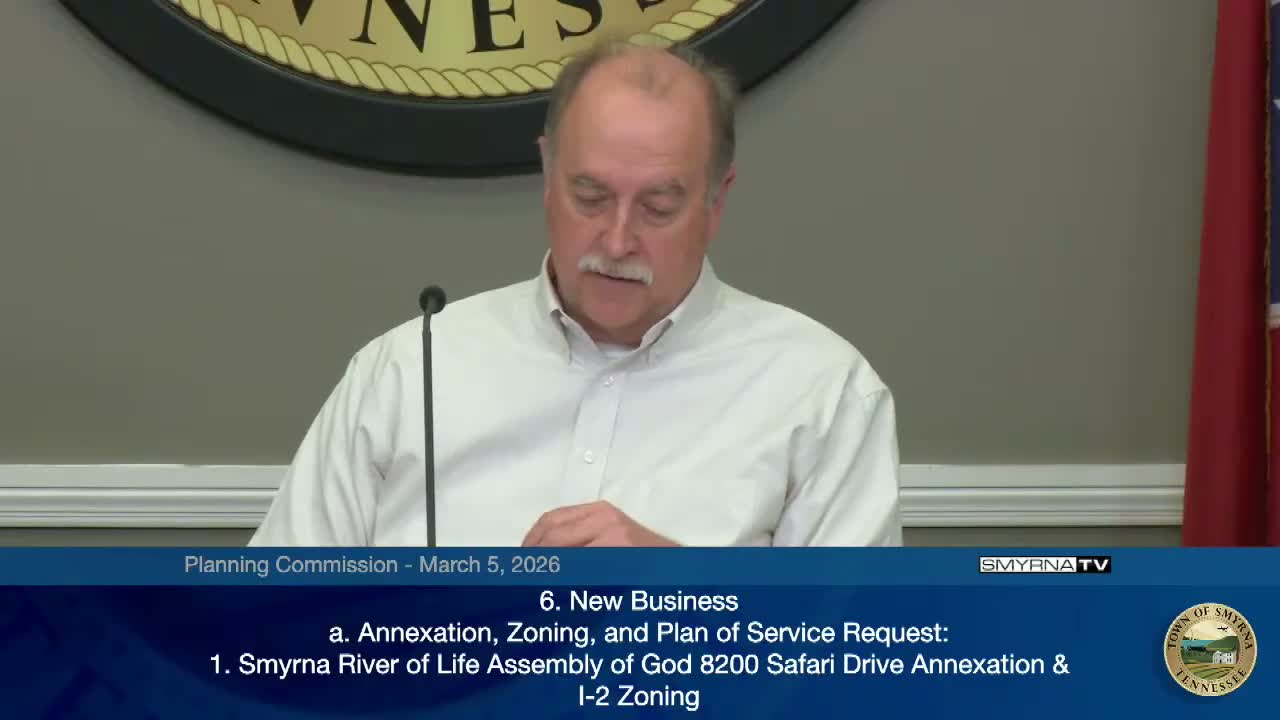
The Smyrna Municipal Planning Commission on March 5 voted to recommend denial of a rezoning/PID request from KBC Advisors and civil engineer Thomas & Hutton that would have allowed up to about 180,000 square feet of industrial space across three buildings along Nissan Drive.
Hundreds of pages of public comment and a packed meeting room framed the debate. Multiple residents told commissioners they were concerned the development would change a long‑standing residential character, increase truck traffic, and worsen chronic drainage problems. Kelly Vaughn, an adjacent homeowner, said the area currently serves as a natural stormwater buffer and warned clearing and adding impervious surfaces could increase runoff and sinkhole risk: "Rezoning this wooded residential adjacent land to industrial would permanently change the character of our neighborhood and introduce real drainage risk to existing homeowners," she said.
Developer representatives argued the product targets local and regional industrial tenants — not a large truck terminal — and said they had designed extra screening and buffers to reduce neighborhood impacts. Huntley Lewis, representing KBC Advisors, told the commission the traffic study (received the day before the meeting) assigned roughly 30% of trips to trucks, which the developer's engineer translated to about 70 truck one‑way trips (roughly 35 truck arrivals and 35 departures) spread across the day. "We're not trying to change the character and subject people to that level of intensity from a truck traffic standpoint," Lewis said, adding the proposal includes internal truck courts designed to discourage high‑volume terminal operations.
Commissioners pressed the developer and engineer on left‑turn movements from the site onto Nissan Drive and Jefferson Pike, the vertical curve on Nissan that limits sight distance, whether semi traffic could be restricted, and whether traffic mitigation devices (no‑left‑turn, turn lanes or signals) would be required. Planning staff and the developer said buildings of the proposed size would require sprinkler systems and fire‑flow upgrades and that any required road improvements from the traffic study would be imposed on the developer at the site‑plan stage.
After extended discussion, Committee member (speaker 11) moved to recommend denial, citing truck traffic, sight‑distance and inconsistency with adjacent residential zoning; the motion was seconded and passed by voice vote. Staff clarified the negative recommendation will be forwarded to the town council for final action unless the applicant withdraws or revises the proposal.
What happens next: The item will appear on the council agenda with a negative recommendation from the Planning Commission. The developer may revise the proposal, present additional traffic or mitigation measures, or withdraw the application prior to council review.
Hundreds of pages of public comment and a packed meeting room framed the debate. Multiple residents told commissioners they were concerned the development would change a long‑standing residential character, increase truck traffic, and worsen chronic drainage problems. Kelly Vaughn, an adjacent homeowner, said the area currently serves as a natural stormwater buffer and warned clearing and adding impervious surfaces could increase runoff and sinkhole risk: "Rezoning this wooded residential adjacent land to industrial would permanently change the character of our neighborhood and introduce real drainage risk to existing homeowners," she said.
Developer representatives argued the product targets local and regional industrial tenants — not a large truck terminal — and said they had designed extra screening and buffers to reduce neighborhood impacts. Huntley Lewis, representing KBC Advisors, told the commission the traffic study (received the day before the meeting) assigned roughly 30% of trips to trucks, which the developer's engineer translated to about 70 truck one‑way trips (roughly 35 truck arrivals and 35 departures) spread across the day. "We're not trying to change the character and subject people to that level of intensity from a truck traffic standpoint," Lewis said, adding the proposal includes internal truck courts designed to discourage high‑volume terminal operations.
Commissioners pressed the developer and engineer on left‑turn movements from the site onto Nissan Drive and Jefferson Pike, the vertical curve on Nissan that limits sight distance, whether semi traffic could be restricted, and whether traffic mitigation devices (no‑left‑turn, turn lanes or signals) would be required. Planning staff and the developer said buildings of the proposed size would require sprinkler systems and fire‑flow upgrades and that any required road improvements from the traffic study would be imposed on the developer at the site‑plan stage.
After extended discussion, Committee member (speaker 11) moved to recommend denial, citing truck traffic, sight‑distance and inconsistency with adjacent residential zoning; the motion was seconded and passed by voice vote. Staff clarified the negative recommendation will be forwarded to the town council for final action unless the applicant withdraws or revises the proposal.
What happens next: The item will appear on the council agenda with a negative recommendation from the Planning Commission. The developer may revise the proposal, present additional traffic or mitigation measures, or withdraw the application prior to council review.
View the Full Meeting & All Its Details
This article offers just a summary. Unlock complete video, transcripts, and insights as a Founder Member.
✓
Watch full, unedited meeting videos
✓
Search every word spoken in unlimited transcripts
✓
AI summaries & real-time alerts (all government levels)
✓
Permanent access to expanding government content
30-day money-back guarantee
