House Finance hears fiscal update showing larger deficits and potential Constitutional Budget Reserve draw
March 04, 2026 | 2026 Legislature Alaska, Alaska
This article was created by AI summarizing key points discussed. AI makes mistakes, so for full details and context, please refer to the video of the full meeting. Please report any errors so we can fix them. Report an error »
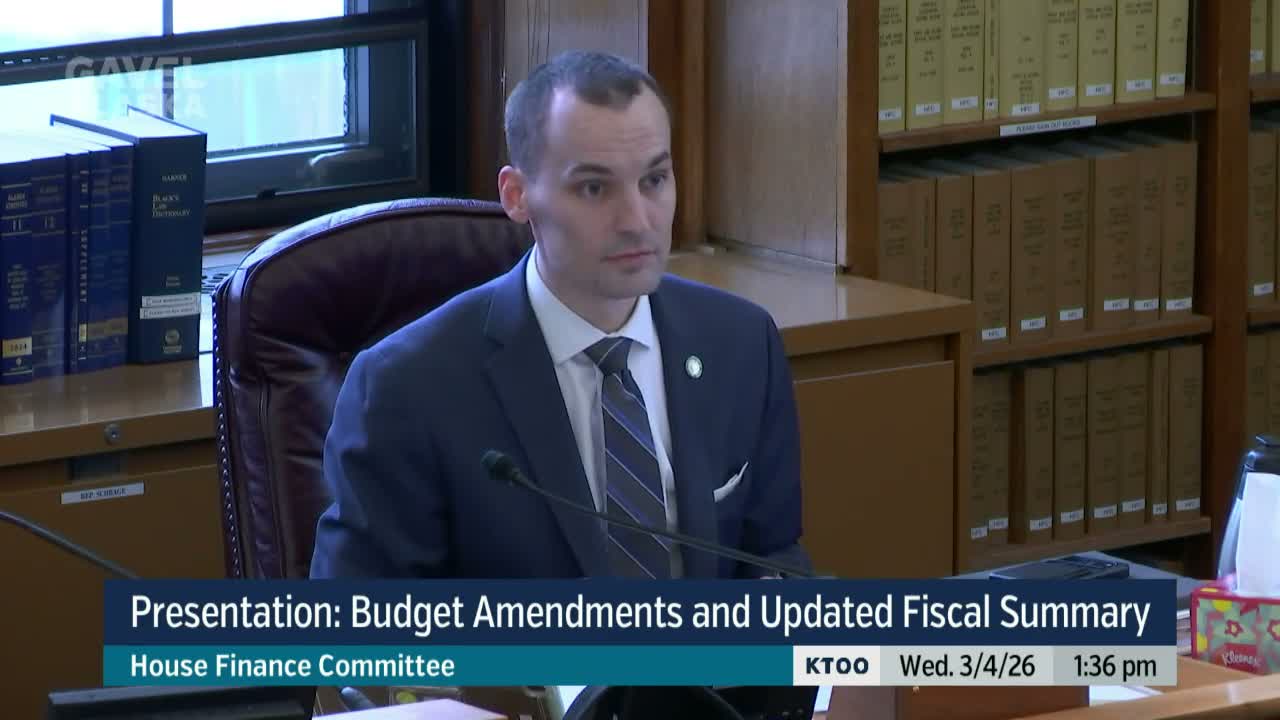
Alexi Painter, Legislative Finance Division, told the House Finance Committee on March 4 that three rounds of supplemental requests have expanded the FY26 fiscal picture and that the legislature faces a potential draw on the Constitutional Budget Reserve (CBR) if oil prices and other factors do not improve.
Painter said the committee’s fiscal summary, based on the fall revenue forecast, shows a starting FY26 deficit of $51,100,000 and that the governor’s supplemental requests push total supplemental-driven deficits to about $336,800,000. He noted the governor’s proposed transfer of $129,600,000 to the higher education fund is recorded as an internal fund transfer in the governor’s submission and therefore does not increase his reported deficit; in the committee’s version the transfer flows through the general fund and therefore appears as deficit spending on the fiscal summary.
Why it matters: the difference in presentation can change the displayed deficit even when the net effect across accounts is similar. Representative Galvin pressed staff to quantify lost investment earnings from leaving the funds in the CBR versus moving them to the higher-education fund; Galvin estimated roughly $400,000 per month in forgone earnings on that transfer and asked staff to model the precise impact. Painter said Legislative Finance would calculate and provide that figure.
Painter also quantified the governor’s total Constitutional Budget Reserve exposure under his supplementals as roughly $466,400,000 (plus an unsubmitted $55,000,000 fire-suppression request). He described the other body’s version of the supplemental as materially similar but including a $35,000,000 contingent disaster relief item and other differences that could alter the realized CBR draw.
On oil prices, Painter said the fall revenue forecast assumed roughly $65.48 per barrel in FY26 and $62 in FY27, but year-to-date FY26 prices were averaging $67.40. He cautioned that to fund all supplementals without tapping the CBR the average price for the remainder of the year would need to be substantially higher (roughly a $105 per-barrel run-rate for the remainder of the year to reach an ~$80–$81 annual average), which the futures market does not support. Painter noted a $71-per-barrel assumption in an alternate spring forecast could produce roughly $280,000,000 more revenue for FY27, reducing a $1.6 billion projected deficit to about $1.3 billion, but not eliminating the structural shortfall.
Committee members asked about program receipts that lapse to the general fund, reactivation of fund codes (Painter described a 2011 budget-clarification project that deactivated some codes for transparency), and whether certain departmental requests (for example, $4.2M in licensing-investigation costs) should be handled by licensing fees or general appropriations. Painter said statute contemplates licensing fees covering investigations but that appropriating funds instead is a policy call for the legislature.
Next steps: Legislative Finance will provide follow-up numbers requested by members (including the lost-investment-earnings calculation and details on receipts that lapse to the general fund). The committee took a brief recess and then resumed to consider House Bill 280.
Painter said the committee’s fiscal summary, based on the fall revenue forecast, shows a starting FY26 deficit of $51,100,000 and that the governor’s supplemental requests push total supplemental-driven deficits to about $336,800,000. He noted the governor’s proposed transfer of $129,600,000 to the higher education fund is recorded as an internal fund transfer in the governor’s submission and therefore does not increase his reported deficit; in the committee’s version the transfer flows through the general fund and therefore appears as deficit spending on the fiscal summary.
Why it matters: the difference in presentation can change the displayed deficit even when the net effect across accounts is similar. Representative Galvin pressed staff to quantify lost investment earnings from leaving the funds in the CBR versus moving them to the higher-education fund; Galvin estimated roughly $400,000 per month in forgone earnings on that transfer and asked staff to model the precise impact. Painter said Legislative Finance would calculate and provide that figure.
Painter also quantified the governor’s total Constitutional Budget Reserve exposure under his supplementals as roughly $466,400,000 (plus an unsubmitted $55,000,000 fire-suppression request). He described the other body’s version of the supplemental as materially similar but including a $35,000,000 contingent disaster relief item and other differences that could alter the realized CBR draw.
On oil prices, Painter said the fall revenue forecast assumed roughly $65.48 per barrel in FY26 and $62 in FY27, but year-to-date FY26 prices were averaging $67.40. He cautioned that to fund all supplementals without tapping the CBR the average price for the remainder of the year would need to be substantially higher (roughly a $105 per-barrel run-rate for the remainder of the year to reach an ~$80–$81 annual average), which the futures market does not support. Painter noted a $71-per-barrel assumption in an alternate spring forecast could produce roughly $280,000,000 more revenue for FY27, reducing a $1.6 billion projected deficit to about $1.3 billion, but not eliminating the structural shortfall.
Committee members asked about program receipts that lapse to the general fund, reactivation of fund codes (Painter described a 2011 budget-clarification project that deactivated some codes for transparency), and whether certain departmental requests (for example, $4.2M in licensing-investigation costs) should be handled by licensing fees or general appropriations. Painter said statute contemplates licensing fees covering investigations but that appropriating funds instead is a policy call for the legislature.
Next steps: Legislative Finance will provide follow-up numbers requested by members (including the lost-investment-earnings calculation and details on receipts that lapse to the general fund). The committee took a brief recess and then resumed to consider House Bill 280.
View the Full Meeting & All Its Details
This article offers just a summary. Unlock complete video, transcripts, and insights as a Founder Member.
✓
Watch full, unedited meeting videos
✓
Search every word spoken in unlimited transcripts
✓
AI summaries & real-time alerts (all government levels)
✓
Permanent access to expanding government content
30-day money-back guarantee
