Committee debates HB 280 digital-tax proposal after Department of Revenue warns the "highly digitized" definition may sweep in airlines, hotels and retailers
March 04, 2026 | 2026 Legislature Alaska, Alaska
This article was created by AI summarizing key points discussed. AI makes mistakes, so for full details and context, please refer to the video of the full meeting. Please report any errors so we can fix them. Report an error »
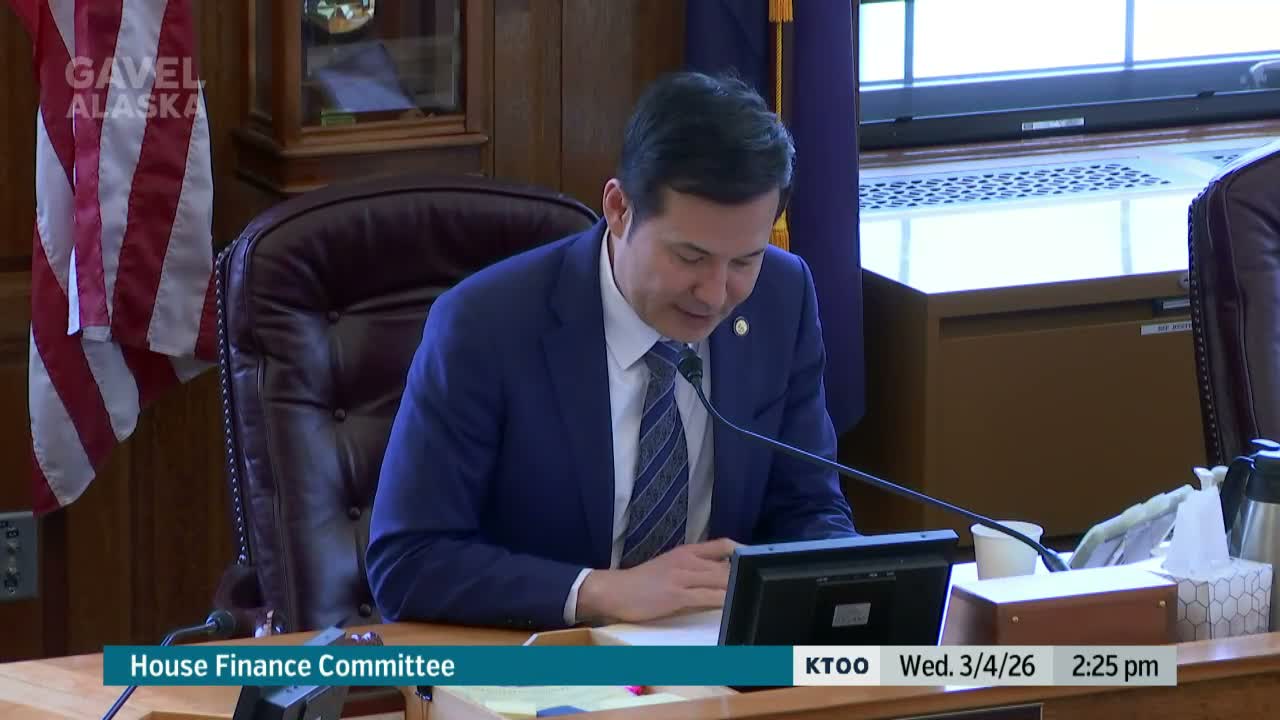
The House Finance Committee continued on March 4 with a hearing on HB 280, a bill that would change apportionment rules for businesses with substantial online sales. Brandon Spanos, acting tax director at the Department of Revenue, and Dan Stickel, the department’s chief economist, briefed members on the statutory and regulatory implications and the fiscal note.
Spanos framed the issue under Alaska’s Unified Division of Income for Tax Purposes Act (UDIPA, Alaska Stat. 43.19), which generally apportions income by property, payroll and sales but already contains industry-specific special apportionment rules (for example, an extraction factor for oil and gas and port- or ground-time rules for carriers). He said the bill’s current definition of "highly digitized" (which the department read as any firm with 50% or more of sales via the Internet) would in practice convert some industries to a single-sales-factor apportionment, potentially overriding specialized treatments for airlines, cruise lines, hotels and even brick-and-mortar retailers that sell heavily online.
"If more than 50% of their sales are electronic ... then, yes, they would be highly digitized and the property and payroll would be thrown out," Spanos said, warning the committee that fast-food apps, online ticketing for airlines, hotel bookings and other commonplace digital sales could be captured under the bill’s current draft.
Stickel summarized the Department of Revenue’s fiscal analysis: the market-based sourcing change (which shifts how sales are sourced to the market location of the customer) is estimated to raise about $15,000,000; the single-sales-factor change for businesses classified as "highly digitized" has a midpoint estimate of roughly $30,000,000 but a wider uncertainty range depending on which sectors are actually captured.
Members pressed options for narrowing scope. Department staff recommended three practical approaches: (1) explicitly exclude industries that already have special apportionment rules, (2) raise the digital-sales threshold (examples discussed ranged from 75% to 85% rather than the current 50%) to better match common understanding of "highly digitized," or (3) state legislative intent in statute but delegate fine-grained definitions and industry-specific adjustments to regulation using Multistate Tax Commission model language so the department can refine categories through a public-rulemaking process.
Several members also objected to the bill’s effective date clause, which sets an effective date of Jan. 1, 2026, noting that retroactive tax changes raise administrative fairness concerns. Stickel said the department could fast-track a regulatory package and target regulations by Jan. 1, 2027, to give taxpayers clearer guidance, but implementing a retroactive tax remains problematic from the members’ perspective.
Next steps: committee staff said they will invite testimony from industry representatives (Motion Picture Association had already provided a written submission and appeared online) and return for further hearings. The committee discussed a possible committee substitute for points of consensus, followed by the amendment process.
Spanos framed the issue under Alaska’s Unified Division of Income for Tax Purposes Act (UDIPA, Alaska Stat. 43.19), which generally apportions income by property, payroll and sales but already contains industry-specific special apportionment rules (for example, an extraction factor for oil and gas and port- or ground-time rules for carriers). He said the bill’s current definition of "highly digitized" (which the department read as any firm with 50% or more of sales via the Internet) would in practice convert some industries to a single-sales-factor apportionment, potentially overriding specialized treatments for airlines, cruise lines, hotels and even brick-and-mortar retailers that sell heavily online.
"If more than 50% of their sales are electronic ... then, yes, they would be highly digitized and the property and payroll would be thrown out," Spanos said, warning the committee that fast-food apps, online ticketing for airlines, hotel bookings and other commonplace digital sales could be captured under the bill’s current draft.
Stickel summarized the Department of Revenue’s fiscal analysis: the market-based sourcing change (which shifts how sales are sourced to the market location of the customer) is estimated to raise about $15,000,000; the single-sales-factor change for businesses classified as "highly digitized" has a midpoint estimate of roughly $30,000,000 but a wider uncertainty range depending on which sectors are actually captured.
Members pressed options for narrowing scope. Department staff recommended three practical approaches: (1) explicitly exclude industries that already have special apportionment rules, (2) raise the digital-sales threshold (examples discussed ranged from 75% to 85% rather than the current 50%) to better match common understanding of "highly digitized," or (3) state legislative intent in statute but delegate fine-grained definitions and industry-specific adjustments to regulation using Multistate Tax Commission model language so the department can refine categories through a public-rulemaking process.
Several members also objected to the bill’s effective date clause, which sets an effective date of Jan. 1, 2026, noting that retroactive tax changes raise administrative fairness concerns. Stickel said the department could fast-track a regulatory package and target regulations by Jan. 1, 2027, to give taxpayers clearer guidance, but implementing a retroactive tax remains problematic from the members’ perspective.
Next steps: committee staff said they will invite testimony from industry representatives (Motion Picture Association had already provided a written submission and appeared online) and return for further hearings. The committee discussed a possible committee substitute for points of consensus, followed by the amendment process.
View the Full Meeting & All Its Details
This article offers just a summary. Unlock complete video, transcripts, and insights as a Founder Member.
✓
Watch full, unedited meeting videos
✓
Search every word spoken in unlimited transcripts
✓
AI summaries & real-time alerts (all government levels)
✓
Permanent access to expanding government content
30-day money-back guarantee
