Pinellas Park council adopts land‑development change, OKs HUD CAPER and narrows CDBG priorities; council approves multiple large contracts
November 27, 2024 | Pinellas Park, Pinellas County, Florida
This article was created by AI summarizing key points discussed. AI makes mistakes, so for full details and context, please refer to the video of the full meeting. Please report any errors so we can fix them. Report an error »
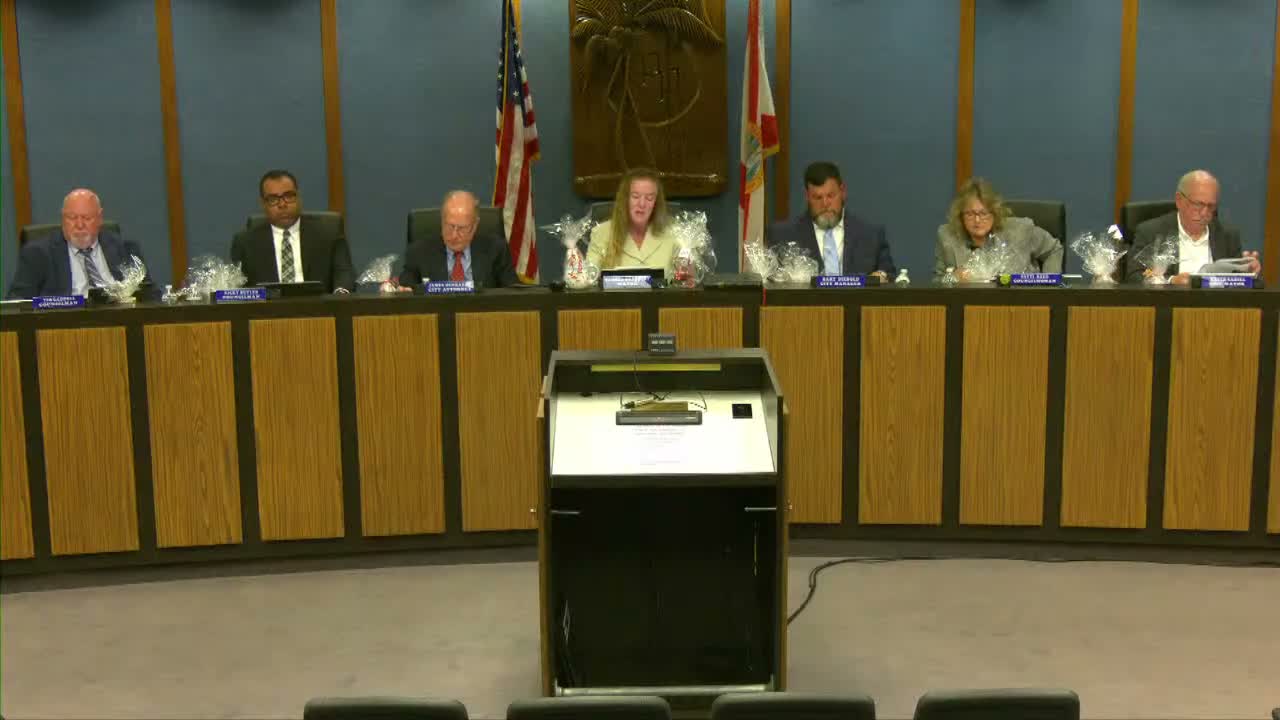
Pinellas Park’s City Council on Nov. 26 adopted an amendment to the city’s Land Development Code that removes local minimum building separation requirements and requires compliance with the Florida Building Code, approved its 2023 Consolidated Annual Performance and Evaluation Report (CAPER) to HUD, and cleared a suite of purchases and contracts as part of a consent agenda.
Megan Montesino, development review manager, told the council the ordinance (42-79) eliminates local Section 18-15-30.17 and adds references to the Florida Building Code for separation standards. "So for residential, let's say, the Florida building code between structures is as minimum as, I believe, 5 feet, where ours is 15 feet," Montesino said, adding commercial minimums differ as well. The council held follow-up questions on how the change applies to multi-story buildings and mechanical equipment and then voted to adopt the ordinance on second and final reading; the motion passed unanimously.
Rebecca Stevenson, grants coordinator, presented Resolution 24-29, the CAPER for program year Oct. 1, 2023–Sept. 30, 2024. Stevenson said the city expended $1,268,104.99 on the Harmony Heights project during the period and described Phase 1A results (sidewalks and paving) and plans to continue phases 2 and 3 with HUD funding. The council voted unanimously to approve the CAPER and authorize staff to submit it to the U.S. Department of Housing and Urban Development.
Stevenson also explained Resolution 24-30, a proposed substantial amendment to the city’s 2023–2027 consolidated CDBG plan. Staff recommended removing several CDBG program goals from the plan (public services, homelessness outreach, homeowner assistance and affordable housing as CDBG-funded goals) and concentrating on two high-priority goals: (1) public facilities and infrastructure improvements (including Harmony Heights work), and (2) planning and administration. Stevenson said the change is intended to better align the city’s requests with HUD-eligible activities and increase the likelihood of approval. Council members confirmed that some resident services will continue but may use other funding sources; the resolution was adopted unanimously.
Votes at a glance
- Ordinance 42-79 (LDC amendment — remove minimum building separation; reference Florida Building Code): motion made and seconded; carried unanimously.
- Resolution 24-29 (2023 CAPER; submit to HUD): motion made and seconded; carried unanimously. Staff reported $1,268,104.99 was expended on Harmony Heights in program year 2023.
- Resolution 24-30 (substantial amendment to 2023–2027 consolidated plan): motion made and seconded; carried unanimously.
- Consent agenda (C1–C17): motion made and seconded; carried unanimously.
Consent and procurement highlights
The consent agenda listed routine and emergency authorizations and several notable procurement items: 19 mobile APX radios ($193,581.88); an estimated $500,000 authorization for emergency disaster debris monitoring services; a 107-foot Pierce HD ladder truck for the fire department at $1,799,999.56; and authorization to award RFP 24/001 for an Advanced Metering Infrastructure (AMI) System to Badger Meter Inc. with a total contract amount of $9,279,657.59. The agenda also included standard vehicle purchases, grant subaward authorizations tied to hurricane recovery, and appointment and resignation items for local boards.
Why it matters
The land‑use change reduces duplicative local separation rules and defers technical separation standards to the Florida Building Code, which can lower minimum distances between buildings; council members questioned how the change will affect neighborhood character and mechanical equipment placement. Narrowing CDBG priorities signals a shift toward infrastructure projects tied to HUD eligibility — in Pinellas Park that has meant continued investment in Harmony Heights — while some social services and homeowner assistance will rely on other local or county funding sources.
What’s next
Staff will submit the CAPER to HUD and implement the substantial amendment as approved. Council did not schedule further readings for the ordinance (it passed at second and final reading). Several consent-agenda contracts move forward to procurement/implementation under staff authority.
Megan Montesino, development review manager, told the council the ordinance (42-79) eliminates local Section 18-15-30.17 and adds references to the Florida Building Code for separation standards. "So for residential, let's say, the Florida building code between structures is as minimum as, I believe, 5 feet, where ours is 15 feet," Montesino said, adding commercial minimums differ as well. The council held follow-up questions on how the change applies to multi-story buildings and mechanical equipment and then voted to adopt the ordinance on second and final reading; the motion passed unanimously.
Rebecca Stevenson, grants coordinator, presented Resolution 24-29, the CAPER for program year Oct. 1, 2023–Sept. 30, 2024. Stevenson said the city expended $1,268,104.99 on the Harmony Heights project during the period and described Phase 1A results (sidewalks and paving) and plans to continue phases 2 and 3 with HUD funding. The council voted unanimously to approve the CAPER and authorize staff to submit it to the U.S. Department of Housing and Urban Development.
Stevenson also explained Resolution 24-30, a proposed substantial amendment to the city’s 2023–2027 consolidated CDBG plan. Staff recommended removing several CDBG program goals from the plan (public services, homelessness outreach, homeowner assistance and affordable housing as CDBG-funded goals) and concentrating on two high-priority goals: (1) public facilities and infrastructure improvements (including Harmony Heights work), and (2) planning and administration. Stevenson said the change is intended to better align the city’s requests with HUD-eligible activities and increase the likelihood of approval. Council members confirmed that some resident services will continue but may use other funding sources; the resolution was adopted unanimously.
Votes at a glance
- Ordinance 42-79 (LDC amendment — remove minimum building separation; reference Florida Building Code): motion made and seconded; carried unanimously.
- Resolution 24-29 (2023 CAPER; submit to HUD): motion made and seconded; carried unanimously. Staff reported $1,268,104.99 was expended on Harmony Heights in program year 2023.
- Resolution 24-30 (substantial amendment to 2023–2027 consolidated plan): motion made and seconded; carried unanimously.
- Consent agenda (C1–C17): motion made and seconded; carried unanimously.
Consent and procurement highlights
The consent agenda listed routine and emergency authorizations and several notable procurement items: 19 mobile APX radios ($193,581.88); an estimated $500,000 authorization for emergency disaster debris monitoring services; a 107-foot Pierce HD ladder truck for the fire department at $1,799,999.56; and authorization to award RFP 24/001 for an Advanced Metering Infrastructure (AMI) System to Badger Meter Inc. with a total contract amount of $9,279,657.59. The agenda also included standard vehicle purchases, grant subaward authorizations tied to hurricane recovery, and appointment and resignation items for local boards.
Why it matters
The land‑use change reduces duplicative local separation rules and defers technical separation standards to the Florida Building Code, which can lower minimum distances between buildings; council members questioned how the change will affect neighborhood character and mechanical equipment placement. Narrowing CDBG priorities signals a shift toward infrastructure projects tied to HUD eligibility — in Pinellas Park that has meant continued investment in Harmony Heights — while some social services and homeowner assistance will rely on other local or county funding sources.
What’s next
Staff will submit the CAPER to HUD and implement the substantial amendment as approved. Council did not schedule further readings for the ordinance (it passed at second and final reading). Several consent-agenda contracts move forward to procurement/implementation under staff authority.
View the Full Meeting & All Its Details
This article offers just a summary. Unlock complete video, transcripts, and insights as a Founder Member.
✓
Watch full, unedited meeting videos
✓
Search every word spoken in unlimited transcripts
✓
AI summaries & real-time alerts (all government levels)
✓
Permanent access to expanding government content
30-day money-back guarantee
