Council hearing spotlights DOI findings that DOC and NYPD sometimes violated sanctuary laws
March 05, 2026 | New York City Council, New York City, New York County, New York
This article was created by AI summarizing key points discussed. AI makes mistakes, so for full details and context, please refer to the video of the full meeting. Please report any errors so we can fix them. Report an error »
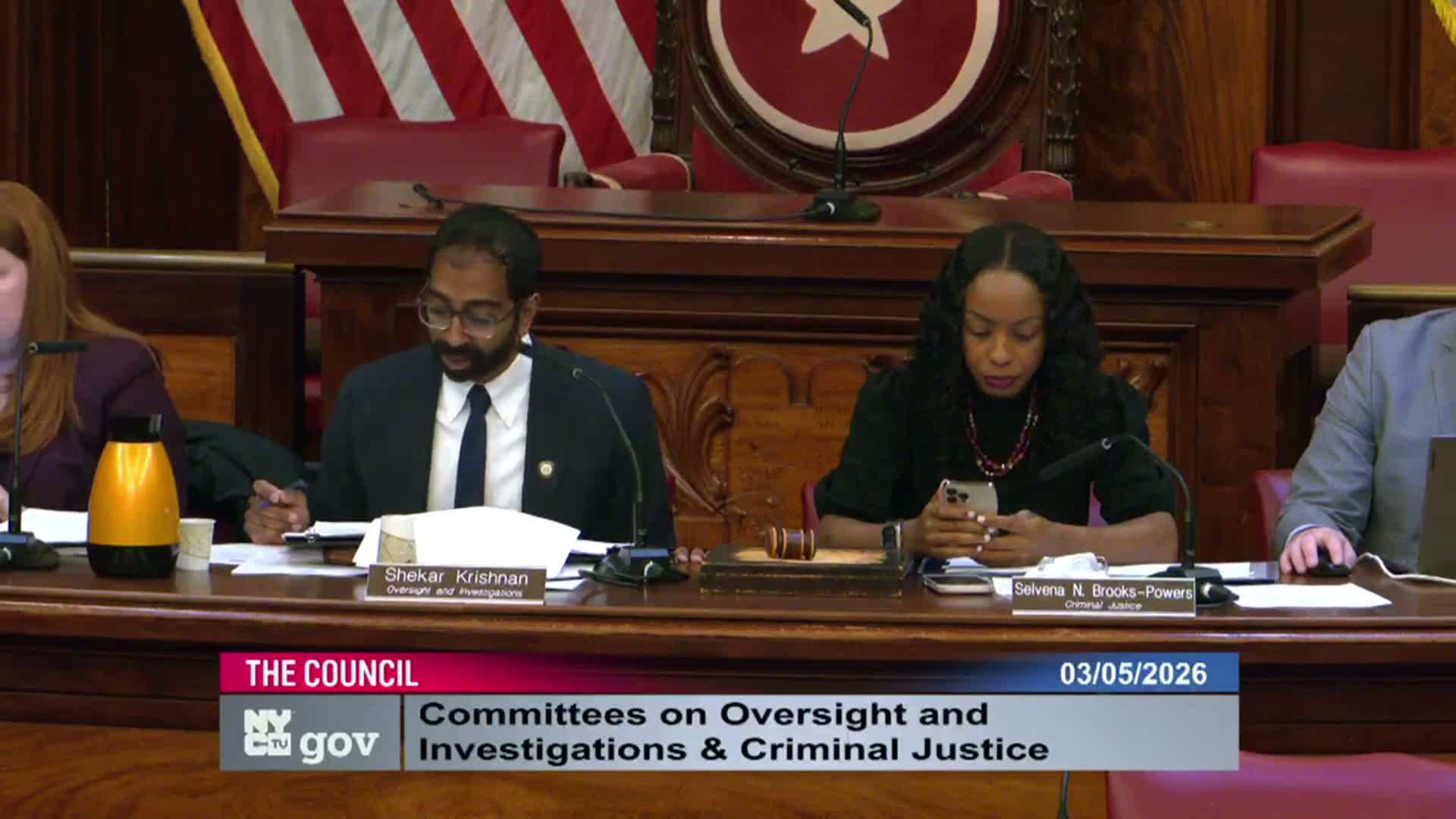
A joint hearing of the New York City Council’s Oversight and Investigations and Criminal Justice committees reviewed Department of Investigation reports that found instances in which city agencies provided information or assistance that could facilitate civil immigration enforcement.
The council convened the hearing to probe DOI’s September and December 2025 reports, hear how the New York City Department of Correction and the New York Police Department have responded, and press DOI on whether the incidents were isolated or indicate broader systemic failures. “This hearing is about reaffirming that our city agencies should be working for New Yorkers, not for ICE,” Council Chair Shekhar Krishnan said in opening remarks.
Acting DOI Commissioner Christopher Ryan told the committees DOI’s investigations substantiated two incidents in which a Department of Correction (DOC) investigator assigned to a federal task force provided information to federal immigration authorities and one instance involving an NYPD officer. DOI recommended seven reforms for each agency, including strengthened training, clearer policies for handling federal requests, and internal audits. Ryan said NYPD accepted all DOI recommendations and had begun policy revisions and training; DOI found DOC accepted four recommendations, implemented two, partially accepted two and continued to consider the remaining recommendation requiring further review.
Deputy Commissioner and General Counsel James Conroy told the council DOC’s longstanding policy is to decline to “honor” detainers (that is, to hold someone beyond their scheduled release) absent a judicial warrant. Conroy also provided DOC data: between July 2024 and June 2025 federal immigration authorities lodged 595 detainers and DOC recorded 19 transfers to federal authorities; calendar-year figures cited by DOC were 403 detainer requests and 18 transfers in 2024 and 895 detainer requests and 25 transfers in 2025.
DOC acknowledged DOI’s finding that a corrections intelligence officer inadvertently provided information used for civil immigration enforcement in two cases and said that shortfalls in training and guidance contributed to the errors. Conroy said the department has implemented in‑person trainings for relevant units, read a departmentwide teletype at roll calls, and begun coordination with federal partners to clarify the department’s legal limits. He described efforts to integrate DOI’s recommendations into audits required by Executive Order 13 and said DOC’s legal division now functions as the primary intake for immigration‑related inquiries.
Members pressed DOI and DOC on the scope and pace of audits. DOI told members the agency recommended targeted audits to discover previously unknown incidents and that DOI and the administration were discussing mechanisms for follow‑up. Several council members pressed that lack of email access among line staff and limits on electronic records at DOC complicate department‑wide email audits and require careful audit design. Conroy acknowledged operational realities—many uniform staff historically lacked email access or individual devices—and said that is why DOC favors targeted reviews and expanded training while working with DOI and the mayor’s office on audit design.
Advocates and legal services groups testified that DOI’s reports reflect longstanding harms to immigrant New Yorkers and urged stronger accountability. They described instances in which people were turned over to ICE without judicial warrants or adequate documentation, and called on the council to enact measures such as the New York City Trust Act. Acting DOI Commissioner Ryan said the reports were intended as an expeditious, substantive response and that audits recommended by DOI were meant to determine whether additional, undiscovered incidents exist.
The hearing did not produce legislative votes. Council members pressed agencies for follow‑up materials, including DOC’s training curricula and a legal explanation of how Administrative Code 9‑131’s provisions on notification and honoring detainers apply. DOI and DOC committed to supplying additional documentation and to continued coordination with the council and the mayor’s office on implementing recommendations.
The committees said they will continue oversight and expect written follow‑up from DOI and DOC on audit plans, training materials, and legal interpretations of detainer‑related requirements.
The council convened the hearing to probe DOI’s September and December 2025 reports, hear how the New York City Department of Correction and the New York Police Department have responded, and press DOI on whether the incidents were isolated or indicate broader systemic failures. “This hearing is about reaffirming that our city agencies should be working for New Yorkers, not for ICE,” Council Chair Shekhar Krishnan said in opening remarks.
Acting DOI Commissioner Christopher Ryan told the committees DOI’s investigations substantiated two incidents in which a Department of Correction (DOC) investigator assigned to a federal task force provided information to federal immigration authorities and one instance involving an NYPD officer. DOI recommended seven reforms for each agency, including strengthened training, clearer policies for handling federal requests, and internal audits. Ryan said NYPD accepted all DOI recommendations and had begun policy revisions and training; DOI found DOC accepted four recommendations, implemented two, partially accepted two and continued to consider the remaining recommendation requiring further review.
Deputy Commissioner and General Counsel James Conroy told the council DOC’s longstanding policy is to decline to “honor” detainers (that is, to hold someone beyond their scheduled release) absent a judicial warrant. Conroy also provided DOC data: between July 2024 and June 2025 federal immigration authorities lodged 595 detainers and DOC recorded 19 transfers to federal authorities; calendar-year figures cited by DOC were 403 detainer requests and 18 transfers in 2024 and 895 detainer requests and 25 transfers in 2025.
DOC acknowledged DOI’s finding that a corrections intelligence officer inadvertently provided information used for civil immigration enforcement in two cases and said that shortfalls in training and guidance contributed to the errors. Conroy said the department has implemented in‑person trainings for relevant units, read a departmentwide teletype at roll calls, and begun coordination with federal partners to clarify the department’s legal limits. He described efforts to integrate DOI’s recommendations into audits required by Executive Order 13 and said DOC’s legal division now functions as the primary intake for immigration‑related inquiries.
Members pressed DOI and DOC on the scope and pace of audits. DOI told members the agency recommended targeted audits to discover previously unknown incidents and that DOI and the administration were discussing mechanisms for follow‑up. Several council members pressed that lack of email access among line staff and limits on electronic records at DOC complicate department‑wide email audits and require careful audit design. Conroy acknowledged operational realities—many uniform staff historically lacked email access or individual devices—and said that is why DOC favors targeted reviews and expanded training while working with DOI and the mayor’s office on audit design.
Advocates and legal services groups testified that DOI’s reports reflect longstanding harms to immigrant New Yorkers and urged stronger accountability. They described instances in which people were turned over to ICE without judicial warrants or adequate documentation, and called on the council to enact measures such as the New York City Trust Act. Acting DOI Commissioner Ryan said the reports were intended as an expeditious, substantive response and that audits recommended by DOI were meant to determine whether additional, undiscovered incidents exist.
The hearing did not produce legislative votes. Council members pressed agencies for follow‑up materials, including DOC’s training curricula and a legal explanation of how Administrative Code 9‑131’s provisions on notification and honoring detainers apply. DOI and DOC committed to supplying additional documentation and to continued coordination with the council and the mayor’s office on implementing recommendations.
The committees said they will continue oversight and expect written follow‑up from DOI and DOC on audit plans, training materials, and legal interpretations of detainer‑related requirements.
View the Full Meeting & All Its Details
This article offers just a summary. Unlock complete video, transcripts, and insights as a Founder Member.
✓
Watch full, unedited meeting videos
✓
Search every word spoken in unlimited transcripts
✓
AI summaries & real-time alerts (all government levels)
✓
Permanent access to expanding government content
30-day money-back guarantee
