Virginia House advances dozens of bills; nine revenue measures moved toward conference
March 04, 2026 | 2026 Legislature VA, Virginia
This article was created by AI summarizing key points discussed. AI makes mistakes, so for full details and context, please refer to the video of the full meeting. Please report any errors so we can fix them. Report an error »
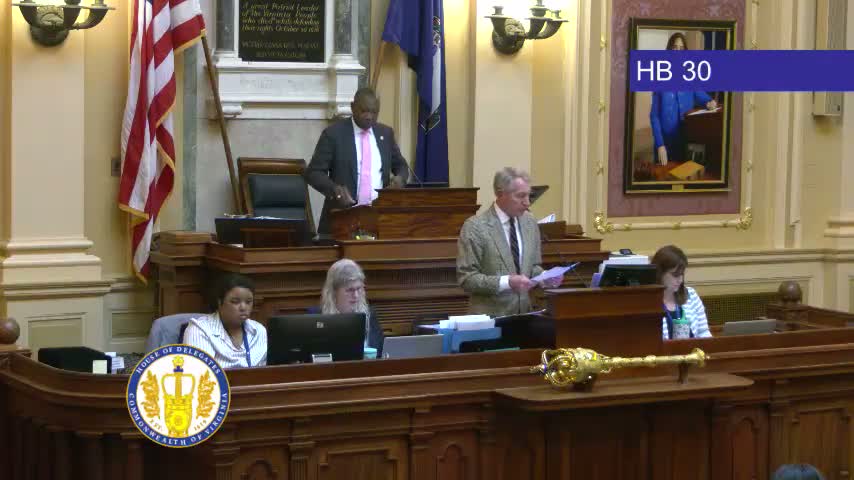
The Virginia House of Delegates spent the afternoon of March 4, 2026, processing more than three dozen house bills returned with senate amendments and a nine‑bill supplemental calendar that includes the biannual budget bill.
The session opened with a procedural motion to reconsider action on Senate Bill 454; the House agreed to reconsider and then referred SB 454 to the Committee on Counties, Cities, and Towns. Shortly after, two uncontested house bills on the second-reading calendar — HB 1530 and HB 1531, both described by a sponsor as MEI commission-approved economic development projects — were engrossed and passed on third reading.
Much of the meeting proceeded as a sequential review of house bills amended by the Senate. For several bills the House adopted senate substitutes (for example, the clerk announced adoption of the senate substitute for HB 40, which addresses unserialized plastic firearms, by recorded tally 64–32). Other bills saw the House reject senate substitutes, preserving the House original for conference (for example, the clerk announced rejection of the senate substitute for HB 19, the dating‑partner cognate, and for HB 75, concerning medical cannabis for terminal patients).
Notable actions included adoption of a senate amendment to HB 82 to move the deadline for receiving absentee ballots to 5 p.m. on the third day after an election; acceptance of a senate substitute for HB 521 that codifies a “no‑net‑loss” wetlands standard and establishes a wetlands work group; and adoption of a senate amendment to HB 1165 setting an effective date of July 1, 2026, for superintendent qualification regulation changes. The House also adopted a senate amendment to HB 690 addressing procedures for search warrants and temporary sealing of affidavits.
The supplemental calendar—Supplemental Calendar No. 1—contains nine bills that the clerk identified as revenue or budget bills affected by the deadline, including HB 30 (the biannual budget bill). The clerk and several sponsors urged members to reject certain senate amendments and send items to conference so they can be negotiated; in recorded voice tallies the House rejected multiple senate amendments on the supplemental calendar, including senate amendments to HB 30, and proceeded to communicate those results to the Senate. Clerks noted any bill on the revenue list must be put into conference or it will die under the procedural resolution.
After finishing the supplemental calendar, the House voted to recess until 5:30 p.m. to allow the Committee on Appropriations and subcommittees to meet and for conferees to be named.
What happened next: conferees are expected to be named and the House and Senate will meet in conference on the revenue and budget bills. The clerk said the Senate was in recess until 5:30 p.m.; the House recessed to make its communications and appoint conferees.
The session opened with a procedural motion to reconsider action on Senate Bill 454; the House agreed to reconsider and then referred SB 454 to the Committee on Counties, Cities, and Towns. Shortly after, two uncontested house bills on the second-reading calendar — HB 1530 and HB 1531, both described by a sponsor as MEI commission-approved economic development projects — were engrossed and passed on third reading.
Much of the meeting proceeded as a sequential review of house bills amended by the Senate. For several bills the House adopted senate substitutes (for example, the clerk announced adoption of the senate substitute for HB 40, which addresses unserialized plastic firearms, by recorded tally 64–32). Other bills saw the House reject senate substitutes, preserving the House original for conference (for example, the clerk announced rejection of the senate substitute for HB 19, the dating‑partner cognate, and for HB 75, concerning medical cannabis for terminal patients).
Notable actions included adoption of a senate amendment to HB 82 to move the deadline for receiving absentee ballots to 5 p.m. on the third day after an election; acceptance of a senate substitute for HB 521 that codifies a “no‑net‑loss” wetlands standard and establishes a wetlands work group; and adoption of a senate amendment to HB 1165 setting an effective date of July 1, 2026, for superintendent qualification regulation changes. The House also adopted a senate amendment to HB 690 addressing procedures for search warrants and temporary sealing of affidavits.
The supplemental calendar—Supplemental Calendar No. 1—contains nine bills that the clerk identified as revenue or budget bills affected by the deadline, including HB 30 (the biannual budget bill). The clerk and several sponsors urged members to reject certain senate amendments and send items to conference so they can be negotiated; in recorded voice tallies the House rejected multiple senate amendments on the supplemental calendar, including senate amendments to HB 30, and proceeded to communicate those results to the Senate. Clerks noted any bill on the revenue list must be put into conference or it will die under the procedural resolution.
After finishing the supplemental calendar, the House voted to recess until 5:30 p.m. to allow the Committee on Appropriations and subcommittees to meet and for conferees to be named.
What happened next: conferees are expected to be named and the House and Senate will meet in conference on the revenue and budget bills. The clerk said the Senate was in recess until 5:30 p.m.; the House recessed to make its communications and appoint conferees.
View the Full Meeting & All Its Details
This article offers just a summary. Unlock complete video, transcripts, and insights as a Founder Member.
✓
Watch full, unedited meeting videos
✓
Search every word spoken in unlimited transcripts
✓
AI summaries & real-time alerts (all government levels)
✓
Permanent access to expanding government content
30-day money-back guarantee
