Task force: residential tax exemption reaches target households but is inefficient; renters may be left out
March 05, 2026 | Concord Public Schools/Concord-Carlisle Regional District, School Boards, Massachusetts
This article was created by AI summarizing key points discussed. AI makes mistakes, so for full details and context, please refer to the video of the full meeting. Please report any errors so we can fix them. Report an error »
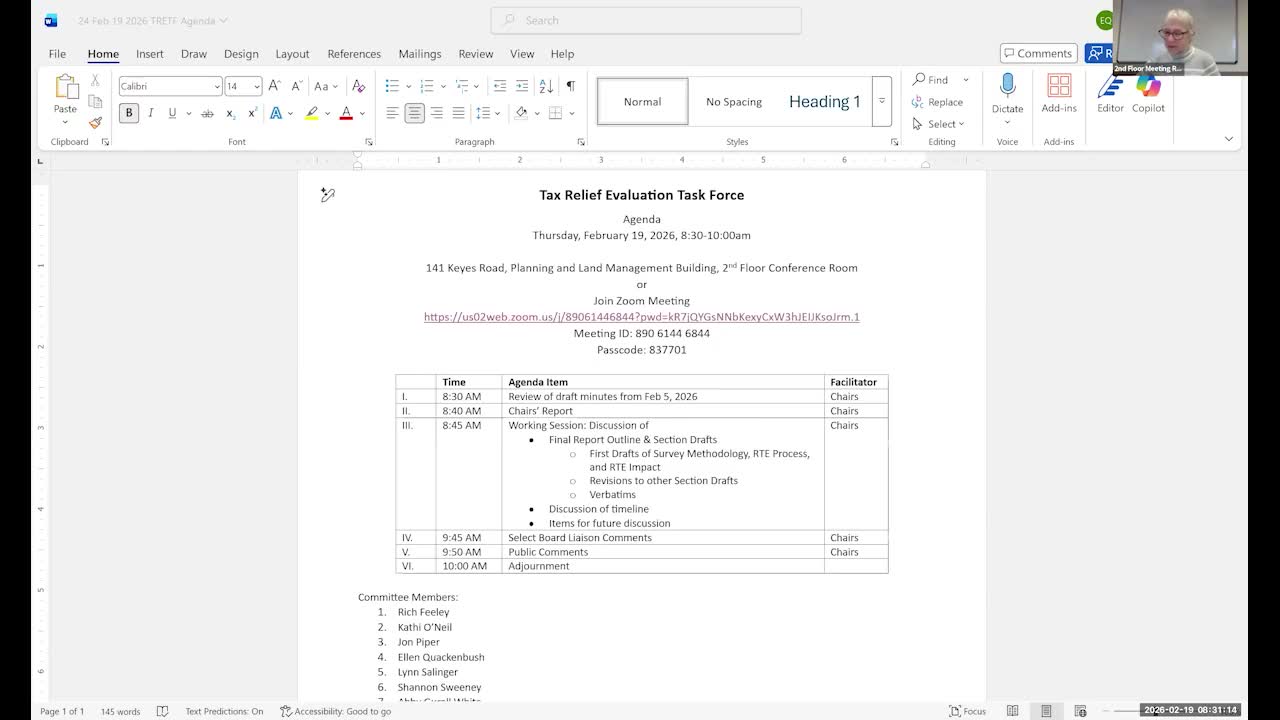
The Tax Relief Evaluation Task Force said its draft analysis shows the town’s Residential Tax Exemption (RTE) succeeds at directing relief to its target group but is inefficient in distribution and leaves renters largely unserved.
The chair said the analysis shows the RTE “is effective at reaching the target … 95%,” but that “55% of the people who get a tax reduction” have household incomes above the draft $150,000 threshold, a pattern members described as inefficient. Chair (meeting lead) attributed those numbers to the task force’s survey-driven model and the assessor’s valuation data.
Lynn, who presented the draft outline and analytic approach, said the report will include an executive summary, a methods appendix and separate sections for interview verbatims and survey analytics. Lynn also reported the team used an automated tool to screen open‑ended responses: “I was brave enough to use ChatGPT to upload an Excel sheet and ask it to analyze the qualitative answers we got, you know, over 900 lines.” Several members cautioned that qualitative verbatims and open‑ended responses should not be conveyed solely as percentages.
The task force discussed per‑unit impacts on rental housing. Ellen (presentation lead) walked the committee through a table estimating average assessed value by rental category and an example per‑unit tax increase of roughly $200 for large apartment complexes, rising to as much as $800 for higher‑assessed rented homes. Members flagged explanatory math and denominator issues in Ellen’s examples, and she agreed to correct and re‑document the spreadsheet.
On the program’s cost distribution, presenters said the assessor calculated a tax shift of about $3,200,000 caused by exemptions granted in the last classification cycle. Members asked who pays that shift and whether landlords would pass increases along to renters; the group concluded the effect on tenants is unclear and recommended targeted outreach and interviews with landlords. One idea discussed was a small pilot (capped intake) to test whether landlords would accept commitments to rent units at affordable rates in exchange for incentives.
The committee agreed to run sensitivity scenarios—e.g., adding 500–1,000 additional qualifying applicants—to show how increased uptake would change the RTE breakeven point and tax rate shift. Members stressed the need to show clearly which population each chart describes (income versus assessed value) and to document all methodological caveats, including that income and assessment are self‑reported in parts of the model.
Next steps include producing an integrated draft with corrected calculations, a methods appendix describing survey representativeness, and sensitivity runs for the next meeting. The task force set follow‑ups for further landlord outreach and recommended Meredith (assessor) be asked to review the integrated draft before publication.
The task force did not take any final policy votes on the RTE at the meeting; work will continue on data corrections, outreach planning and scenario modeling.
The chair said the analysis shows the RTE “is effective at reaching the target … 95%,” but that “55% of the people who get a tax reduction” have household incomes above the draft $150,000 threshold, a pattern members described as inefficient. Chair (meeting lead) attributed those numbers to the task force’s survey-driven model and the assessor’s valuation data.
Lynn, who presented the draft outline and analytic approach, said the report will include an executive summary, a methods appendix and separate sections for interview verbatims and survey analytics. Lynn also reported the team used an automated tool to screen open‑ended responses: “I was brave enough to use ChatGPT to upload an Excel sheet and ask it to analyze the qualitative answers we got, you know, over 900 lines.” Several members cautioned that qualitative verbatims and open‑ended responses should not be conveyed solely as percentages.
The task force discussed per‑unit impacts on rental housing. Ellen (presentation lead) walked the committee through a table estimating average assessed value by rental category and an example per‑unit tax increase of roughly $200 for large apartment complexes, rising to as much as $800 for higher‑assessed rented homes. Members flagged explanatory math and denominator issues in Ellen’s examples, and she agreed to correct and re‑document the spreadsheet.
On the program’s cost distribution, presenters said the assessor calculated a tax shift of about $3,200,000 caused by exemptions granted in the last classification cycle. Members asked who pays that shift and whether landlords would pass increases along to renters; the group concluded the effect on tenants is unclear and recommended targeted outreach and interviews with landlords. One idea discussed was a small pilot (capped intake) to test whether landlords would accept commitments to rent units at affordable rates in exchange for incentives.
The committee agreed to run sensitivity scenarios—e.g., adding 500–1,000 additional qualifying applicants—to show how increased uptake would change the RTE breakeven point and tax rate shift. Members stressed the need to show clearly which population each chart describes (income versus assessed value) and to document all methodological caveats, including that income and assessment are self‑reported in parts of the model.
Next steps include producing an integrated draft with corrected calculations, a methods appendix describing survey representativeness, and sensitivity runs for the next meeting. The task force set follow‑ups for further landlord outreach and recommended Meredith (assessor) be asked to review the integrated draft before publication.
The task force did not take any final policy votes on the RTE at the meeting; work will continue on data corrections, outreach planning and scenario modeling.
View the Full Meeting & All Its Details
This article offers just a summary. Unlock complete video, transcripts, and insights as a Founder Member.
✓
Watch full, unedited meeting videos
✓
Search every word spoken in unlimited transcripts
✓
AI summaries & real-time alerts (all government levels)
✓
Permanent access to expanding government content
30-day money-back guarantee
