Design council approves Chris Papan riverfront glass mural with condition on four‑pointed star
March 05, 2026 | Wichita City, Sedgwick County, Kansas
This article was created by AI summarizing key points discussed. AI makes mistakes, so for full details and context, please refer to the video of the full meeting. Please report any errors so we can fix them. Report an error »
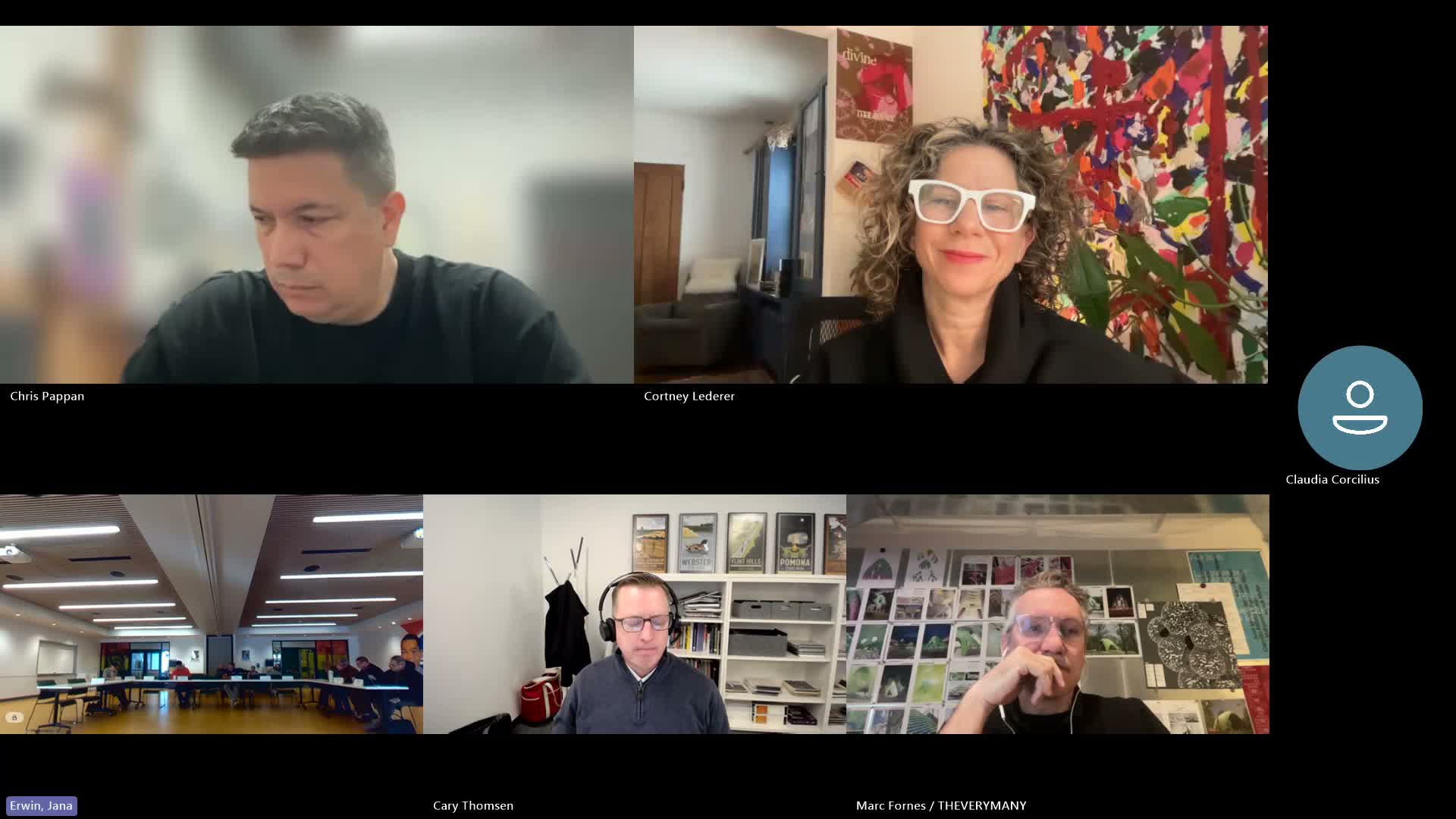
The Wichita City design council on Monday approved a 90% design for three glass-panel public artworks by artist Chris Papan along the Arkansas River, but asked Papan to change a four‑pointed star element so it will not be mistaken for a medical symbol.
Courtney Lederer, the project's art consultant, introduced the package and said the works aim to "enhance the aesthetics and character of the riverfront, create a unique and memorable experience for visitors, foster a sense of community in place, reflect the natural and cultural heritage of Wichita, be durable, safe, and low maintenance." Lederer then turned the presentation over to Papan.
Papan told the council the largest wall is about 13 feet high and will use three glass panels (the central panel roughly 10.5 feet by 5.5 feet) with imagery printed and baked directly onto the glass. He said the design draws on a vintage 1940s aeronautical map showing early Kaw (Kanza) reservation boundaries and portraits of Kanza delegates, and that the project includes a commissioned poem titled "Nikashinga, Yega, Wakan, and You." "I want this work to instill pride in the local indigenous and non‑indigenous community," Papan said, and described plans for indigenous medicinal plants beneath the murals.
Council members questioned fabrication, mounting and lighting details. Papan explained a standoff mounting system to accommodate an uneven limestone veneer and confirmed the panels would be ceramic‑printed and baked (not laminated between two sheets of glass), reducing weight. He also said local installers and fabricators who worked on other Wichita projects will be used for installation and lighting.
A council member raised concern about a red four‑pointed star in the designs, saying illuminated in red it could be read as a medical or emergency symbol and draw focus from the artwork. Papan replied that the motif is a traditional four‑pointed star in indigenous design but agreed to adjust either the color or the shape to reduce that association. "I can totally do that," he said.
After discussion, a council member moved to approve the 90% design "as presented with the exception of the four‑pointed star being modified either by color and/or shape." The motion was seconded and the council approved the design unanimously, with the condition that Papan circulate the updated rendering to council members when the revision is available.
Next steps include finalizing the modified star design and sharing the updated images with council members before the project proceeds to full construction. The council did not set a new formal review date for the revised artwork in the meeting record.
Courtney Lederer, the project's art consultant, introduced the package and said the works aim to "enhance the aesthetics and character of the riverfront, create a unique and memorable experience for visitors, foster a sense of community in place, reflect the natural and cultural heritage of Wichita, be durable, safe, and low maintenance." Lederer then turned the presentation over to Papan.
Papan told the council the largest wall is about 13 feet high and will use three glass panels (the central panel roughly 10.5 feet by 5.5 feet) with imagery printed and baked directly onto the glass. He said the design draws on a vintage 1940s aeronautical map showing early Kaw (Kanza) reservation boundaries and portraits of Kanza delegates, and that the project includes a commissioned poem titled "Nikashinga, Yega, Wakan, and You." "I want this work to instill pride in the local indigenous and non‑indigenous community," Papan said, and described plans for indigenous medicinal plants beneath the murals.
Council members questioned fabrication, mounting and lighting details. Papan explained a standoff mounting system to accommodate an uneven limestone veneer and confirmed the panels would be ceramic‑printed and baked (not laminated between two sheets of glass), reducing weight. He also said local installers and fabricators who worked on other Wichita projects will be used for installation and lighting.
A council member raised concern about a red four‑pointed star in the designs, saying illuminated in red it could be read as a medical or emergency symbol and draw focus from the artwork. Papan replied that the motif is a traditional four‑pointed star in indigenous design but agreed to adjust either the color or the shape to reduce that association. "I can totally do that," he said.
After discussion, a council member moved to approve the 90% design "as presented with the exception of the four‑pointed star being modified either by color and/or shape." The motion was seconded and the council approved the design unanimously, with the condition that Papan circulate the updated rendering to council members when the revision is available.
Next steps include finalizing the modified star design and sharing the updated images with council members before the project proceeds to full construction. The council did not set a new formal review date for the revised artwork in the meeting record.
Don't Miss a Word: See the Full Meeting!
Go beyond summaries. Unlock every video, transcript, and key insight with a Founder Membership.
✓
Get instant access to full meeting videos
✓
Search and clip any phrase from complete transcripts
✓
Receive AI-powered summaries & custom alerts
✓
Enjoy lifetime, unrestricted access to government data
30-day money-back guarantee
