Assigned attorney trains task force on open meetings, ex parte rules and CORA
March 06, 2026 | Public Utilities Commission, Governor's Boards and Commissions, Organizations, Executive, Colorado
This article was created by AI summarizing key points discussed. AI makes mistakes, so for full details and context, please refer to the video of the full meeting. Please report any errors so we can fix them. Report an error »
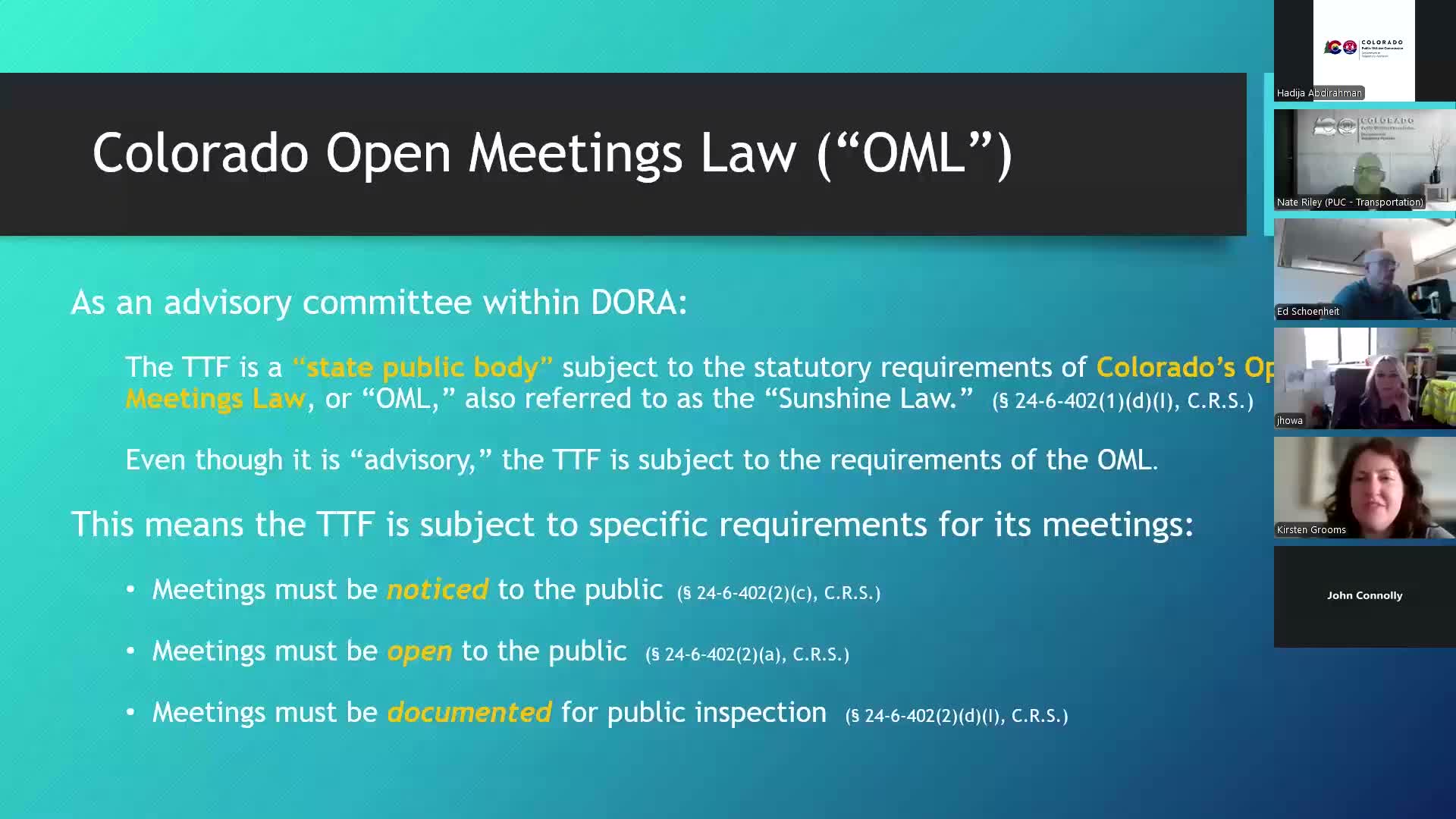
Kirsten Grooms, the Public Utilities Commission’s assigned attorney for the towing task force, provided legal training on Feb. 25 covering Colorado open meetings law, ex parte communications, conflicts of interest and the Colorado Open Records Act (CORA).
Grooms told members that, even as an advisory body, the task force is considered a state public body subject to open meetings requirements: meetings must be noticed to the public, open to the public when required, and documented in minutes. She reminded members that executive sessions are an exception limited to specific matters, such as conferrals with counsel about pending or imminent litigation.
On ex parte communications she explained that one-sided communications with decisionmakers can prejudice other parties and that PUC commissioners and staff are prohibited from ex parte communications on disputed facts in ongoing cases. "If it feels icky, it might be icky," Grooms said, advising members to err on the side of disclosure.
Grooms also described conflict-of-interest rules for unpaid public bodies (citing CRS 24-18-108.5) and the need to disclose direct financial or material interests that may affect a member's participation. Regarding CORA, she warned that virtually any writing maintained by the agency—emails, calendars, voice mails or notes—may be subject to public inspection and asked members to forward any records requests immediately to staff. She noted the office has a 72-hour turnaround window for initial responses on records requests.
Members had no immediate legal questions and were encouraged to contact Grooms by email for follow-up. The counseling was presented as best-practice guidance for future task force deliberations rather than a change in duty or formal rulemaking.
Grooms told members that, even as an advisory body, the task force is considered a state public body subject to open meetings requirements: meetings must be noticed to the public, open to the public when required, and documented in minutes. She reminded members that executive sessions are an exception limited to specific matters, such as conferrals with counsel about pending or imminent litigation.
On ex parte communications she explained that one-sided communications with decisionmakers can prejudice other parties and that PUC commissioners and staff are prohibited from ex parte communications on disputed facts in ongoing cases. "If it feels icky, it might be icky," Grooms said, advising members to err on the side of disclosure.
Grooms also described conflict-of-interest rules for unpaid public bodies (citing CRS 24-18-108.5) and the need to disclose direct financial or material interests that may affect a member's participation. Regarding CORA, she warned that virtually any writing maintained by the agency—emails, calendars, voice mails or notes—may be subject to public inspection and asked members to forward any records requests immediately to staff. She noted the office has a 72-hour turnaround window for initial responses on records requests.
Members had no immediate legal questions and were encouraged to contact Grooms by email for follow-up. The counseling was presented as best-practice guidance for future task force deliberations rather than a change in duty or formal rulemaking.
View the Full Meeting & All Its Details
This article offers just a summary. Unlock complete video, transcripts, and insights as a Founder Member.
✓
Watch full, unedited meeting videos
✓
Search every word spoken in unlimited transcripts
✓
AI summaries & real-time alerts (all government levels)
✓
Permanent access to expanding government content
30-day money-back guarantee
