Madison residents urge safer street design after pedestrian death, citing Park and South Park corridors
March 05, 2026 | Madison, Dane County, Wisconsin
This article was created by AI summarizing key points discussed. AI makes mistakes, so for full details and context, please refer to the video of the full meeting. Please report any errors so we can fix them. Report an error »
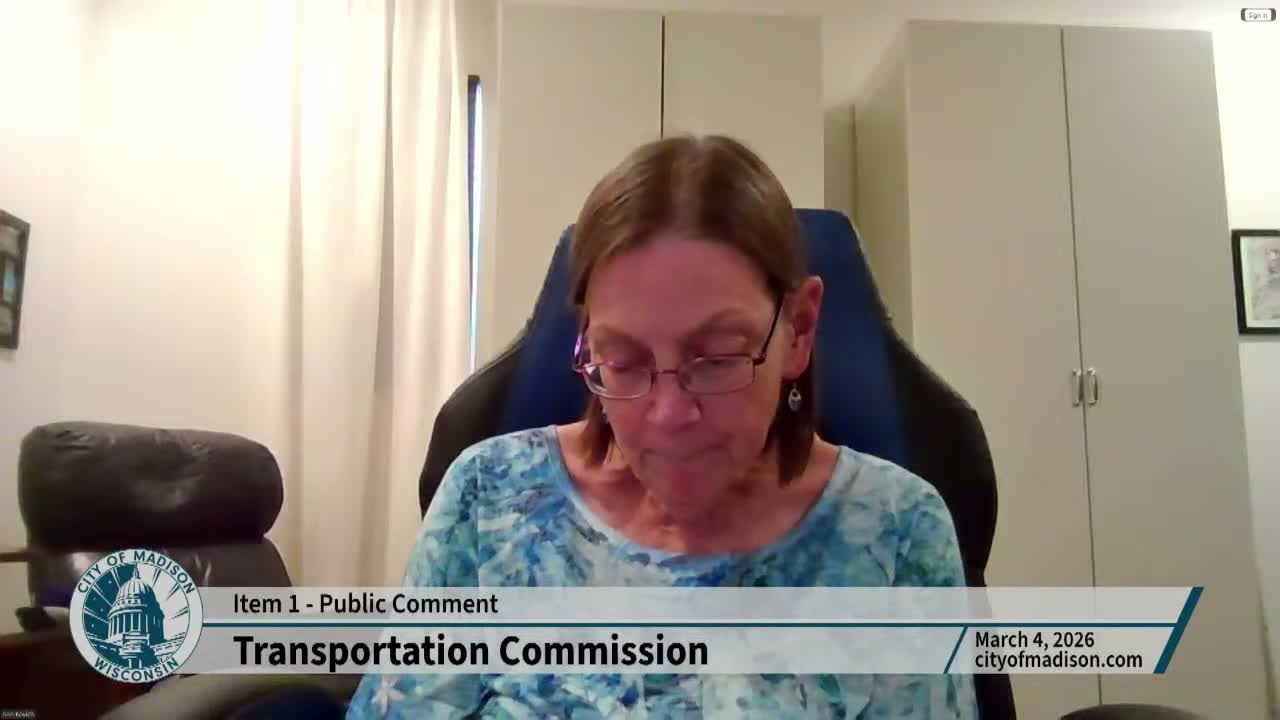
Residents told the Madison Transportation Commission on March 4 that the city needs faster, design-focused action after the fatal pedestrian crash at Burr Oak and South Park.
During the public-comment portion, Sage Gullen Gullenor described the family and neighborhood impact of Sasha Rosen's death and said the intersection has had "5 accidents in 5 years," including multiple serious collisions in 2026. "Where Sasha died at the intersection of Burr Oak and South Park, there have been 5 accidents in 5 years," Gullenor said, arguing the corridor should no longer function as an arterial thoroughfare.
Another registrant, Steph Bugash, who identified herself as a Madison resident and public-health professional, said she crosses Park Street daily and described repeated failures by motorists to stop for a flashing beacon: "I think that the flashing beacon is not enough...if you design the road to be able to go 50, people will go 50." She urged the commission and staff to favor physical traffic-calming measures—bump-outs, lower design speeds and lane reductions—over signs or speed displays.
A third commenter, Alexandre Manot, asked why the city has not pursued citywide speed reductions, noting Paris's recent 19 mph policy and saying the Commission's duty is to improve safety even when measures are unpopular.
Why this matters: speakers connected the recent fatality to a pattern of speeding and risky behavior and repeatedly framed the issue as a design problem (how the street is built and prioritized) rather than an enforcement-only problem. Multiple speakers cited the city's Vision Zero goal and told commissioners the preferred path is to design for the speed and mode priorities the city wants to see in neighborhoods.
What the Commission heard from staff and members: Chair and staff thanked commenters and acknowledged the public's grief; commissioners asked no formal motions during the public-comment segment. Separately in the meeting staff confirmed Park Street is scheduled for redesign work and acknowledged the need to re-examine crossing treatments and traffic calming in the short term.
Next steps: Commissioners directed staff to continue pedestrian-first design work in upcoming projects and to bring forward candidate short-term safety fixes for high-risk crossings while advancing longer-term redesign efforts.
During the public-comment portion, Sage Gullen Gullenor described the family and neighborhood impact of Sasha Rosen's death and said the intersection has had "5 accidents in 5 years," including multiple serious collisions in 2026. "Where Sasha died at the intersection of Burr Oak and South Park, there have been 5 accidents in 5 years," Gullenor said, arguing the corridor should no longer function as an arterial thoroughfare.
Another registrant, Steph Bugash, who identified herself as a Madison resident and public-health professional, said she crosses Park Street daily and described repeated failures by motorists to stop for a flashing beacon: "I think that the flashing beacon is not enough...if you design the road to be able to go 50, people will go 50." She urged the commission and staff to favor physical traffic-calming measures—bump-outs, lower design speeds and lane reductions—over signs or speed displays.
A third commenter, Alexandre Manot, asked why the city has not pursued citywide speed reductions, noting Paris's recent 19 mph policy and saying the Commission's duty is to improve safety even when measures are unpopular.
Why this matters: speakers connected the recent fatality to a pattern of speeding and risky behavior and repeatedly framed the issue as a design problem (how the street is built and prioritized) rather than an enforcement-only problem. Multiple speakers cited the city's Vision Zero goal and told commissioners the preferred path is to design for the speed and mode priorities the city wants to see in neighborhoods.
What the Commission heard from staff and members: Chair and staff thanked commenters and acknowledged the public's grief; commissioners asked no formal motions during the public-comment segment. Separately in the meeting staff confirmed Park Street is scheduled for redesign work and acknowledged the need to re-examine crossing treatments and traffic calming in the short term.
Next steps: Commissioners directed staff to continue pedestrian-first design work in upcoming projects and to bring forward candidate short-term safety fixes for high-risk crossings while advancing longer-term redesign efforts.
View the Full Meeting & All Its Details
This article offers just a summary. Unlock complete video, transcripts, and insights as a Founder Member.
✓
Watch full, unedited meeting videos
✓
Search every word spoken in unlimited transcripts
✓
AI summaries & real-time alerts (all government levels)
✓
Permanent access to expanding government content
30-day money-back guarantee
