Residents press planners over data-center rezoning as Columbia County commission recommends approval
March 05, 2026 | Columbia County, Georgia
This article was created by AI summarizing key points discussed. AI makes mistakes, so for full details and context, please refer to the video of the full meeting. Please report any errors so we can fix them. Report an error »
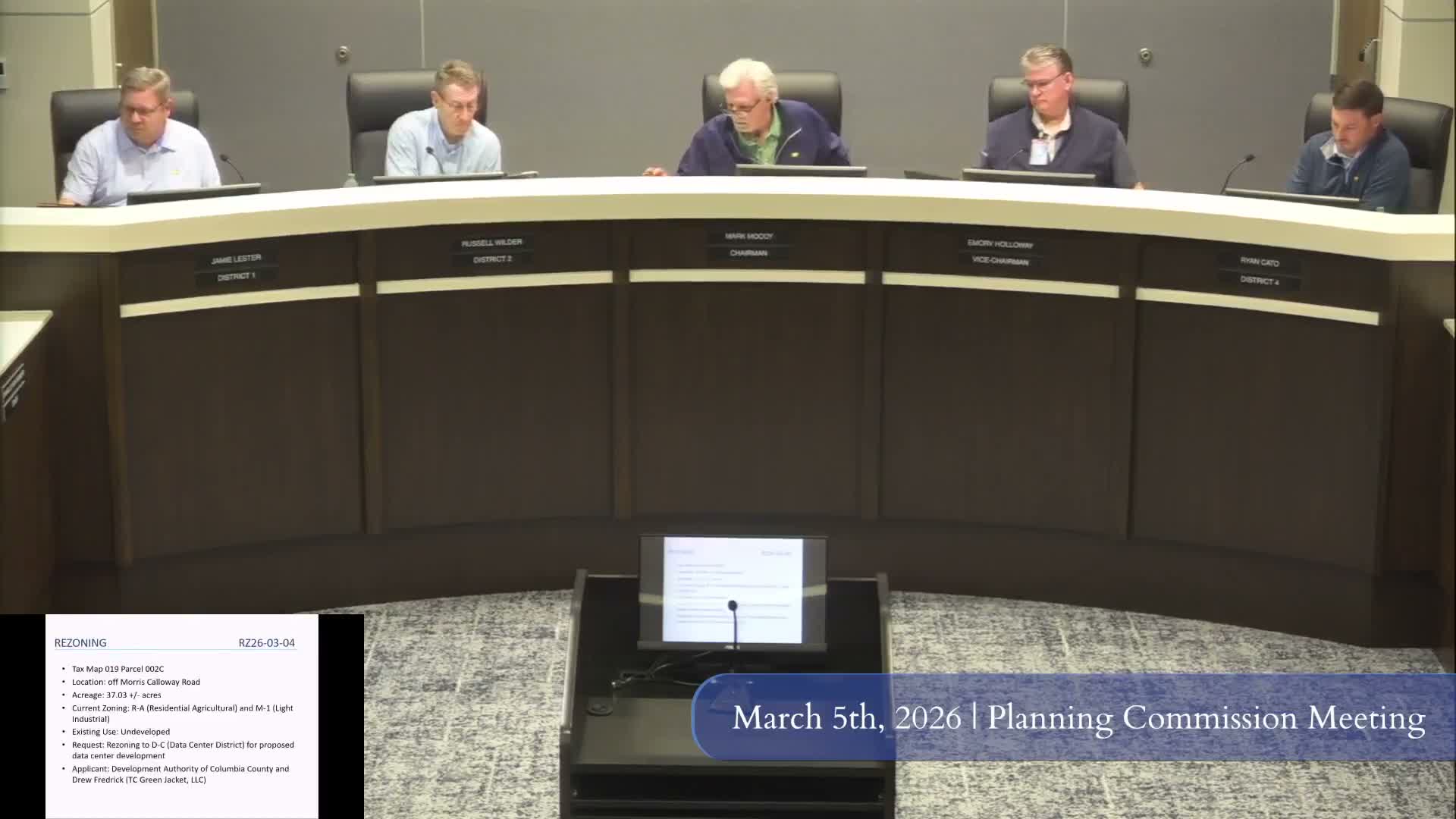
A re-advertised rezoning aimed at allowing a data-center at the White Oak Technology Park off Morris Callaway Road drew extended public scrutiny Wednesday night, but the Columbia County Planning Commission recommended the measure to the Board of Commissioners.
Planner Will presented the county's staff recommendation to rezone the parcel (tax map 019 Partial 002 C) from RA and M-1 to DC to allow data-center development as part of the White Oak Technology Park. Will said the parcel was part of a larger package previously considered and that staff supports rezoning the site to fit the surrounding technology/industrial character and existing DC zoning nearby.
Multiple residents spoke against or sought clarification before the vote. Vin Mueller, who gave his address in the record, pressed the commission on several technical and process points: he highlighted an apparent discrepancy between noise thresholds in the rezoning narrative and the DC ordinance (citing 70 decibels vs. 65 decibels in conditions), asked whether construction-phase traffic studies have been done given estimates of thousands of construction workers, and sought clarity on buildout timelines (public materials cited 15–20 years while a county official was reported to have said five years). "There is a big discrepancy between 5 years and 15 to 20 years, and that impacts both the traffic congestion and the tax benefits that we have been promised," Mueller said.
Mueller also raised water concerns and geothermal drilling, asking the county to be explicit about whether private wells would be used and whether geothermal drilling would be permitted. "Geothermal technology requires drilling and fracking of the ground in order to make it work," he said, adding he wants assurances that groundwater and cooling methods will not harm neighbors.
A representative of the Development Authority, Chaney Eldridge, said the project is part of a broader effort to recruit technology uses and that some development materials outlining intent and concept plans are included in the application narrative. Jonathan Aceves, representing private developers for other items earlier in the meeting, described typical developer commitments to extend sewer when needed; for this parcel, Will said staff expects applicants to resolve sewer and stormwater matters through standard engineering reviews.
County staff answered several procedural questions: Will and other planners said the conditions attached to the rezoning — including noise limits and stormwater requirements — would control operational impacts, stormwater will be reviewed by the county's stormwater division as part of engineered site plans, and construction-phase traffic has not been studied for the project at this stage. The record also shows public concern about tax incentives and abatements; documents and presentations referenced tax-abate or incentive discussions but the commission noted that the Board of Commissioners has stated publicly that full property taxes would be paid on these properties.
After discussion and questions, a commissioner moved to recommend approval of RZ260304 with conditions; the motion passed on a voice vote. The planning commission's recommendation now goes to the Columbia County Board of Commissioners, which will take final action at its March 17 meeting.
The record shows the principal outstanding public requests: a clear construction-phase traffic analysis, precise and authoritative documentation of expected buildout timelines, explicit explanations of water-supply and cooling strategies (and whether geothermal drilling would be used), clarification on any incentive discussions, and the engineering-level stormwater detention plan that will be required before building permits are issued. The next procedural step is the Board of Commissioners hearing on March 17, 2026, where the county will consider the commission's recommendation and any additional materials submitted by applicants.
Planner Will presented the county's staff recommendation to rezone the parcel (tax map 019 Partial 002 C) from RA and M-1 to DC to allow data-center development as part of the White Oak Technology Park. Will said the parcel was part of a larger package previously considered and that staff supports rezoning the site to fit the surrounding technology/industrial character and existing DC zoning nearby.
Multiple residents spoke against or sought clarification before the vote. Vin Mueller, who gave his address in the record, pressed the commission on several technical and process points: he highlighted an apparent discrepancy between noise thresholds in the rezoning narrative and the DC ordinance (citing 70 decibels vs. 65 decibels in conditions), asked whether construction-phase traffic studies have been done given estimates of thousands of construction workers, and sought clarity on buildout timelines (public materials cited 15–20 years while a county official was reported to have said five years). "There is a big discrepancy between 5 years and 15 to 20 years, and that impacts both the traffic congestion and the tax benefits that we have been promised," Mueller said.
Mueller also raised water concerns and geothermal drilling, asking the county to be explicit about whether private wells would be used and whether geothermal drilling would be permitted. "Geothermal technology requires drilling and fracking of the ground in order to make it work," he said, adding he wants assurances that groundwater and cooling methods will not harm neighbors.
A representative of the Development Authority, Chaney Eldridge, said the project is part of a broader effort to recruit technology uses and that some development materials outlining intent and concept plans are included in the application narrative. Jonathan Aceves, representing private developers for other items earlier in the meeting, described typical developer commitments to extend sewer when needed; for this parcel, Will said staff expects applicants to resolve sewer and stormwater matters through standard engineering reviews.
County staff answered several procedural questions: Will and other planners said the conditions attached to the rezoning — including noise limits and stormwater requirements — would control operational impacts, stormwater will be reviewed by the county's stormwater division as part of engineered site plans, and construction-phase traffic has not been studied for the project at this stage. The record also shows public concern about tax incentives and abatements; documents and presentations referenced tax-abate or incentive discussions but the commission noted that the Board of Commissioners has stated publicly that full property taxes would be paid on these properties.
After discussion and questions, a commissioner moved to recommend approval of RZ260304 with conditions; the motion passed on a voice vote. The planning commission's recommendation now goes to the Columbia County Board of Commissioners, which will take final action at its March 17 meeting.
The record shows the principal outstanding public requests: a clear construction-phase traffic analysis, precise and authoritative documentation of expected buildout timelines, explicit explanations of water-supply and cooling strategies (and whether geothermal drilling would be used), clarification on any incentive discussions, and the engineering-level stormwater detention plan that will be required before building permits are issued. The next procedural step is the Board of Commissioners hearing on March 17, 2026, where the county will consider the commission's recommendation and any additional materials submitted by applicants.
Don't Miss a Word: See the Full Meeting!
Go beyond summaries. Unlock every video, transcript, and key insight with a Founder Membership.
✓
Get instant access to full meeting videos
✓
Search and clip any phrase from complete transcripts
✓
Receive AI-powered summaries & custom alerts
✓
Enjoy lifetime, unrestricted access to government data
30-day money-back guarantee
