Housing committee advances tenant‑organizing bill after amendment limiting outside organizers
March 05, 2026 | Housing, House of Representatives, Committees, Legislative, Connecticut
This article was created by AI summarizing key points discussed. AI makes mistakes, so for full details and context, please refer to the video of the full meeting. Please report any errors so we can fix them. Report an error »
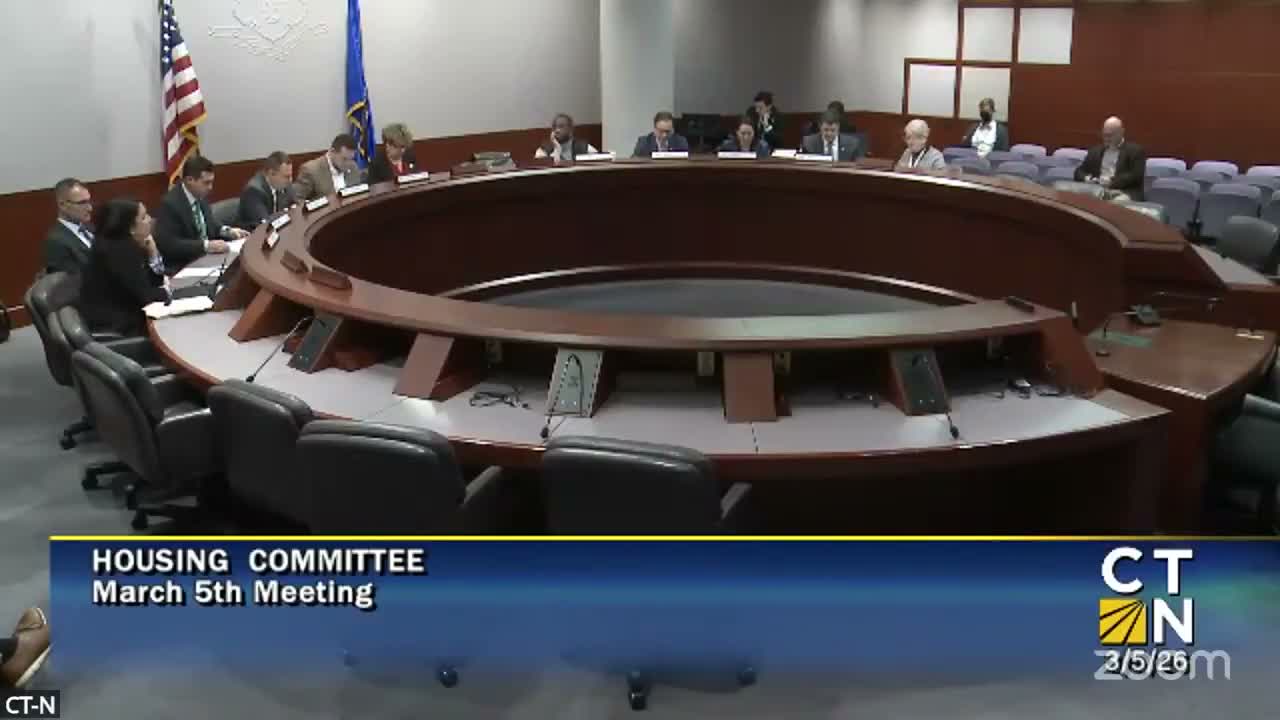
Representative Felipe, chairing the committee, moved House Bill 5258 forward after a lengthy discussion over how the measure defines and limits tenant organizers and tenant organizations.
The bill, described by Felipe as extending existing anti‑retaliation protections, would add four months of protection against retaliatory evictions or withholding of services for a set of tenant organizational activities — such as distributing leaflets, placing materials in common areas, conducting door‑to‑door surveys and holding meetings in community rooms — while leaving current six‑month protections for some activities unchanged and not expanding protections for rent increases beyond existing statute. "This bill is really getting at, a couple of tenant organizations over the summer ... and some retaliatory actions from property owners," Felipe said, urging the committee to support the measure as written with clarifying language to address members' concerns.
Senator Sampson argued the bill goes well beyond residents organizing among themselves and said it effectively creates a vehicle for outside organizers and unions to operate inside rental buildings. "This is not about housing. This is not about tenants. This is about organizing," Sampson said, pressing that the measure belongs in the Labor Committee rather than Housing. Sampson and several colleagues questioned whether definitions permit non‑resident organizers to gain access to secured buildings, raised safety and background‑check concerns and objected to provisions that allow political caucuses and candidate speeches in tenant common rooms without the owner present.
Supporters countered the bill protects tenants from retaliation for legitimate organizing and clarified that the measure does not supersede federal law governing certain government‑owned housing (including some Section 8 and public housing rules). The chair said the law would not override federal requirements and noted the bill’s purpose is to support tenants who have already formed organizations rather than to mandate creation of new groups.
In response to repeated concerns about unfettered access by non‑resident organizers, Representative Felipe offered an amendment that struck the standalone authority for tenant organizers and replaced it with a requirement that "tenant organizers be accompanied by tenants of such dwelling" when conducting the enumerated activities in a given unit's common areas. Senator Sampson and others spoke in favor of that change as improving the bill and narrowing access.
After the amendment was moved and seconded, the committee took a roll‑call vote to send the bill JFS (Joint Favorable Substitute) to the floor as amended. The chair said staff will circulate the underlying statutory language, LCO drafting notes and any further clarifying edits to address questions about applicability to different housing types, frequency of meetings, what constitutes "meeting regularly," and how the measure interfaces with existing fair‑rent and building code complaints. The committee left open the potential for technical language changes before the bill reaches the floor.
What the bill would do and what it would not: The text expands the list of protected tenant activities (leafleting, posting on bulletin boards, initiating contact, assisting participation in tenant organizations, and holding meetings) and provides an additional four months of protection in certain circumstances for those activities. It does not, in its current form before amendment, change the existing six‑month protection for organizing that is already in statute for some retaliatory actions; it also does not create an automatic mechanism to fund tenant organizations — any appropriations would be decided separately in appropriations. The chair said the bill was not intended to create a perpetual eviction shield for tenants who fail to pay rent and confirmed nonpayment is still a permissible ground for eviction.
Next steps: The committee reported HB 5258 JFS to the floor as amended; staff will provide members with the current statute excerpts, substitute language and suggested clarifications. The chair and proponents said they will work with colleagues to tighten definitions around frequency of meetings, registration or bylaws for tenant organizations if necessary, and exceptions for federally regulated housing.
Representative Felipe (Chair) and multiple committee members indicated they expect to iterate on drafting before floor action to ensure the bill's goals — protecting tenants from retaliation while limiting unwanted access to private residential facilities — are appropriately balanced.
Ending: The committee advanced the amended bill to the floor; further drafting and explanatory materials were pledged by the chair to resolve remaining questions on scope and implementation.
The bill, described by Felipe as extending existing anti‑retaliation protections, would add four months of protection against retaliatory evictions or withholding of services for a set of tenant organizational activities — such as distributing leaflets, placing materials in common areas, conducting door‑to‑door surveys and holding meetings in community rooms — while leaving current six‑month protections for some activities unchanged and not expanding protections for rent increases beyond existing statute. "This bill is really getting at, a couple of tenant organizations over the summer ... and some retaliatory actions from property owners," Felipe said, urging the committee to support the measure as written with clarifying language to address members' concerns.
Senator Sampson argued the bill goes well beyond residents organizing among themselves and said it effectively creates a vehicle for outside organizers and unions to operate inside rental buildings. "This is not about housing. This is not about tenants. This is about organizing," Sampson said, pressing that the measure belongs in the Labor Committee rather than Housing. Sampson and several colleagues questioned whether definitions permit non‑resident organizers to gain access to secured buildings, raised safety and background‑check concerns and objected to provisions that allow political caucuses and candidate speeches in tenant common rooms without the owner present.
Supporters countered the bill protects tenants from retaliation for legitimate organizing and clarified that the measure does not supersede federal law governing certain government‑owned housing (including some Section 8 and public housing rules). The chair said the law would not override federal requirements and noted the bill’s purpose is to support tenants who have already formed organizations rather than to mandate creation of new groups.
In response to repeated concerns about unfettered access by non‑resident organizers, Representative Felipe offered an amendment that struck the standalone authority for tenant organizers and replaced it with a requirement that "tenant organizers be accompanied by tenants of such dwelling" when conducting the enumerated activities in a given unit's common areas. Senator Sampson and others spoke in favor of that change as improving the bill and narrowing access.
After the amendment was moved and seconded, the committee took a roll‑call vote to send the bill JFS (Joint Favorable Substitute) to the floor as amended. The chair said staff will circulate the underlying statutory language, LCO drafting notes and any further clarifying edits to address questions about applicability to different housing types, frequency of meetings, what constitutes "meeting regularly," and how the measure interfaces with existing fair‑rent and building code complaints. The committee left open the potential for technical language changes before the bill reaches the floor.
What the bill would do and what it would not: The text expands the list of protected tenant activities (leafleting, posting on bulletin boards, initiating contact, assisting participation in tenant organizations, and holding meetings) and provides an additional four months of protection in certain circumstances for those activities. It does not, in its current form before amendment, change the existing six‑month protection for organizing that is already in statute for some retaliatory actions; it also does not create an automatic mechanism to fund tenant organizations — any appropriations would be decided separately in appropriations. The chair said the bill was not intended to create a perpetual eviction shield for tenants who fail to pay rent and confirmed nonpayment is still a permissible ground for eviction.
Next steps: The committee reported HB 5258 JFS to the floor as amended; staff will provide members with the current statute excerpts, substitute language and suggested clarifications. The chair and proponents said they will work with colleagues to tighten definitions around frequency of meetings, registration or bylaws for tenant organizations if necessary, and exceptions for federally regulated housing.
Representative Felipe (Chair) and multiple committee members indicated they expect to iterate on drafting before floor action to ensure the bill's goals — protecting tenants from retaliation while limiting unwanted access to private residential facilities — are appropriately balanced.
Ending: The committee advanced the amended bill to the floor; further drafting and explanatory materials were pledged by the chair to resolve remaining questions on scope and implementation.
View the Full Meeting & All Its Details
This article offers just a summary. Unlock complete video, transcripts, and insights as a Founder Member.
✓
Watch full, unedited meeting videos
✓
Search every word spoken in unlimited transcripts
✓
AI summaries & real-time alerts (all government levels)
✓
Permanent access to expanding government content
30-day money-back guarantee
