Court hears dispute over whether hospital workers' meal-break and rounding claims must go to arbitration
March 05, 2026 | Other Court, Judicial , Washington
This article was created by AI summarizing key points discussed. AI makes mistakes, so for full details and context, please refer to the video of the full meeting. Please report any errors so we can fix them. Report an error »
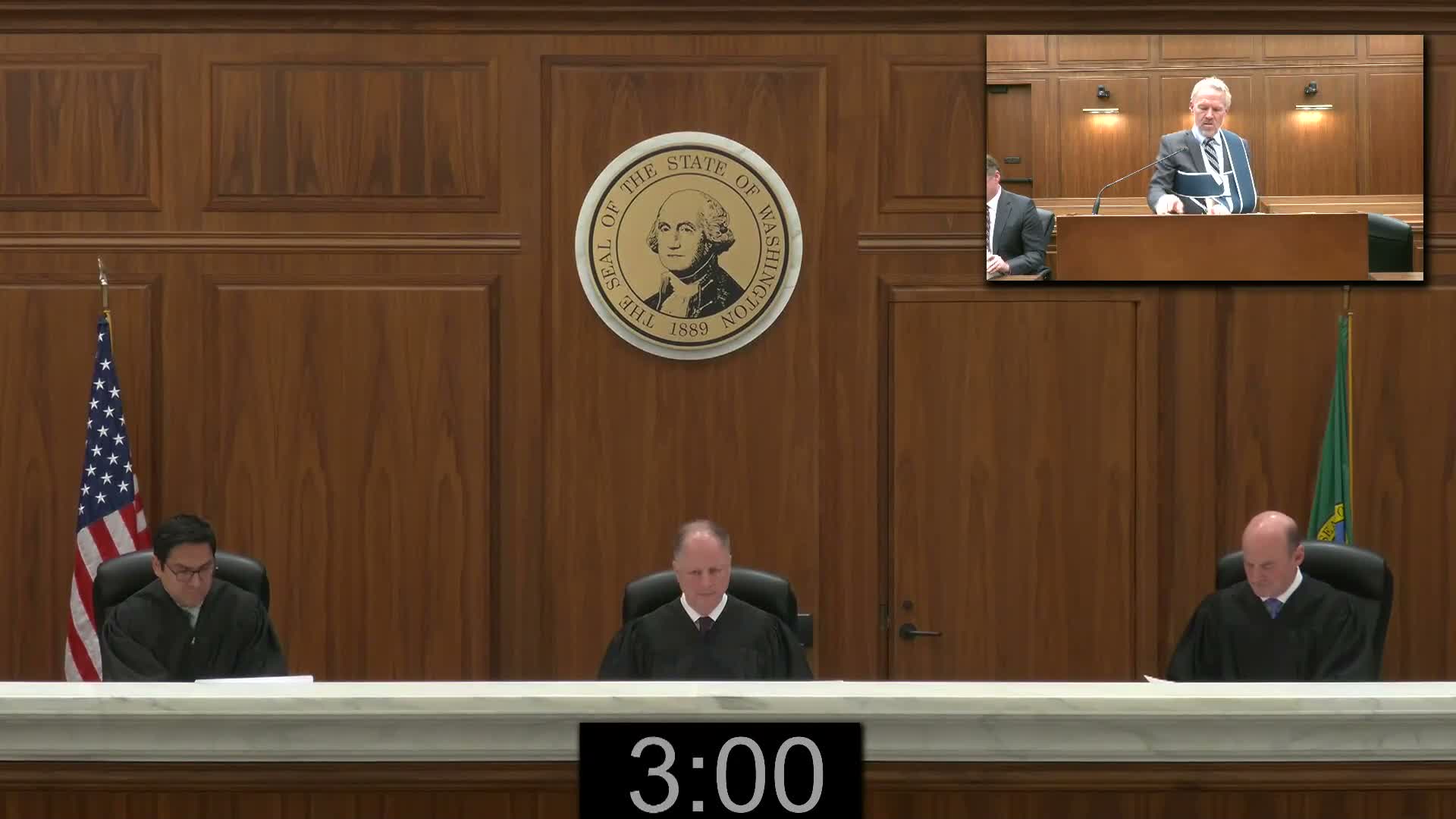
The court heard arguments over whether a collective bargaining agreement bars hospital employees from bringing statutory meal-break and time-rounding claims in court and instead requires arbitration.
Daniel Johnson, attorney for plaintiff Mason Frederick, told the court that employers “cannot compel arbitration of statutory claims under a collective bargaining agreement unless that collective bargaining agreement clearly and unmistakably requires it.” Johnson said the CBA at issue contains no clear waiver of statutory rights and that rounding and meal-break claims should remain for judicial resolution on the merits, not be routed automatically to arbitration.
Johnson also argued there is no evidence that the employee group here was a certified bargaining unit under the Public Employment Relations Commission and said the trial court erred in compelling arbitration without resolving whether the CBA actually covers these statutory claims.
Darren Feider, counsel for Skagit Valley Public Hospital No. 2 (Island Health), responded that the Legislature has provided the mechanism for these disputes: "It belongs in arbitration," he said, pointing to RCW 49.12.187(2). Feider argued the CBA contains provisions—he identified shift definitions, a one-meal-per-shift clause, and a provision on pay/rounding—that differ from and therefore "vary or supersede" the relevant administrative rules (WAC). Under that reading, Feider said, the claims become contractual and fall within the contract’s grievance and arbitration scheme.
Counsel and the court debated whether contract language that says employees “shall receive an unpaid meal period of 1 and a half hours” and that defines "normal work day" and specific shift lengths should be read as removing an employee’s statutory right to an additional meal period on longer shifts or whether that language is too vague to constitute a clear waiver. Feider relied on case law (including Brundridge and Stafford v. Key Mechanical cited in argument) to say a general arbitration clause combined with specific provisions about meal breaks and pay can meet the "clear and unmistakable" standard. Johnson countered that the CBA’s rounding language is narrow (he pointed to paragraph 6.12) and does not amount to a broad waiver of statutory wage claims.
The arguments turned on statutory interpretation of RCW 49.12.187(2), the extent to which a CBA must specifically reference or vary administrative rules (WAC) to create a contractual claim, and whether rounding provisions in the CBA (as written) are broad enough to bring rounding disputes within the contract’s arbitration procedures. The court heard extended questioning but did not issue a ruling from the bench.
The court concluded oral argument with, "That concludes the cases." No opinion or order was announced on the record; any further procedural steps or timing for a decision were not stated during the hearing.
Daniel Johnson, attorney for plaintiff Mason Frederick, told the court that employers “cannot compel arbitration of statutory claims under a collective bargaining agreement unless that collective bargaining agreement clearly and unmistakably requires it.” Johnson said the CBA at issue contains no clear waiver of statutory rights and that rounding and meal-break claims should remain for judicial resolution on the merits, not be routed automatically to arbitration.
Johnson also argued there is no evidence that the employee group here was a certified bargaining unit under the Public Employment Relations Commission and said the trial court erred in compelling arbitration without resolving whether the CBA actually covers these statutory claims.
Darren Feider, counsel for Skagit Valley Public Hospital No. 2 (Island Health), responded that the Legislature has provided the mechanism for these disputes: "It belongs in arbitration," he said, pointing to RCW 49.12.187(2). Feider argued the CBA contains provisions—he identified shift definitions, a one-meal-per-shift clause, and a provision on pay/rounding—that differ from and therefore "vary or supersede" the relevant administrative rules (WAC). Under that reading, Feider said, the claims become contractual and fall within the contract’s grievance and arbitration scheme.
Counsel and the court debated whether contract language that says employees “shall receive an unpaid meal period of 1 and a half hours” and that defines "normal work day" and specific shift lengths should be read as removing an employee’s statutory right to an additional meal period on longer shifts or whether that language is too vague to constitute a clear waiver. Feider relied on case law (including Brundridge and Stafford v. Key Mechanical cited in argument) to say a general arbitration clause combined with specific provisions about meal breaks and pay can meet the "clear and unmistakable" standard. Johnson countered that the CBA’s rounding language is narrow (he pointed to paragraph 6.12) and does not amount to a broad waiver of statutory wage claims.
The arguments turned on statutory interpretation of RCW 49.12.187(2), the extent to which a CBA must specifically reference or vary administrative rules (WAC) to create a contractual claim, and whether rounding provisions in the CBA (as written) are broad enough to bring rounding disputes within the contract’s arbitration procedures. The court heard extended questioning but did not issue a ruling from the bench.
The court concluded oral argument with, "That concludes the cases." No opinion or order was announced on the record; any further procedural steps or timing for a decision were not stated during the hearing.
View the Full Meeting & All Its Details
This article offers just a summary. Unlock complete video, transcripts, and insights as a Founder Member.
✓
Watch full, unedited meeting videos
✓
Search every word spoken in unlimited transcripts
✓
AI summaries & real-time alerts (all government levels)
✓
Permanent access to expanding government content
30-day money-back guarantee
