Fort Worth police outline Lancaster Corridor ‘HOPE’ push as partners expand cleanup, outreach and community court referrals
March 04, 2026 | Fort Worth, Tarrant County, Texas
This article was created by AI summarizing key points discussed. AI makes mistakes, so for full details and context, please refer to the video of the full meeting. Please report any errors so we can fix them. Report an error »
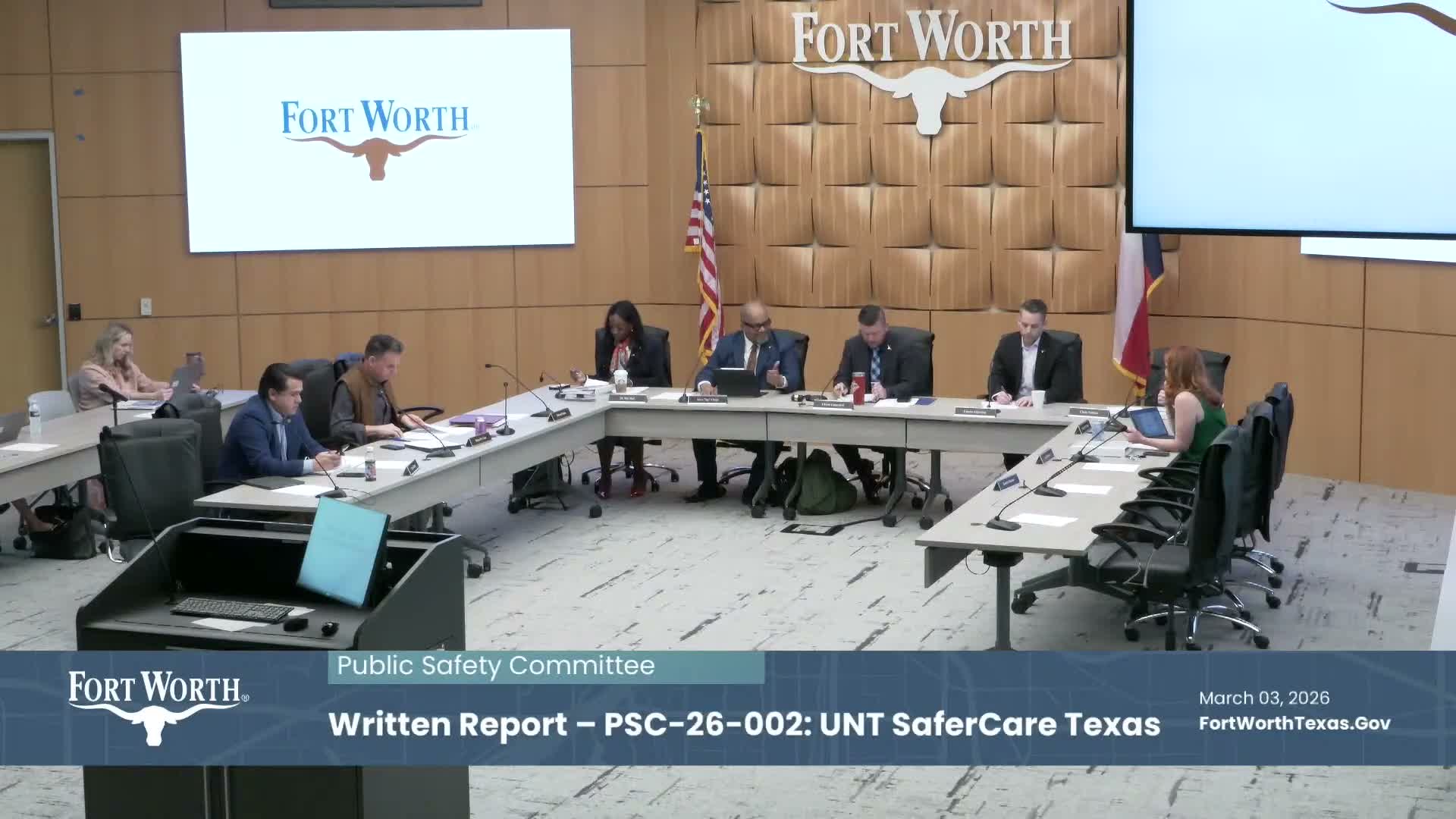
Deputy Chief Buck Wheeler of the Fort Worth Police Department told the Public Sector Committee that a new, concentrated HOPE‑team effort along the East Lancaster corridor aims to reduce violent crime while preserving access to services for people experiencing homelessness.
The update, presented with city environmental and outreach partners, said the initiative focuses enforcement on low‑level offenses that officers say can lead to more serious crime — illegal camping, obstructing roadways and sidewalks, littering, stored vehicles, narcotics and prostitution — while directing people toward help. Commander Stewart (Central Division) reported that from Jan. 23 to Feb. 17 teams removed 265 illegal camps, issued 735 warnings and 74 citations — roughly one citation for every 10 warnings — and made multiple felony arrests that targeted drug dealers operating in the area.
City environmental services official Wendy Turpin described an expanded cleanup effort (92 camps cleaned in the recent period and 18,000 tons of debris removed as reported during the presentation) and a redirection plan that concentrates street feeding and charity activity into three designated locations. Homeless Strategies staff said outreach capacity tripled (from two to six funded outreach workers) and one outreach team of two is dedicated to the East Lancaster Historic South Side area. Judge Houston explained the Community Court program that accepts referrals from service providers; successful participants can have fines waived or citations dismissed after completing a compliance plan that may include getting ID, applying for jobs, enrolling in medical care and other supports.
Why it matters: Committee members pressed officials on two tensions at the center of the initiative — whether a concentrated enforcement presence displaces people to other neighborhoods, and whether ticketing for low‑level offenses effectively criminalizes homelessness. Several council members described anecdotal upticks in nearby districts and asked for data on displacement; police and partners said they have not seen large‑scale displacement and described internal reporting from MPOs and criminologists that track movement. Officials emphasized warnings, linkage to services and the City’s community court pathway as alternatives to punitive outcomes.
Key exchanges included council members asking for more examples of “lasting” efficiencies; Wheeler said the initiative broke down departmental silos, improved use of the My Fort Worth app for service requests, and introduced rotation of MPOs to maintain presence without permanently drawing resources away from other neighborhoods. On the question of possessions removed during cleanups, police said they provide two‑hour warnings before removing items and that environmental services conducts the cleanup; staff acknowledged it is hard to attribute leftover debris to specific individuals.
Officials also provided cost and staffing context: Stewart presented an estimated $157,000 in officer salary/benefit costs tied to the effort over the reported period and described an overtime detail running through March 7 to increase evening coverage. Outreach staff said their website and business‑facing signage will encourage giving at designated charity sites rather than on rights of way.
What’s next: Committee members requested follow‑up data on camping complaints and any measurable displacement patterns (e.g., increased camping reports in Magnolia, West 7th, District 9). Officials agreed to provide camping complaint trends and further updates. The Community Court representative offered to answer operational questions and highlighted recent program outcomes: over five years the court set roughly 5,000 cases, closed 3,644 through program participation and administratively closed about 1,700 stale cases.
The committee did not take formal action on the initiative during the meeting but asked staff to return with more data and implementation details.
The update, presented with city environmental and outreach partners, said the initiative focuses enforcement on low‑level offenses that officers say can lead to more serious crime — illegal camping, obstructing roadways and sidewalks, littering, stored vehicles, narcotics and prostitution — while directing people toward help. Commander Stewart (Central Division) reported that from Jan. 23 to Feb. 17 teams removed 265 illegal camps, issued 735 warnings and 74 citations — roughly one citation for every 10 warnings — and made multiple felony arrests that targeted drug dealers operating in the area.
City environmental services official Wendy Turpin described an expanded cleanup effort (92 camps cleaned in the recent period and 18,000 tons of debris removed as reported during the presentation) and a redirection plan that concentrates street feeding and charity activity into three designated locations. Homeless Strategies staff said outreach capacity tripled (from two to six funded outreach workers) and one outreach team of two is dedicated to the East Lancaster Historic South Side area. Judge Houston explained the Community Court program that accepts referrals from service providers; successful participants can have fines waived or citations dismissed after completing a compliance plan that may include getting ID, applying for jobs, enrolling in medical care and other supports.
Why it matters: Committee members pressed officials on two tensions at the center of the initiative — whether a concentrated enforcement presence displaces people to other neighborhoods, and whether ticketing for low‑level offenses effectively criminalizes homelessness. Several council members described anecdotal upticks in nearby districts and asked for data on displacement; police and partners said they have not seen large‑scale displacement and described internal reporting from MPOs and criminologists that track movement. Officials emphasized warnings, linkage to services and the City’s community court pathway as alternatives to punitive outcomes.
Key exchanges included council members asking for more examples of “lasting” efficiencies; Wheeler said the initiative broke down departmental silos, improved use of the My Fort Worth app for service requests, and introduced rotation of MPOs to maintain presence without permanently drawing resources away from other neighborhoods. On the question of possessions removed during cleanups, police said they provide two‑hour warnings before removing items and that environmental services conducts the cleanup; staff acknowledged it is hard to attribute leftover debris to specific individuals.
Officials also provided cost and staffing context: Stewart presented an estimated $157,000 in officer salary/benefit costs tied to the effort over the reported period and described an overtime detail running through March 7 to increase evening coverage. Outreach staff said their website and business‑facing signage will encourage giving at designated charity sites rather than on rights of way.
What’s next: Committee members requested follow‑up data on camping complaints and any measurable displacement patterns (e.g., increased camping reports in Magnolia, West 7th, District 9). Officials agreed to provide camping complaint trends and further updates. The Community Court representative offered to answer operational questions and highlighted recent program outcomes: over five years the court set roughly 5,000 cases, closed 3,644 through program participation and administratively closed about 1,700 stale cases.
The committee did not take formal action on the initiative during the meeting but asked staff to return with more data and implementation details.
View the Full Meeting & All Its Details
This article offers just a summary. Unlock complete video, transcripts, and insights as a Founder Member.
✓
Watch full, unedited meeting videos
✓
Search every word spoken in unlimited transcripts
✓
AI summaries & real-time alerts (all government levels)
✓
Permanent access to expanding government content
30-day money-back guarantee
