Fort Worth announces 90‑day pilot to shift EMS single‑role staffing to 24‑hour model to address attrition and coverage gaps
March 04, 2026 | Fort Worth, Tarrant County, Texas
This article was created by AI summarizing key points discussed. AI makes mistakes, so for full details and context, please refer to the video of the full meeting. Please report any errors so we can fix them. Report an error »
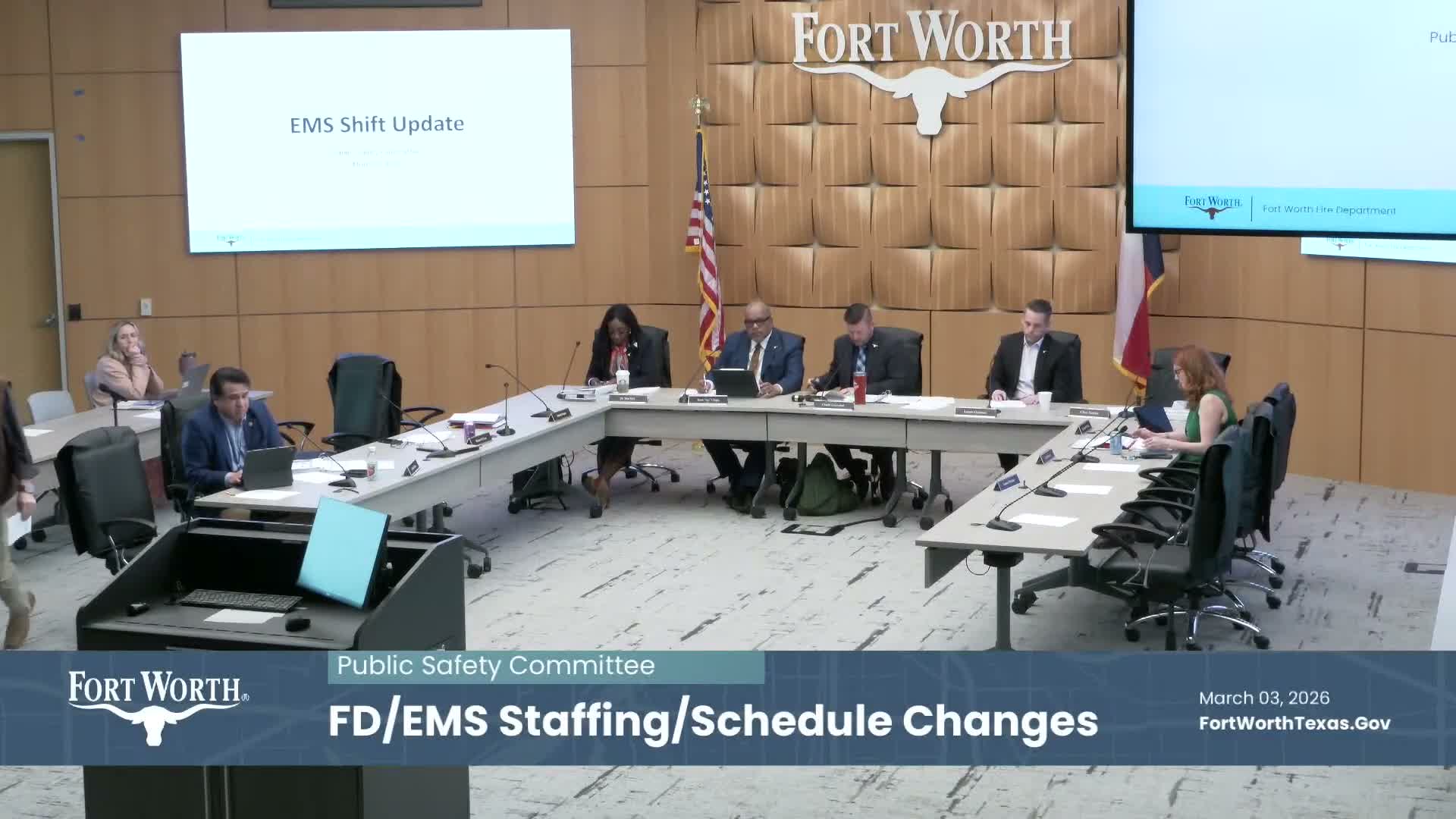
Interim Fire Chief Raymond Hill briefed the Public Sector Committee on a proposed schedule change for single‑role EMS providers from 12‑hour shifts to a 24‑hour (24/48) model, citing workforce pressures and operational shortfalls.
Hill said the department currently falls short of Fitch recommendations (360 on staff against a recommended 449) and reported 89 current vacancies with 55 separations since last April and an attrition rate of about 16%. The department plans a 90‑day pilot beginning Saturday to move EMS single‑role staffing to a 24/48 pattern; Hill said surveys show strong support for the change among providers and supervisors (management poll ~87% in favor; one referenced poll of single‑role staff at 68%).
Operational goals: Hill said the 24/48 model would put units at 45 stations (up from coverage at 35 stations under the 12‑hour model), increase advanced life support (ALS) density during peak demand, lower unit‑hour utilization, cut forced overtime by creating a 12‑member paramedic relief pool and improve surge capacity for major incidents. He noted the system handles roughly 500–550 calls per day and said the change is designed to scale with an expected 9.1% compounded annual growth in call volume.
Council members pressed practical issues before the pilot: availability of beds and partitions in fire stations (beds are on order with an estimated 60‑day delivery), whether mixed‑gender sleeping would require crew relocation or other accommodations, potential liability (lactation rooms and fair‑labor considerations), and whether the pilot should wait until facilities are fully prepared. Hill said logistics teams have prepared partitions and cots where needed, that crews will be swapped between stations as required, and that procurement and legal issues will be addressed during implementation; he also emphasized a plan to collect provider feedback via SharePoint and to evaluate the pilot after 90 days.
Why it matters: The shift is pitched as a retention and reliability move to reduce force hires and overtime that the department says are harmful to morale. Committee members asked for clarity on the number of times ambulance availability falls to zero and requested follow‑up reporting on actual ambulance availability during the transition. Hill committed to providing additional data and working with procurement and legal to resolve accommodations and compliance concerns.
No formal council action was taken; the committee used the presentation to probe operational readiness and risks prior to pilot launch.
Hill said the department currently falls short of Fitch recommendations (360 on staff against a recommended 449) and reported 89 current vacancies with 55 separations since last April and an attrition rate of about 16%. The department plans a 90‑day pilot beginning Saturday to move EMS single‑role staffing to a 24/48 pattern; Hill said surveys show strong support for the change among providers and supervisors (management poll ~87% in favor; one referenced poll of single‑role staff at 68%).
Operational goals: Hill said the 24/48 model would put units at 45 stations (up from coverage at 35 stations under the 12‑hour model), increase advanced life support (ALS) density during peak demand, lower unit‑hour utilization, cut forced overtime by creating a 12‑member paramedic relief pool and improve surge capacity for major incidents. He noted the system handles roughly 500–550 calls per day and said the change is designed to scale with an expected 9.1% compounded annual growth in call volume.
Council members pressed practical issues before the pilot: availability of beds and partitions in fire stations (beds are on order with an estimated 60‑day delivery), whether mixed‑gender sleeping would require crew relocation or other accommodations, potential liability (lactation rooms and fair‑labor considerations), and whether the pilot should wait until facilities are fully prepared. Hill said logistics teams have prepared partitions and cots where needed, that crews will be swapped between stations as required, and that procurement and legal issues will be addressed during implementation; he also emphasized a plan to collect provider feedback via SharePoint and to evaluate the pilot after 90 days.
Why it matters: The shift is pitched as a retention and reliability move to reduce force hires and overtime that the department says are harmful to morale. Committee members asked for clarity on the number of times ambulance availability falls to zero and requested follow‑up reporting on actual ambulance availability during the transition. Hill committed to providing additional data and working with procurement and legal to resolve accommodations and compliance concerns.
No formal council action was taken; the committee used the presentation to probe operational readiness and risks prior to pilot launch.
View the Full Meeting & All Its Details
This article offers just a summary. Unlock complete video, transcripts, and insights as a Founder Member.
✓
Watch full, unedited meeting videos
✓
Search every word spoken in unlimited transcripts
✓
AI summaries & real-time alerts (all government levels)
✓
Permanent access to expanding government content
30-day money-back guarantee
