Fluvanna supervisors review stricter conditions for Tenaska plant amid sustained public alarm
March 05, 2026 | Fluvanna County, Virginia
This article was created by AI summarizing key points discussed. AI makes mistakes, so for full details and context, please refer to the video of the full meeting. Please report any errors so we can fix them. Report an error »
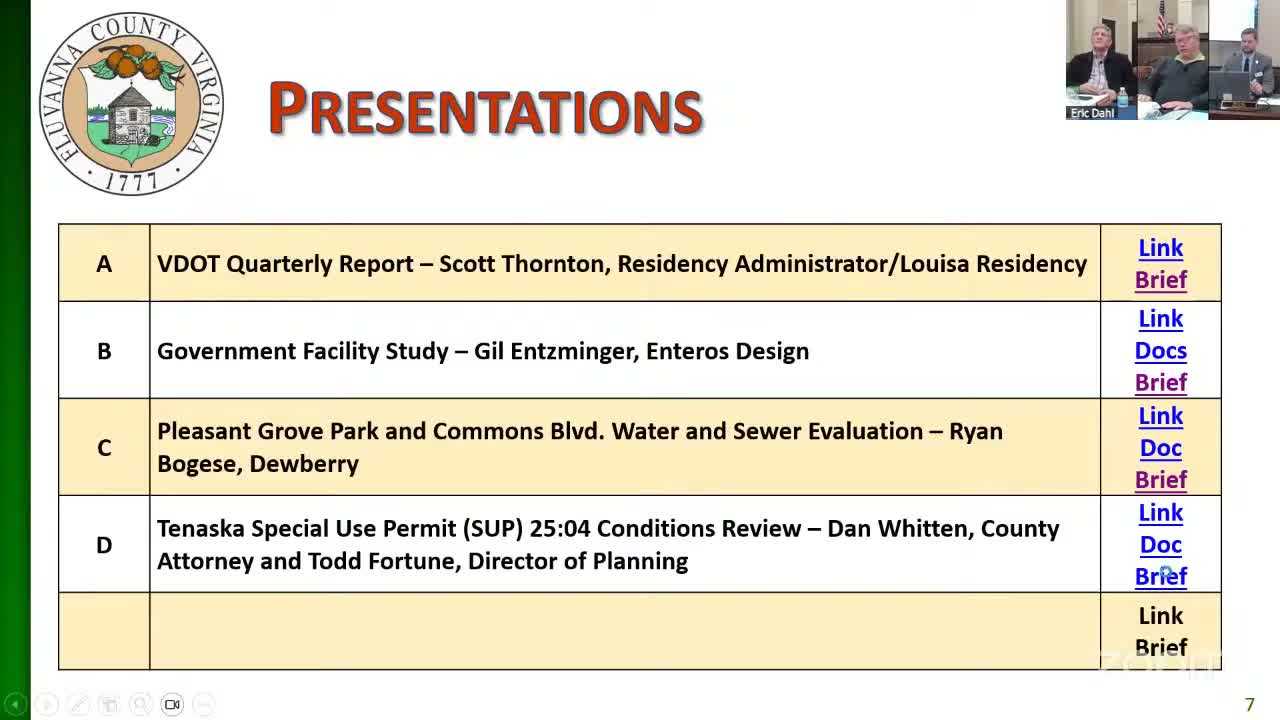
Fluvanna County’s Board of Supervisors spent the bulk of its March 4 meeting reviewing a newly revised package of proposed special‑use permit conditions for Tenaska’s proposed gas‑fired power plant and laydown areas.
Planning staff said the latest draft includes 45 conditions that address operational noise (a 1‑hour LAEq cap of 60 dBA at project boundary points), baseline pre‑operation sound testing, a requirement that a certified acoustical practitioner perform follow‑up tests paid for by the applicant, time‑of‑day limits for high‑noise construction activities, and monetary penalties for repeated exceedances.
“ We are now up to 45 conditions,” said planning staff (planning director/lead presenter), describing the package as a response to planning‑commission and public comments. The conditions also require Tenaska to develop a construction traffic mitigation plan and to reimburse the county for the traffic study and related mitigation work, and they include an offer by the applicant to contribute up to $5.5 million toward intersection improvements such as a roundabout at Route 53 and Ruritan Lake Road.
Residents at length questioned how the county would detect and enforce violations. Adam Combs, a local resident who describes himself as an environmental organizer, told supervisors he wants continuous monitoring and stronger independent oversight. “The problem I have is that folks aren’t really understanding the science behind this technology,” Combs said, arguing the public needs independent engineering input and continuous data to detect surges and isolate sound sources.
Board members and staff acknowledged technical and enforcement limits. Planning staff said continuous, AI‑based 24/7 source‑identification systems are not yet a reliable substitute for professionally attended testing and that the county lacks an on‑staff acoustical engineer to perform source separation; the draft therefore relies on baseline testing and periodic certified engineer surveys, and on complaint‑driven attended testing when results indicate an exceedance.
Other conditions discussed include mandatory, county‑approved conservation easements on parcels the applicant proposes to buy and restore; a required decommissioning plan; lighting and exterior color standards; on‑site emergency response staffing; and limits on where process water may be discharged. Some items that had been discussed previously—such as a proposed “good neighbor fund” and first‑responder contributions—were moved into separate restrictive covenants rather than being written as SUP conditions.
Public commenters and several supervisors pressed for more enforceable, phase‑by‑phase construction logistics, including truck count caps for peak days, specified delivery time windows, enforceable routes, independent monitoring, and road‑repair bonds. One resident warned that average‑based traffic models could mask surge days of hundreds of heavy‑truck movements during concrete pours and other concentrated operations.
Planning staff said they will continue negotiating with the applicant and with county technical consultants and expect to return to the board for public hearings on March 18 (appeal of substantial accord and public hearings on related text amendments), with final decisions to follow the advertised schedule.
Next steps: the board will consider the appeal of the planning commission’s substantial accord determination and hold public hearings on March 18. Meanwhile the board asked staff to continue negotiating conditions and to research available continuous monitoring technologies.
Planning staff said the latest draft includes 45 conditions that address operational noise (a 1‑hour LAEq cap of 60 dBA at project boundary points), baseline pre‑operation sound testing, a requirement that a certified acoustical practitioner perform follow‑up tests paid for by the applicant, time‑of‑day limits for high‑noise construction activities, and monetary penalties for repeated exceedances.
“ We are now up to 45 conditions,” said planning staff (planning director/lead presenter), describing the package as a response to planning‑commission and public comments. The conditions also require Tenaska to develop a construction traffic mitigation plan and to reimburse the county for the traffic study and related mitigation work, and they include an offer by the applicant to contribute up to $5.5 million toward intersection improvements such as a roundabout at Route 53 and Ruritan Lake Road.
Residents at length questioned how the county would detect and enforce violations. Adam Combs, a local resident who describes himself as an environmental organizer, told supervisors he wants continuous monitoring and stronger independent oversight. “The problem I have is that folks aren’t really understanding the science behind this technology,” Combs said, arguing the public needs independent engineering input and continuous data to detect surges and isolate sound sources.
Board members and staff acknowledged technical and enforcement limits. Planning staff said continuous, AI‑based 24/7 source‑identification systems are not yet a reliable substitute for professionally attended testing and that the county lacks an on‑staff acoustical engineer to perform source separation; the draft therefore relies on baseline testing and periodic certified engineer surveys, and on complaint‑driven attended testing when results indicate an exceedance.
Other conditions discussed include mandatory, county‑approved conservation easements on parcels the applicant proposes to buy and restore; a required decommissioning plan; lighting and exterior color standards; on‑site emergency response staffing; and limits on where process water may be discharged. Some items that had been discussed previously—such as a proposed “good neighbor fund” and first‑responder contributions—were moved into separate restrictive covenants rather than being written as SUP conditions.
Public commenters and several supervisors pressed for more enforceable, phase‑by‑phase construction logistics, including truck count caps for peak days, specified delivery time windows, enforceable routes, independent monitoring, and road‑repair bonds. One resident warned that average‑based traffic models could mask surge days of hundreds of heavy‑truck movements during concrete pours and other concentrated operations.
Planning staff said they will continue negotiating with the applicant and with county technical consultants and expect to return to the board for public hearings on March 18 (appeal of substantial accord and public hearings on related text amendments), with final decisions to follow the advertised schedule.
Next steps: the board will consider the appeal of the planning commission’s substantial accord determination and hold public hearings on March 18. Meanwhile the board asked staff to continue negotiating conditions and to research available continuous monitoring technologies.
Don't Miss a Word: See the Full Meeting!
Go beyond summaries. Unlock every video, transcript, and key insight with a Founder Membership.
✓
Get instant access to full meeting videos
✓
Search and clip any phrase from complete transcripts
✓
Receive AI-powered summaries & custom alerts
✓
Enjoy lifetime, unrestricted access to government data
30-day money-back guarantee
