Lake County hears workshop on state "pro housing" designation as staff aim to apply by March 31
March 04, 2026 | Lake County, California
This article was created by AI summarizing key points discussed. AI makes mistakes, so for full details and context, please refer to the video of the full meeting. Please report any errors so we can fix them. Report an error »
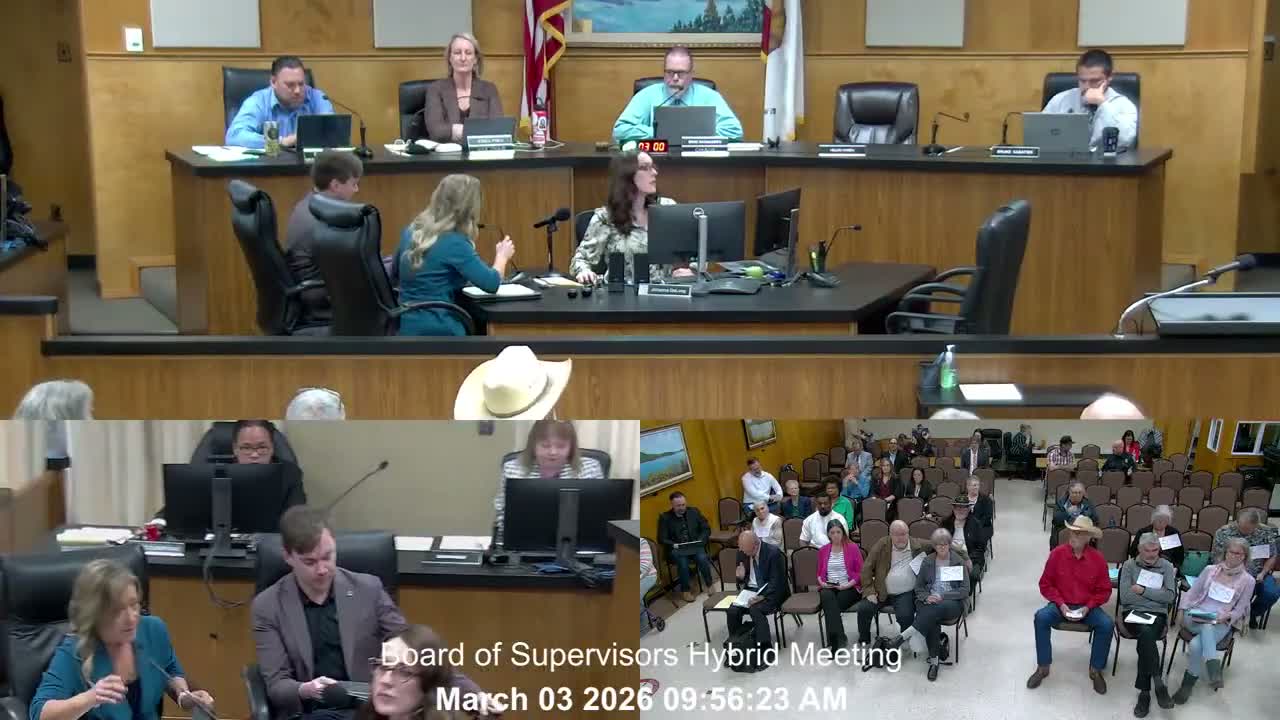
County staff and a consultant told the Board of Supervisors on March 3 that Lake County plans to pursue the state's Pro Housing designation to gain priority access to several state funding programs.
"We are excited to bring to you today the opportunity for the County Of Lake to become a pro housing designated jurisdiction in the state of California," said Lisa Judd, deputy county administrative officer for housing, introducing the item and noting a targeted application submission date of March 31, 2026 for both the Pro Housing designation and the Pro Housing Incentive Program (PIP).
Consultant Luke Lindenbusch of 4 Leaf, Inc., outlined how the program — created by Assembly Bill 101 — scores jurisdictions across four categories focused on production, acceleration, cost reduction and subsidies. "The attached appendix 3 identifies how the county ... puts the county in the low forties in terms of points," Lindenbusch said, noting that the draft application is currently around 42 points, above the 30‑point threshold required for designation.
Why it matters: Pro Housing designation is a gateway to the PIP funds and can provide priority processing and tie‑breaking advantage for other state-funded housing and infrastructure programs. Lindenbusch said the base PIP amount for a county Lake County's size is $250,000, with an additional $10,000 per point up to 50 points — meaning incremental points could increase available funds.
Board and public concerns: Supervisors and members of the public asked whether the program focuses solely on new housing production or can be used for preservation and protections for existing residents, including mobile‑home park residents. Rachel Tillman Parsons, the county's social services director, urged explicit attention to preservation and supports for low‑income seniors, saying the county should look for ways to apply PIP funds toward those needs. Lindenbusch and staff said while the designation scoring emphasizes production, some uses of PIP funds can support rehabilitation, preservation and tenant protections in practice.
Public engagement and next steps: The workshop launches a 30‑day public review period; staff will post the draft application and a public survey on the county website and reach out through area plan meetings and existing housing engagement channels. Staff said they will return with a formal resolution authorizing the application after public outreach; the board indicated consensus to direct staff and county counsel to continue pursuing the application this cycle.
Timeline and implementation constraints: HCD (California Department of Housing and Community Development) will review the application within 60 days of submittal; the application requires demonstrated public participation and staff capacity to implement any proposed programs within two years as part of the scoring. The board emphasized that designation alone does not guarantee PIP funds and that the county must balance production goals with protections for existing residents.
The board expressed cautious support and directed staff to continue the application process and public outreach, with a resolution to come back for formal authorization.
"We are excited to bring to you today the opportunity for the County Of Lake to become a pro housing designated jurisdiction in the state of California," said Lisa Judd, deputy county administrative officer for housing, introducing the item and noting a targeted application submission date of March 31, 2026 for both the Pro Housing designation and the Pro Housing Incentive Program (PIP).
Consultant Luke Lindenbusch of 4 Leaf, Inc., outlined how the program — created by Assembly Bill 101 — scores jurisdictions across four categories focused on production, acceleration, cost reduction and subsidies. "The attached appendix 3 identifies how the county ... puts the county in the low forties in terms of points," Lindenbusch said, noting that the draft application is currently around 42 points, above the 30‑point threshold required for designation.
Why it matters: Pro Housing designation is a gateway to the PIP funds and can provide priority processing and tie‑breaking advantage for other state-funded housing and infrastructure programs. Lindenbusch said the base PIP amount for a county Lake County's size is $250,000, with an additional $10,000 per point up to 50 points — meaning incremental points could increase available funds.
Board and public concerns: Supervisors and members of the public asked whether the program focuses solely on new housing production or can be used for preservation and protections for existing residents, including mobile‑home park residents. Rachel Tillman Parsons, the county's social services director, urged explicit attention to preservation and supports for low‑income seniors, saying the county should look for ways to apply PIP funds toward those needs. Lindenbusch and staff said while the designation scoring emphasizes production, some uses of PIP funds can support rehabilitation, preservation and tenant protections in practice.
Public engagement and next steps: The workshop launches a 30‑day public review period; staff will post the draft application and a public survey on the county website and reach out through area plan meetings and existing housing engagement channels. Staff said they will return with a formal resolution authorizing the application after public outreach; the board indicated consensus to direct staff and county counsel to continue pursuing the application this cycle.
Timeline and implementation constraints: HCD (California Department of Housing and Community Development) will review the application within 60 days of submittal; the application requires demonstrated public participation and staff capacity to implement any proposed programs within two years as part of the scoring. The board emphasized that designation alone does not guarantee PIP funds and that the county must balance production goals with protections for existing residents.
The board expressed cautious support and directed staff to continue the application process and public outreach, with a resolution to come back for formal authorization.
Don't Miss a Word: See the Full Meeting!
Go beyond summaries. Unlock every video, transcript, and key insight with a Founder Membership.
✓
Get instant access to full meeting videos
✓
Search and clip any phrase from complete transcripts
✓
Receive AI-powered summaries & custom alerts
✓
Enjoy lifetime, unrestricted access to government data
30-day money-back guarantee
