Council committee reports resolution urging shelters at low-frequency bus stops
March 05, 2026 | Honolulu City, Honolulu County, Hawaii
This article was created by AI summarizing key points discussed. AI makes mistakes, so for full details and context, please refer to the video of the full meeting. Please report any errors so we can fix them. Report an error »
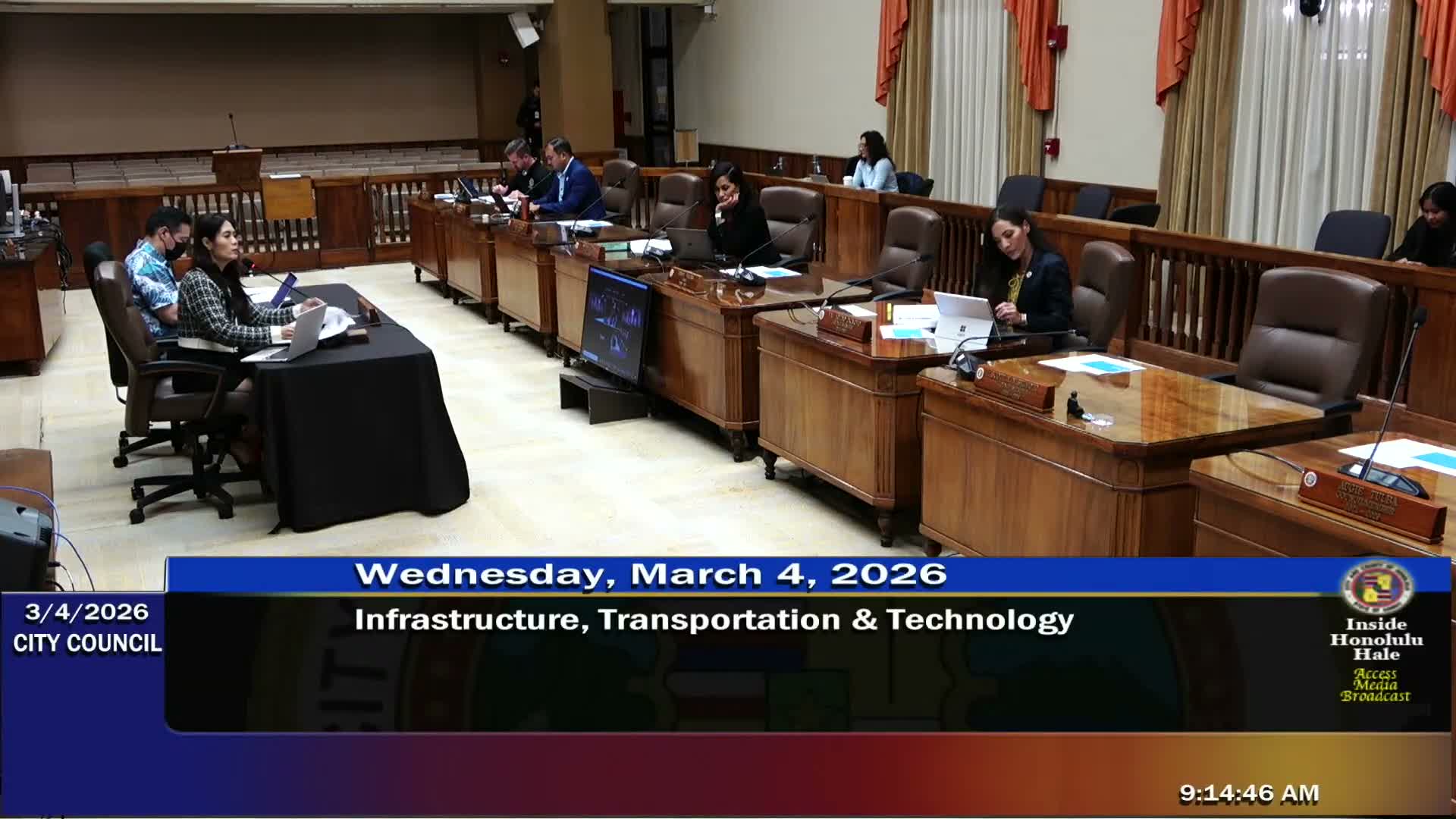
The Committee on Infrastructure, Transportation and Technology voted to report out Resolution 26-47, which asks the Department of Transportation Services to prioritize installing shelters at bus stops on routes with service frequencies exceeding 30 minutes and to give priority to unprotected stops.
The resolution, introduced by the committee chair, responds to constituent concerns about riders' exposure to sun and rain, and specifically calls for attention to stops used by kupuna and caregivers. John Noguchi, director of transit, told the committee, "DTS definitely supports the intent of this resolution," and described a data-driven approach that considers boardings, alightings, route type, transfer connections, ADA clearances and sidewalk constraints when deciding where to place shelters and other amenities.
Noguchi said the department already budgets for bus stops and ADA improvements in the capital improvement program, and that stop-level ridership is a primary driver of where shelters are placed. "We will continue use to use the data driven metrics and also consider frequency a little bit harder as part of that calculation," he said. He noted there are trade-offs when increasing frequency and when choosing between coverage and higher-service corridors.
Committee members pressed on practicalities. Vice Chair Okimoto asked whether benches installed now could be upgraded to shelters later; Noguchi said they could, but cautioned that shelters often require site-specific design and can carry substantial construction costs. "Putting up a bus stop could cost us anywhere upwards of, you know, $250,000 just for the construction," he said, pointing to utility conflicts, ADA ramps and site preparation as cost drivers.
Councilmember Tupala asked about current coverage; Noguchi reported roughly 3,700 to 3,800 bus stops islandwide, with about 1,095 having shelters (29%), 990 having seating only (26%), and roughly 55% of stops having some amenity. Councilmembers debated whether to prioritize adding shelters over existing benches or to target heavily used unsheltered stops first.
Members also discussed funding strategies. Several asked whether recent fare increases should lead to a proportionate growth in bus amenities; Noguchi replied that fare revenue is largely allocated to operating needs and service frequency, while shelters and other construction-related amenities typically fall under capital funding and the CIP, so a direct percentage allocation is not automatic.
The committee also asked DTS to explore sponsorship models and public-private partnerships similar to a Honolulu Zoo pilot for amenity funding. Noguchi said existing sponsorship or community-benefit arrangements are possible and welcomed additional partnerships.
With no registered public testimony taken at the committee hearing, Chair Cordero recommended the resolution be reported out for consideration by the full council. The committee ordered it reported out with no objections.
The resolution, introduced by the committee chair, responds to constituent concerns about riders' exposure to sun and rain, and specifically calls for attention to stops used by kupuna and caregivers. John Noguchi, director of transit, told the committee, "DTS definitely supports the intent of this resolution," and described a data-driven approach that considers boardings, alightings, route type, transfer connections, ADA clearances and sidewalk constraints when deciding where to place shelters and other amenities.
Noguchi said the department already budgets for bus stops and ADA improvements in the capital improvement program, and that stop-level ridership is a primary driver of where shelters are placed. "We will continue use to use the data driven metrics and also consider frequency a little bit harder as part of that calculation," he said. He noted there are trade-offs when increasing frequency and when choosing between coverage and higher-service corridors.
Committee members pressed on practicalities. Vice Chair Okimoto asked whether benches installed now could be upgraded to shelters later; Noguchi said they could, but cautioned that shelters often require site-specific design and can carry substantial construction costs. "Putting up a bus stop could cost us anywhere upwards of, you know, $250,000 just for the construction," he said, pointing to utility conflicts, ADA ramps and site preparation as cost drivers.
Councilmember Tupala asked about current coverage; Noguchi reported roughly 3,700 to 3,800 bus stops islandwide, with about 1,095 having shelters (29%), 990 having seating only (26%), and roughly 55% of stops having some amenity. Councilmembers debated whether to prioritize adding shelters over existing benches or to target heavily used unsheltered stops first.
Members also discussed funding strategies. Several asked whether recent fare increases should lead to a proportionate growth in bus amenities; Noguchi replied that fare revenue is largely allocated to operating needs and service frequency, while shelters and other construction-related amenities typically fall under capital funding and the CIP, so a direct percentage allocation is not automatic.
The committee also asked DTS to explore sponsorship models and public-private partnerships similar to a Honolulu Zoo pilot for amenity funding. Noguchi said existing sponsorship or community-benefit arrangements are possible and welcomed additional partnerships.
With no registered public testimony taken at the committee hearing, Chair Cordero recommended the resolution be reported out for consideration by the full council. The committee ordered it reported out with no objections.
Don't Miss a Word: See the Full Meeting!
Go beyond summaries. Unlock every video, transcript, and key insight with a Founder Membership.
✓
Get instant access to full meeting videos
✓
Search and clip any phrase from complete transcripts
✓
Receive AI-powered summaries & custom alerts
✓
Enjoy lifetime, unrestricted access to government data
30-day money-back guarantee
