Honolulu Department of Environmental Services outlines GROW pilot to collect food waste in six neighborhoods starting April 1, 2026
March 04, 2026 | Honolulu City, Honolulu County, Hawaii
This article was created by AI summarizing key points discussed. AI makes mistakes, so for full details and context, please refer to the video of the full meeting. Please report any errors so we can fix them. Report an error »
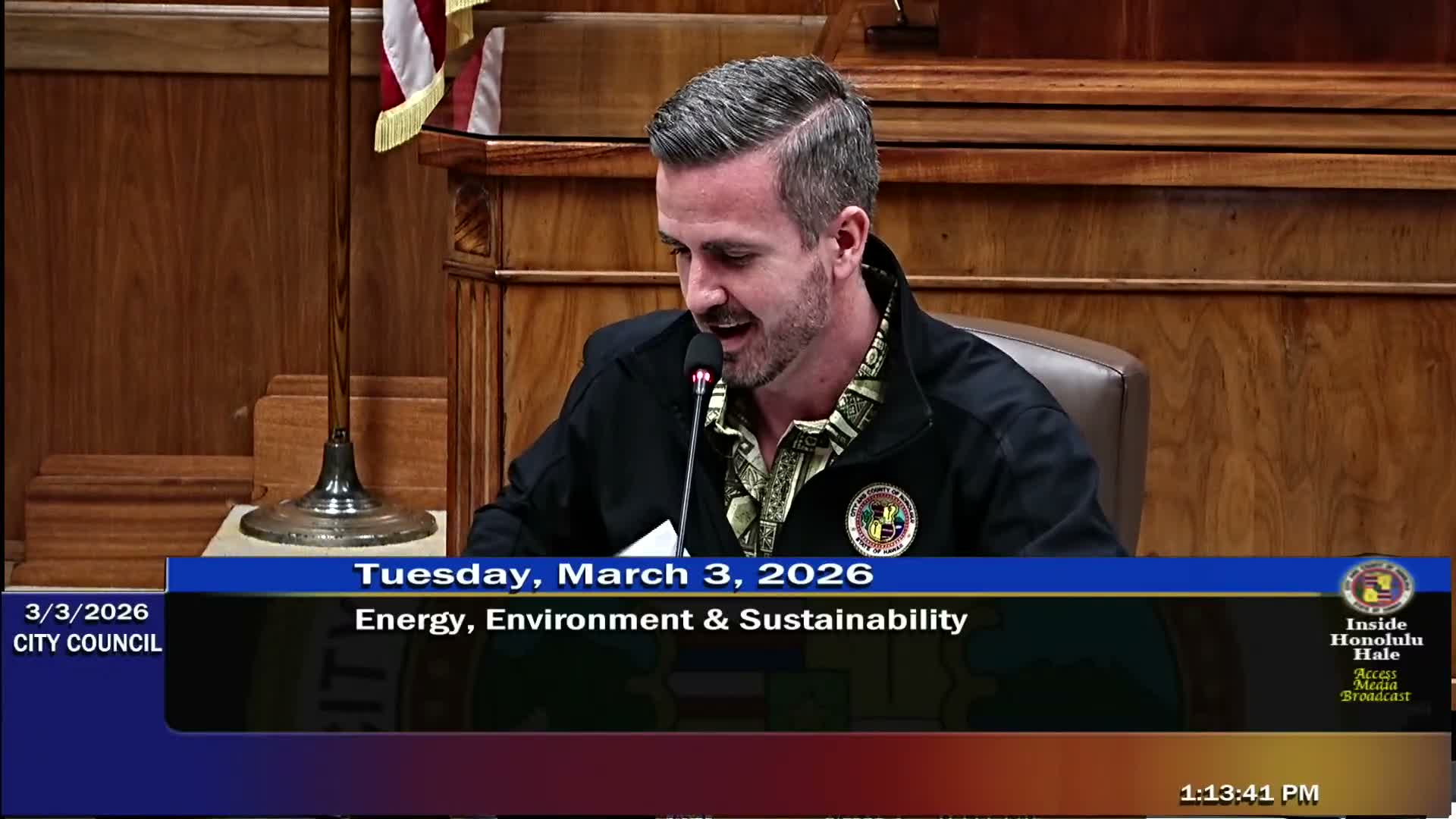
The Department of Environmental Services on March 3 briefed the Committee on Energy, Environment and Sustainability on GROW (green recycling organic waste), a residential food‑waste collection pilot scheduled to begin April 1, 2026 in six pilot areas and expand islandwide Oct. 1.
Henry Gabriel, refuse division recycling branch, told the committee GROW is intended to divert food waste from landfills and to produce compost via a contractor using an in‑vessel system. "This is the GROW program," Gabriel said. "We would rather see food waste composted rather than trying to burn it." He said the pilot areas were selected to represent a cross‑section of the island’s routes and that participating households will receive a mailer on March 9.
Gabriel gave a list of accepted materials for the green compost cart — fruits and vegetables, solid/semi‑solid dairy (cheese, yogurt), baked goods, pasta, rice, grains, beans, nuts, meat, seafood, poultry and bones of any size, eggshells, coffee grounds and plate scrapings — and stressed the program is aimed at diverting existing food waste rather than generating more. He noted some items remain prohibited during phase 1: liquids, many paper products and manufactured compostables (pending PFAS review), plastics, glass and pet waste.
On PFAS, Gabriel said the EPA and the state are studying thresholds in compostable materials; he estimated a roughly two‑year timeline before the city can adopt phase‑2 limits that would allow manufactured compostables and bio bags. "Compost PFAS threshold is 45 parts per million," he said, adding that the department is coordinating with Hawaiian Earth Recycling and the Department of Health.
Gabriel described Hawaiian Earth’s in‑vessel process at Wahiawa, which allows staff to control moisture and temperature and to shorten processing time compared with windrow systems. He said the in‑vessel system can produce a finished product within three to four months (plus a curing period), versus 12–18 months for windrow composting.
The department cited a 2017 study finding about 36% of Honolulu’s waste stream is organic, with roughly 20% of that being food. Applying those percentages to an annual estimate of 800,000 tons of municipal waste yields about 160,000 tons of food waste annually; Gabriel said the residential program could divert roughly 60,000 tons.
Committee members pressed the department on practicality and incentives. One council member asked how residents would be encouraged to freeze scraps or otherwise manage odor and pests; Gabriel recommended layering food waste with green waste, using small countertop containers and offered reusable silicone bags and workshop education. The same member suggested market or regulatory incentives and described successful separation in some European cities, noting both incentives and fines can change behavior.
Gabriel also said the city enforces a business‑focused food‑waste ordinance for large generators and inspects grocery stores, hospitals and restaurants; he suggested amending that ordinance could be one way to capture more business food waste. On drop‑off logistics, Gabriel confirmed residents could self‑drop at Hawaiian Earth in Wahiawa and that the department is exploring additional local drop‑off sites and custom bins for convenience centers in later phases.
Gabriel said the department will monitor participation rates, contamination and route performance during the pilot and continue public workshops and social media outreach (honolulu.gov/emv/grow). The committee closed public testimony for the briefing and asked the department to keep the committee updated on pilot performance and PFAS study outcomes.
Henry Gabriel, refuse division recycling branch, told the committee GROW is intended to divert food waste from landfills and to produce compost via a contractor using an in‑vessel system. "This is the GROW program," Gabriel said. "We would rather see food waste composted rather than trying to burn it." He said the pilot areas were selected to represent a cross‑section of the island’s routes and that participating households will receive a mailer on March 9.
Gabriel gave a list of accepted materials for the green compost cart — fruits and vegetables, solid/semi‑solid dairy (cheese, yogurt), baked goods, pasta, rice, grains, beans, nuts, meat, seafood, poultry and bones of any size, eggshells, coffee grounds and plate scrapings — and stressed the program is aimed at diverting existing food waste rather than generating more. He noted some items remain prohibited during phase 1: liquids, many paper products and manufactured compostables (pending PFAS review), plastics, glass and pet waste.
On PFAS, Gabriel said the EPA and the state are studying thresholds in compostable materials; he estimated a roughly two‑year timeline before the city can adopt phase‑2 limits that would allow manufactured compostables and bio bags. "Compost PFAS threshold is 45 parts per million," he said, adding that the department is coordinating with Hawaiian Earth Recycling and the Department of Health.
Gabriel described Hawaiian Earth’s in‑vessel process at Wahiawa, which allows staff to control moisture and temperature and to shorten processing time compared with windrow systems. He said the in‑vessel system can produce a finished product within three to four months (plus a curing period), versus 12–18 months for windrow composting.
The department cited a 2017 study finding about 36% of Honolulu’s waste stream is organic, with roughly 20% of that being food. Applying those percentages to an annual estimate of 800,000 tons of municipal waste yields about 160,000 tons of food waste annually; Gabriel said the residential program could divert roughly 60,000 tons.
Committee members pressed the department on practicality and incentives. One council member asked how residents would be encouraged to freeze scraps or otherwise manage odor and pests; Gabriel recommended layering food waste with green waste, using small countertop containers and offered reusable silicone bags and workshop education. The same member suggested market or regulatory incentives and described successful separation in some European cities, noting both incentives and fines can change behavior.
Gabriel also said the city enforces a business‑focused food‑waste ordinance for large generators and inspects grocery stores, hospitals and restaurants; he suggested amending that ordinance could be one way to capture more business food waste. On drop‑off logistics, Gabriel confirmed residents could self‑drop at Hawaiian Earth in Wahiawa and that the department is exploring additional local drop‑off sites and custom bins for convenience centers in later phases.
Gabriel said the department will monitor participation rates, contamination and route performance during the pilot and continue public workshops and social media outreach (honolulu.gov/emv/grow). The committee closed public testimony for the briefing and asked the department to keep the committee updated on pilot performance and PFAS study outcomes.
Don't Miss a Word: See the Full Meeting!
Go beyond summaries. Unlock every video, transcript, and key insight with a Founder Membership.
✓
Get instant access to full meeting videos
✓
Search and clip any phrase from complete transcripts
✓
Receive AI-powered summaries & custom alerts
✓
Enjoy lifetime, unrestricted access to government data
30-day money-back guarantee
