Committee questions $1.28 million write‑off tied to failed LIHTC deal, asks for clearer documentation
March 04, 2026 | Honolulu City, Honolulu County, Hawaii
This article was created by AI summarizing key points discussed. AI makes mistakes, so for full details and context, please refer to the video of the full meeting. Please report any errors so we can fix them. Report an error »
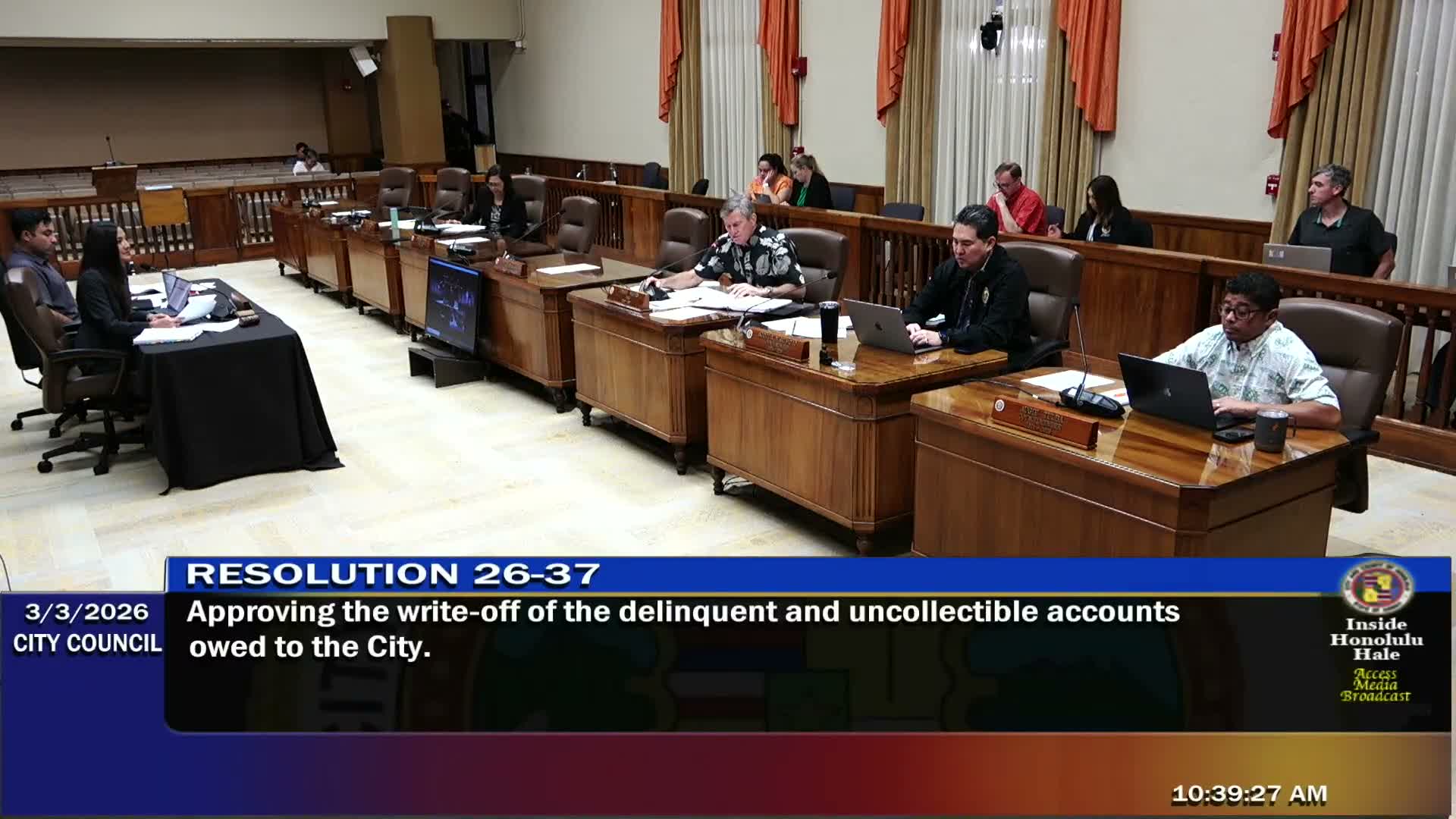
Resolution 26-37, which would write off several small delinquencies and a larger accrued-interest balance of roughly $1.28 million tied to an earlier low‑income housing tax credit (LIHTC) transaction, was reported out of committee but with reservations and a request for additional documentation.
Deputy Director Carrie Castle (Budget & Fiscal Services) said the resolution covers three debt holders: liquor law violations (~$4,021), facilities maintenance (~$4,333), and an accrued interest balance of about $1,282,607 related to a failed LIHTC transaction originally recorded between 2006 and 2011. She said collection agencies had pursued legal means on the smaller accounts and that the larger balance was a legacy accrued interest entry that should have been written off earlier.
Council members raised concerns that publicly available filings (a council member cited IRS/iCandid data) show the nonprofit developer referenced in testimony (EAH / Evo Homes LP as reported in paperwork) has substantial unrestricted net assets, and questioned whether forgiving the $1.28 million is appropriate without additional context or demonstrated collection efforts. Chair Waters said the resolution’s supporting documents did not include the information presented verbally and that the committee should defer additional action until written clarification is provided.
Director Andy Kawano (Budget & Fiscal Services) described the entry as an accounting cleanup: when the anticipated LIHTC award did not materialize, accrued interest was booked and later remained on the city’s books as receivable; the department now seeks to remove that residual amount. Kawano agreed to supply written documentation specifying whether collection efforts were pursued and which accounts were handled by collection agencies.
The committee reported the measure out for adoption with reservations and asked BFS and DCS to provide a written explanation of the history, collection steps taken (if any), and why the balance is considered uncollectible prior to full-council scheduling.
Deputy Director Carrie Castle (Budget & Fiscal Services) said the resolution covers three debt holders: liquor law violations (~$4,021), facilities maintenance (~$4,333), and an accrued interest balance of about $1,282,607 related to a failed LIHTC transaction originally recorded between 2006 and 2011. She said collection agencies had pursued legal means on the smaller accounts and that the larger balance was a legacy accrued interest entry that should have been written off earlier.
Council members raised concerns that publicly available filings (a council member cited IRS/iCandid data) show the nonprofit developer referenced in testimony (EAH / Evo Homes LP as reported in paperwork) has substantial unrestricted net assets, and questioned whether forgiving the $1.28 million is appropriate without additional context or demonstrated collection efforts. Chair Waters said the resolution’s supporting documents did not include the information presented verbally and that the committee should defer additional action until written clarification is provided.
Director Andy Kawano (Budget & Fiscal Services) described the entry as an accounting cleanup: when the anticipated LIHTC award did not materialize, accrued interest was booked and later remained on the city’s books as receivable; the department now seeks to remove that residual amount. Kawano agreed to supply written documentation specifying whether collection efforts were pursued and which accounts were handled by collection agencies.
The committee reported the measure out for adoption with reservations and asked BFS and DCS to provide a written explanation of the history, collection steps taken (if any), and why the balance is considered uncollectible prior to full-council scheduling.
Don't Miss a Word: See the Full Meeting!
Go beyond summaries. Unlock every video, transcript, and key insight with a Founder Membership.
✓
Get instant access to full meeting videos
✓
Search and clip any phrase from complete transcripts
✓
Receive AI-powered summaries & custom alerts
✓
Enjoy lifetime, unrestricted access to government data
30-day money-back guarantee
