Lubbock officials and residents spar over proposed landscaping changes to Unified Development Code
September 27, 2024 | Lubbock, Lubbock County, Texas
This article was created by AI summarizing key points discussed. AI makes mistakes, so for full details and context, please refer to the video of the full meeting. Please report any errors so we can fix them. Report an error »
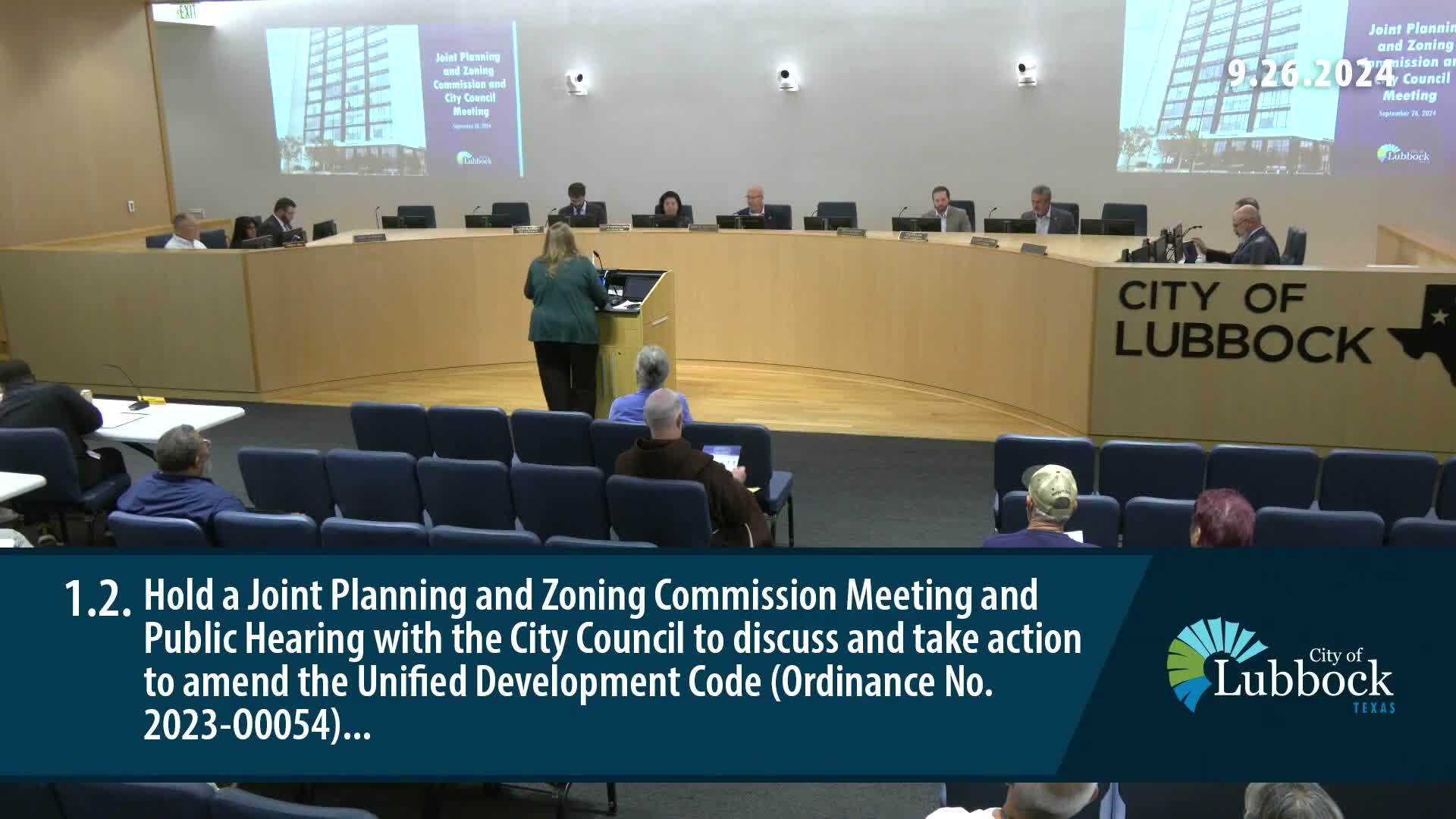
City planning staff on Thursday presented 28 proposed landscaping changes to Lubbock’s Unified Development Code, drawing support from developers and landscape professionals and concerns from neighborhood advocates about equity, walkability and environmental impacts.
Kristen Seager of the city’s planning staff told the Lubbock City Council and the Planning and Zoning Commission that the package would authorize xeriscape ground cover with a requirement of five live plants per 100 square feet, streamline buffer-yard rules, clarify the landscape-point system and remove Appendix A—the city’s list of approved and prohibited plants. "There are 28 landscape amendments in front of you tonight," Seager said as she summarized the draft.
Why it matters: the changes would alter how new and infill projects meet landscaping requirements across the city. Supporters said the revisions reduce overly prescriptive requirements and make regulation more flexible for developers and designers. Terry Hohman of Hugo Reed & Associates, representing the Developers Council, said the draft reflects collaboration between private and public stakeholders and defends a contextual-landscaping provision limiting its application to industrial infill that is not adjacent to residential zoning. "We stand in full support of what you have in front of you this evening," Hohman said.
Support from practitioners: landscape professionals at the hearing generally favored the package. Alex Scarborough of Thomas Tree Place, speaking for the Lubbock Alliance of Landscape Architects, thanked staff and said the changes were a "great step forward" for the city’s future development. Designer Dustin Wright of New West Workshop said the revisions struck a better balance than the prior code but raised a few technical objections, including opposition to removing a 60/40 species-mix requirement and to allowing artificial turf. "I do not support striking this... It encourages a monoculture of tree cover," Wright said, and he urged either keeping species-mix requirements or creating separate parking-lot tree mandates.
Neighborhood and equity concerns: several residents and community representatives urged the council to consider how the rules would affect historically industrial areas in north and east Lubbock. Researcher Yanya Ramirez said contextual landscaping, as drafted, could perpetuate car-centric and segregated development patterns and asked for a clearer definition of what "average of the context" would measure (trees, grass cover or other metrics). "If we require them to develop similarly to what is already being developed... were going to not just perpetuate the same problems," Ramirez said, noting concerns about sidewalks, bike access and air quality in areas surrounded by industry.
Technical clarifications: staff explained how buffer yards would be scaled by adjacent districts, with Type A buffers 5 feet, Type B 10 feet, Type C 15 feet and Type D 30 feet, and that the contextual-landscaping option would apply only when infill sites are not adjacent to residential zoning. "If you have a general industrial zone property adjacent to SF-2," Seager said, "you would be required the largest Type D buffer yard."
Key proposed changes called out during the hearing include allowing xeriscape materials with a minimum live-plant density; removing Appendix A plant lists; changing landscape-point calculations and canopy definitions; raising the parking-buffer trigger from more than 10 spaces to more than 30 spaces; permitting synthetic turf under certain conditions; awarding points for plans stamped by a licensed landscape architect; and creating a contextual-landscaping pathway for specified industrial infill sites.
Next steps: no action was taken at the Sept. 26 hearing. Seager and the chair reminded the public that the Planning and Zoning Commission will consider and vote on the amendments at its Oct. 3 meeting; the City Council is scheduled to consider first reading on Oct. 8 and second reading on Oct. 22.
The hearing included multiple exchanges between designers, residents and staff over how to preserve design flexibility while avoiding monocultures and protecting neighborhoods adjacent to industrial areas. Commissioners asked for and received additional specificity about buffer widths and the limits of the contextual-landscaping provision; proponents and opponents said they would continue to refine language before the upcoming votes.
Kristen Seager of the city’s planning staff told the Lubbock City Council and the Planning and Zoning Commission that the package would authorize xeriscape ground cover with a requirement of five live plants per 100 square feet, streamline buffer-yard rules, clarify the landscape-point system and remove Appendix A—the city’s list of approved and prohibited plants. "There are 28 landscape amendments in front of you tonight," Seager said as she summarized the draft.
Why it matters: the changes would alter how new and infill projects meet landscaping requirements across the city. Supporters said the revisions reduce overly prescriptive requirements and make regulation more flexible for developers and designers. Terry Hohman of Hugo Reed & Associates, representing the Developers Council, said the draft reflects collaboration between private and public stakeholders and defends a contextual-landscaping provision limiting its application to industrial infill that is not adjacent to residential zoning. "We stand in full support of what you have in front of you this evening," Hohman said.
Support from practitioners: landscape professionals at the hearing generally favored the package. Alex Scarborough of Thomas Tree Place, speaking for the Lubbock Alliance of Landscape Architects, thanked staff and said the changes were a "great step forward" for the city’s future development. Designer Dustin Wright of New West Workshop said the revisions struck a better balance than the prior code but raised a few technical objections, including opposition to removing a 60/40 species-mix requirement and to allowing artificial turf. "I do not support striking this... It encourages a monoculture of tree cover," Wright said, and he urged either keeping species-mix requirements or creating separate parking-lot tree mandates.
Neighborhood and equity concerns: several residents and community representatives urged the council to consider how the rules would affect historically industrial areas in north and east Lubbock. Researcher Yanya Ramirez said contextual landscaping, as drafted, could perpetuate car-centric and segregated development patterns and asked for a clearer definition of what "average of the context" would measure (trees, grass cover or other metrics). "If we require them to develop similarly to what is already being developed... were going to not just perpetuate the same problems," Ramirez said, noting concerns about sidewalks, bike access and air quality in areas surrounded by industry.
Technical clarifications: staff explained how buffer yards would be scaled by adjacent districts, with Type A buffers 5 feet, Type B 10 feet, Type C 15 feet and Type D 30 feet, and that the contextual-landscaping option would apply only when infill sites are not adjacent to residential zoning. "If you have a general industrial zone property adjacent to SF-2," Seager said, "you would be required the largest Type D buffer yard."
Key proposed changes called out during the hearing include allowing xeriscape materials with a minimum live-plant density; removing Appendix A plant lists; changing landscape-point calculations and canopy definitions; raising the parking-buffer trigger from more than 10 spaces to more than 30 spaces; permitting synthetic turf under certain conditions; awarding points for plans stamped by a licensed landscape architect; and creating a contextual-landscaping pathway for specified industrial infill sites.
Next steps: no action was taken at the Sept. 26 hearing. Seager and the chair reminded the public that the Planning and Zoning Commission will consider and vote on the amendments at its Oct. 3 meeting; the City Council is scheduled to consider first reading on Oct. 8 and second reading on Oct. 22.
The hearing included multiple exchanges between designers, residents and staff over how to preserve design flexibility while avoiding monocultures and protecting neighborhoods adjacent to industrial areas. Commissioners asked for and received additional specificity about buffer widths and the limits of the contextual-landscaping provision; proponents and opponents said they would continue to refine language before the upcoming votes.
Don't Miss a Word: See the Full Meeting!
Go beyond summaries. Unlock every video, transcript, and key insight with a Founder Membership.
✓
Get instant access to full meeting videos
✓
Search and clip any phrase from complete transcripts
✓
Receive AI-powered summaries & custom alerts
✓
Enjoy lifetime, unrestricted access to government data
30-day money-back guarantee
