Broad coalition urges free school meals while some officials warn funding would shift education dollars
March 06, 2026 | Appropriations, House of Representatives, Committees, Legislative, Connecticut
This article was created by AI summarizing key points discussed. AI makes mistakes, so for full details and context, please refer to the video of the full meeting. Please report any errors so we can fix them. Report an error »
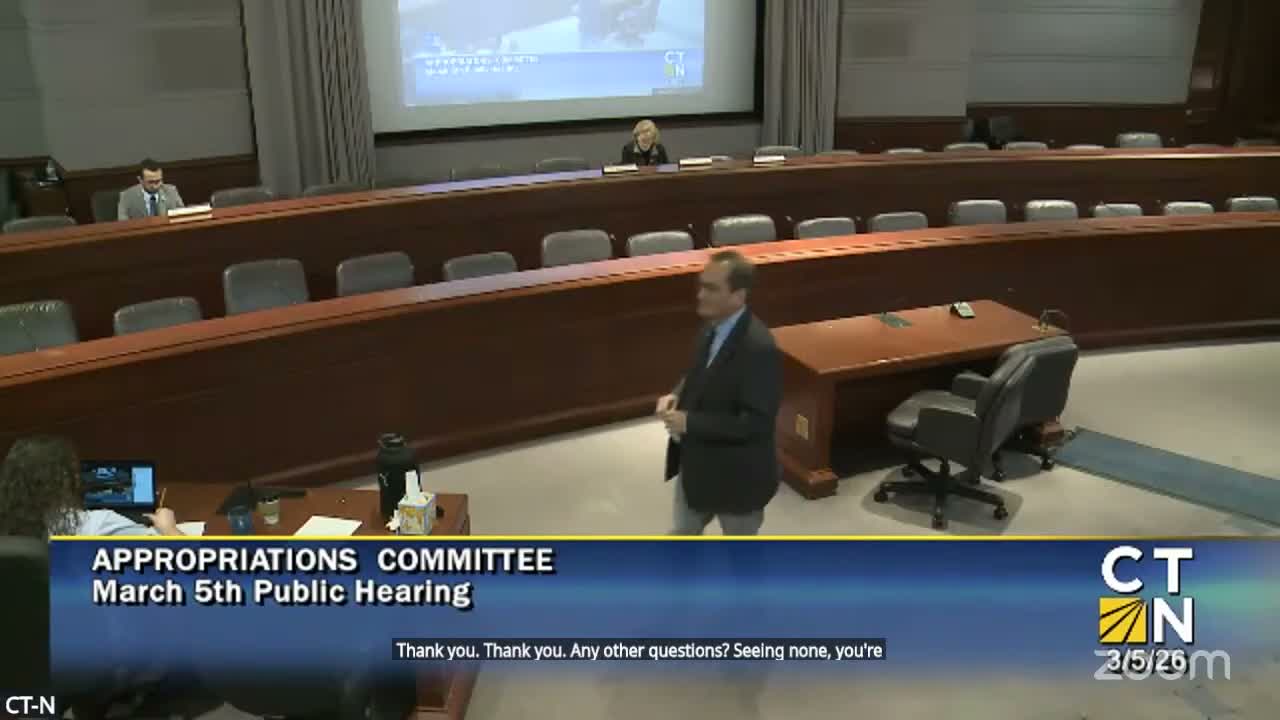
Supporters urged Connecticut legislators on March 5 to make school meals free for all students, saying the policy would reduce childhood food insecurity, simplify operations and increase federal reimbursements, while at least one local education official warned the bill’s funding mechanism could force cuts to essential school services.
Multiple witnesses told the Appropriations Committee that HB 5144 — an act concerning funding for school meals — would help families and students across the state. Daniel Fitzmaurice, director of advocacy at United Way of Connecticut, said the state’s ALICE research shows at least 581,000 Connecticut households are asset-limited and income-constrained; he argued that no-cost breakfast for all and no-cost lunch for reduced-price families would lift a real burden off those households. “This bill simply extends that same relief to families across our state who need it just as much,” Fitzmaurice said.
Public-health and nonprofit groups framed meals as prevention. Aaron Bassuto, a Yale public health graduate student, cited regional precedents in Massachusetts and New Mexico and academic reviews linking universal meal policies to lower childhood obesity and improved school outcomes. Jim Williams, government relations director for the American Heart Association in Connecticut, said polling shows overwhelming public support and offered a potential revenue idea — a 2¢ per-ounce sugary drink tax — which he provided to committee staff.
Local food advocates urged pairing universal meals with increased local procurement. Meg Horrigan of the Connecticut Food Sovereignty Collective said requiring even a modest share of Connecticut-sourced food could boost local farmers while improving nutrition in school cafeterias. Stephanie Deason, president of the School Nutrition Association of Connecticut and a food-service director, told lawmakers that removing universal breakfast had reduced participation by 30–70 percent in her district and driven up unrecoverable meal debt; she urged covering reduced-price households to stabilize operations.
But Joseph Sikalovic, vice chair of the Bridgeport Board of Education, opposed the bill as drafted. He told the committee that HB 5144’s funding appears to be offset in the education operating budget rather than supported by new revenue, a choice he said would require cuts to special education, magnet programs and other services Bridgeport relies on. That, he argued, would amount to a regressive redistribution of resources that benefits wealthier districts while harming high-need communities. “Until this proposal is properly funded, restructured, and removed from the education budget, I respectfully oppose 5144,” Sikalovic said.
Committee members asked witnesses for cost estimates and operational details. Kate Mazada of the Connecticut Children with Incarcerated Parents Initiative and student and community speakers described food insecurity and urged lawmakers to consider how universal access reduces stigma and improves attendance and concentration. The student witness from Wesleyan said free meals in his Massachusetts high school reduced shame and helped him focus on studies.
The hearing produced multiple funding ideas — from a sugary-drink tax to other revenue proposals — but no formal vote. Lawmakers said they would continue examining the bill, asking for cost estimates and program details as they work through budget adjustment discussions.
Next steps: the committee did not take a vote at the hearing; staff and witnesses were asked to provide additional cost and implementation details to inform budget negotiations.
Multiple witnesses told the Appropriations Committee that HB 5144 — an act concerning funding for school meals — would help families and students across the state. Daniel Fitzmaurice, director of advocacy at United Way of Connecticut, said the state’s ALICE research shows at least 581,000 Connecticut households are asset-limited and income-constrained; he argued that no-cost breakfast for all and no-cost lunch for reduced-price families would lift a real burden off those households. “This bill simply extends that same relief to families across our state who need it just as much,” Fitzmaurice said.
Public-health and nonprofit groups framed meals as prevention. Aaron Bassuto, a Yale public health graduate student, cited regional precedents in Massachusetts and New Mexico and academic reviews linking universal meal policies to lower childhood obesity and improved school outcomes. Jim Williams, government relations director for the American Heart Association in Connecticut, said polling shows overwhelming public support and offered a potential revenue idea — a 2¢ per-ounce sugary drink tax — which he provided to committee staff.
Local food advocates urged pairing universal meals with increased local procurement. Meg Horrigan of the Connecticut Food Sovereignty Collective said requiring even a modest share of Connecticut-sourced food could boost local farmers while improving nutrition in school cafeterias. Stephanie Deason, president of the School Nutrition Association of Connecticut and a food-service director, told lawmakers that removing universal breakfast had reduced participation by 30–70 percent in her district and driven up unrecoverable meal debt; she urged covering reduced-price households to stabilize operations.
But Joseph Sikalovic, vice chair of the Bridgeport Board of Education, opposed the bill as drafted. He told the committee that HB 5144’s funding appears to be offset in the education operating budget rather than supported by new revenue, a choice he said would require cuts to special education, magnet programs and other services Bridgeport relies on. That, he argued, would amount to a regressive redistribution of resources that benefits wealthier districts while harming high-need communities. “Until this proposal is properly funded, restructured, and removed from the education budget, I respectfully oppose 5144,” Sikalovic said.
Committee members asked witnesses for cost estimates and operational details. Kate Mazada of the Connecticut Children with Incarcerated Parents Initiative and student and community speakers described food insecurity and urged lawmakers to consider how universal access reduces stigma and improves attendance and concentration. The student witness from Wesleyan said free meals in his Massachusetts high school reduced shame and helped him focus on studies.
The hearing produced multiple funding ideas — from a sugary-drink tax to other revenue proposals — but no formal vote. Lawmakers said they would continue examining the bill, asking for cost estimates and program details as they work through budget adjustment discussions.
Next steps: the committee did not take a vote at the hearing; staff and witnesses were asked to provide additional cost and implementation details to inform budget negotiations.
Don't Miss a Word: See the Full Meeting!
Go beyond summaries. Unlock every video, transcript, and key insight with a Founder Membership.
✓
Get instant access to full meeting videos
✓
Search and clip any phrase from complete transcripts
✓
Receive AI-powered summaries & custom alerts
✓
Enjoy lifetime, unrestricted access to government data
30-day money-back guarantee
