Zoning commission told state law limits adding historic‑district restrictions; pauses permit reviews until enforcement plan is in place
March 04, 2026 | Marion County, Texas
This article was created by AI summarizing key points discussed. AI makes mistakes, so for full details and context, please refer to the video of the full meeting. Please report any errors so we can fix them. Report an error »
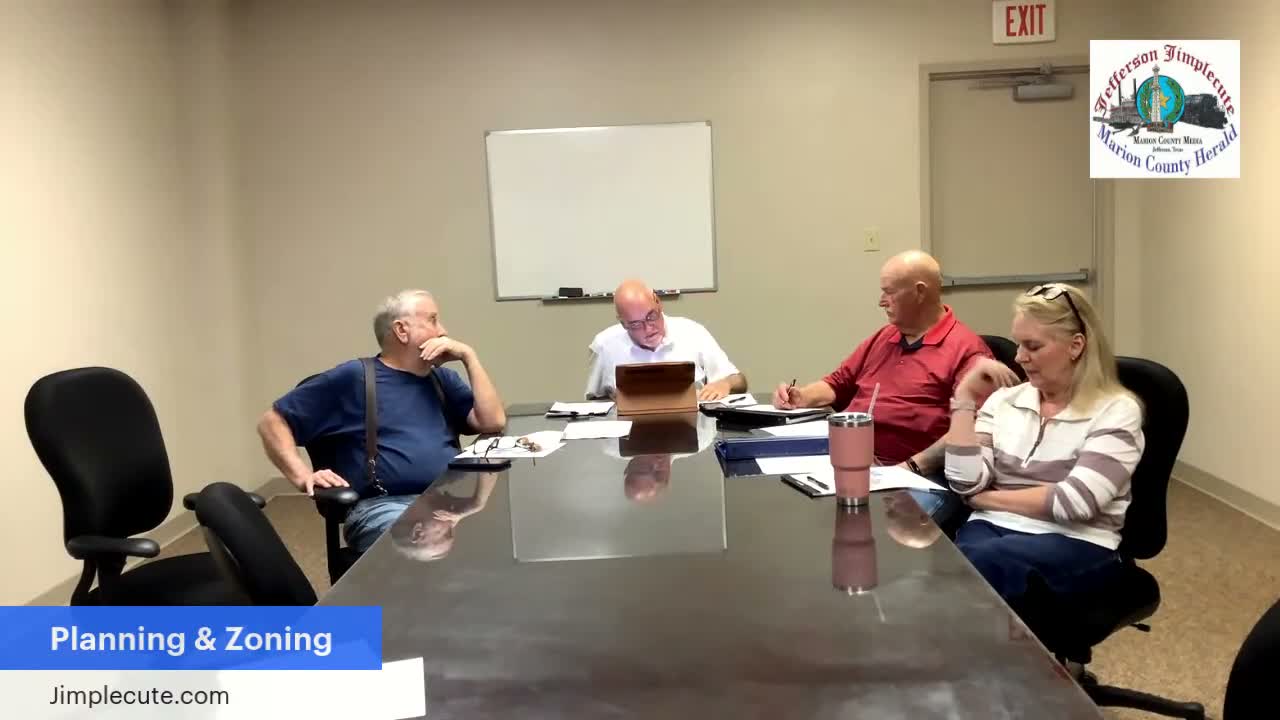
The City of Jefferson Pleasant Planning and Zoning Commission on March 3 heard from the city attorney's office that the federal listing of the town's historic district does not, by itself, give the city authority to impose restrictions on private properties inside the district without following state law, and the commission voted unanimously to stop routine review of building permits until enforcement arrangements are in place.
Catherine Shamay, an associate attorney with the city attorney's office, told commissioners the National Register designation helps with grant eligibility but does not allow the city to add encumbrances or new restrictions on property owners without further steps under state law. "To do that, you have to establish the historic district through state law which is the Local Government Code 211.0165," Shamay said, explaining that imposing property-level restrictions requires either written consent from owners or a three‑fourths vote of the governing body.
The commission — led by its chair — raised a history of confusion about prior guidance and asked what the next steps would be if the city wants to regulate new construction inside the district. Chair (speaker 2) framed the meeting around both getting the zoning ordinance right and ensuring the city can actually enforce it: "The rubber is gonna hit the road when it comes to enforcement," the chair said, noting the city currently lacks a dedicated building-code official or inspection staff. "City of Jefferson does not have an enforcement body or a person, doesn't have a building code official, and we need one."
Commissioners and the attorney discussed several related components that the draft zoning and code package must address before the city imposes new on‑the‑ground requirements: clear statutory definitions for manufactured and HUD-code homes, whether older pre‑1976 mobile homes should be prohibited going forward, grandfathering of existing nonconforming units, explicit processes for adopting design restrictions, and a practical enforcement plan that could be delivered either by a contracted consultant or by hiring a code official.
Shamay said the attorney's office reviewed highlighted provisions and found them consistent with state law, and noted the importance of matching ordinance definitions to the exact statutory language to avoid future enforcement problems. She also offered to provide model templates and resources to help draft a local process that would withstand legal scrutiny.
Commissioners discussed past negotiations with a consulting firm, Willdan, which had proposed services but would have produced a contract that exceeded a $50,000 threshold, prompting the need for a formal solicitation. The group debated whether to hire a consultant to provide code-review and inspection services, to engage outside counsel for consulting, or to recruit a part‑time or full‑time building-code official; they also discussed fee structures — inspection fees, administrative charges and reinspection fees — that would allow the city to recover costs instead of subsidizing inspections.
After discussion, the commission voted to suspend review of incoming building-permit applications until the ordinance text, the enforcement approach and either a consultant contract or staffing plan are in place. The motion carried in a unanimous voice vote; the transcript records that the vote was unanimous but does not provide a numerical tally.
The commission also entered into the record the resignation of member Hugh Lewis, effective Feb. 27, 2026, and thanked him for his service. The commission asked the city attorney's office to review the draft scope-of-work and RFP language for a building-code consultant and requested that feedback be available by the commission's next meeting, with an aim of discussing attorney comments at the April meeting.
What happens next: the attorney's office will provide sample language and resources, and staff will circulate the previously drafted scope of work and the draft zoning documents for further comment. The commission intends to return to the issue once it has attorney feedback and a clearer enforcement plan.
Catherine Shamay, an associate attorney with the city attorney's office, told commissioners the National Register designation helps with grant eligibility but does not allow the city to add encumbrances or new restrictions on property owners without further steps under state law. "To do that, you have to establish the historic district through state law which is the Local Government Code 211.0165," Shamay said, explaining that imposing property-level restrictions requires either written consent from owners or a three‑fourths vote of the governing body.
The commission — led by its chair — raised a history of confusion about prior guidance and asked what the next steps would be if the city wants to regulate new construction inside the district. Chair (speaker 2) framed the meeting around both getting the zoning ordinance right and ensuring the city can actually enforce it: "The rubber is gonna hit the road when it comes to enforcement," the chair said, noting the city currently lacks a dedicated building-code official or inspection staff. "City of Jefferson does not have an enforcement body or a person, doesn't have a building code official, and we need one."
Commissioners and the attorney discussed several related components that the draft zoning and code package must address before the city imposes new on‑the‑ground requirements: clear statutory definitions for manufactured and HUD-code homes, whether older pre‑1976 mobile homes should be prohibited going forward, grandfathering of existing nonconforming units, explicit processes for adopting design restrictions, and a practical enforcement plan that could be delivered either by a contracted consultant or by hiring a code official.
Shamay said the attorney's office reviewed highlighted provisions and found them consistent with state law, and noted the importance of matching ordinance definitions to the exact statutory language to avoid future enforcement problems. She also offered to provide model templates and resources to help draft a local process that would withstand legal scrutiny.
Commissioners discussed past negotiations with a consulting firm, Willdan, which had proposed services but would have produced a contract that exceeded a $50,000 threshold, prompting the need for a formal solicitation. The group debated whether to hire a consultant to provide code-review and inspection services, to engage outside counsel for consulting, or to recruit a part‑time or full‑time building-code official; they also discussed fee structures — inspection fees, administrative charges and reinspection fees — that would allow the city to recover costs instead of subsidizing inspections.
After discussion, the commission voted to suspend review of incoming building-permit applications until the ordinance text, the enforcement approach and either a consultant contract or staffing plan are in place. The motion carried in a unanimous voice vote; the transcript records that the vote was unanimous but does not provide a numerical tally.
The commission also entered into the record the resignation of member Hugh Lewis, effective Feb. 27, 2026, and thanked him for his service. The commission asked the city attorney's office to review the draft scope-of-work and RFP language for a building-code consultant and requested that feedback be available by the commission's next meeting, with an aim of discussing attorney comments at the April meeting.
What happens next: the attorney's office will provide sample language and resources, and staff will circulate the previously drafted scope of work and the draft zoning documents for further comment. The commission intends to return to the issue once it has attorney feedback and a clearer enforcement plan.
Don't Miss a Word: See the Full Meeting!
Go beyond summaries. Unlock every video, transcript, and key insight with a Founder Membership.
✓
Get instant access to full meeting videos
✓
Search and clip any phrase from complete transcripts
✓
Receive AI-powered summaries & custom alerts
✓
Enjoy lifetime, unrestricted access to government data
30-day money-back guarantee
