Murrysville staff outlines draft stormwater credit manual tied to new fee; council questions 35% cap
March 05, 2026 | Murrysville, Westmoreland County, Pennsylvania
This article was created by AI summarizing key points discussed. AI makes mistakes, so for full details and context, please refer to the video of the full meeting. Please report any errors so we can fix them. Report an error »
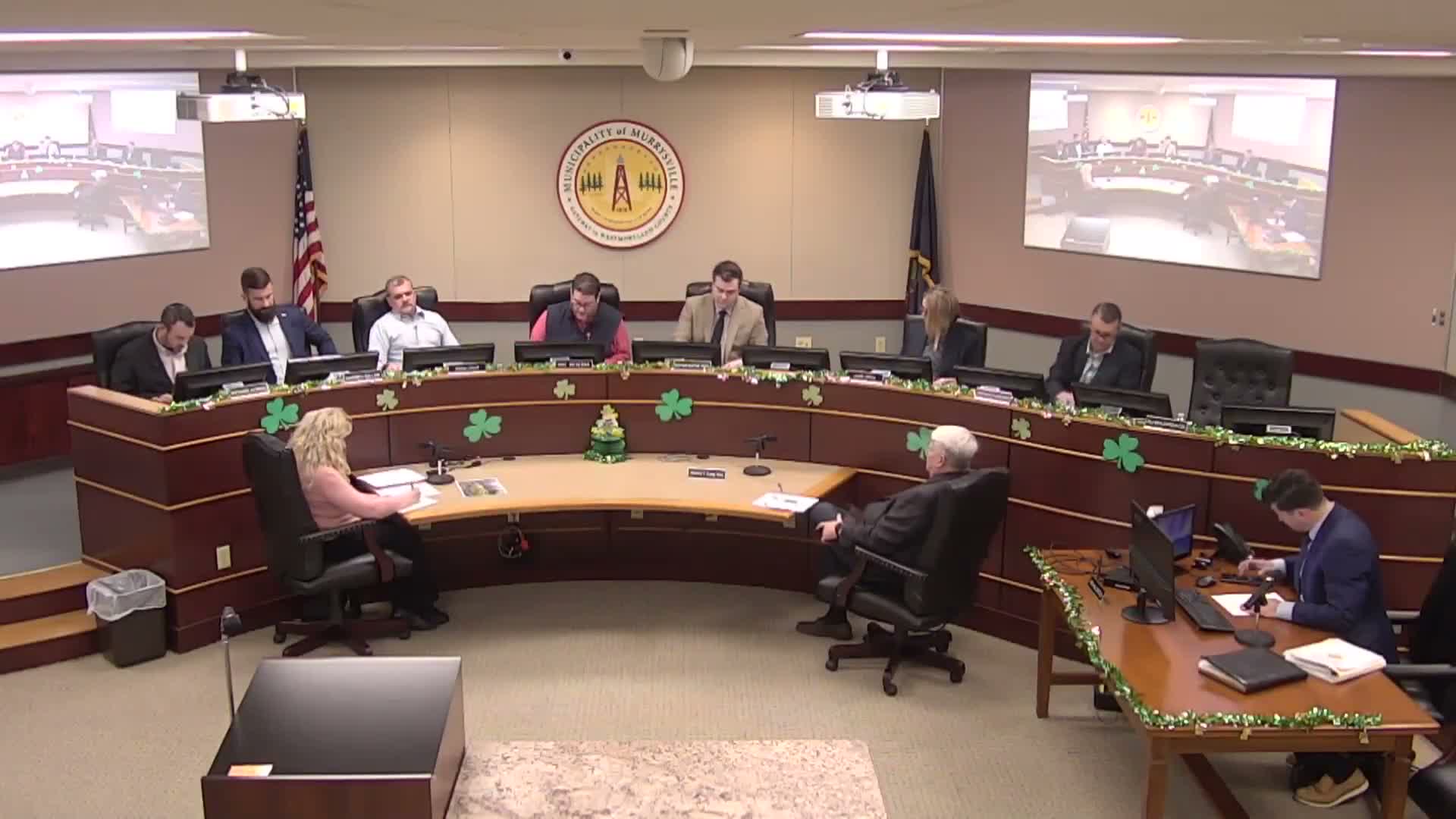
Murrysville Chief Administrator Mike presented a draft stormwater credit manual on March 4 that would implement credits tied to the stormwater fee adopted in December and lay out how property owners could apply for reductions on their annual bills.
The manual proposes four ratepayer tiers and an approach that staff said is manageable for the municipality’s limited stormwater administration staff. Under the draft, small residential accounts would be eligible for a one‑time $40 rain‑barrel credit after a photo and simple application. Larger single‑family parcels and nonresidential properties would be able to apply for credits tied to best management practices (BMPs) — such as rain gardens, swales, permeable pavement and detention basins — with a stated maximum of about a 35% reduction in a property’s yearly stormwater fee.
Mike told council the draft is intended to balance administrative capacity with incentives for meaningful runoff reduction: “We wanted to try to enter into it with something that was manageable, and feasible for staff,” he said, adding that credits would require engineer‑certified documentation, possible inspections and an operation and maintenance agreement. Credits would generally be awarded for a five‑year window and require annual documentation to remain in place.
Several council members pressed staff on whether the 35% cap is equitable for large property owners who may capture most runoff on‑site. Councilmember Michael said the cap could leave high‑performing properties paying a large share of the system cost: “In my personal opinion, the balance there is not fair,” he said, arguing the fee should reflect impact on the system rather than act like a secondary property tax.
Staff responded with systemwide context, noting that roughly 7,800 of the municipality’s ~8,000 ratepayers pay $126 or less annually, which limits the municipality’s ability to offer deep discounts broadly without shifting costs. Staff also reviewed comparable approaches from nearby jurisdictions: some municipalities limit residential credits, others offer 25–35% BMP credits and some provide small rebates for rain barrels.
The draft’s structural BMP credit is broken into components — peak flow attenuation (up to 10%), volume control (up to 10%) and water‑quality improvements (up to 15%) — that can combine up to the suggested 35% cap. Staff said the manual currently mirrors the ordinance’s appeal language so property owners may contest fee assessments or credit determinations through staff and, if needed, to council.
Council members recommended additional clarifications to the draft table, requested more context for compounding credits, and asked staff to return with options for how to structure maximums and whether certain credits should be compounded. Staff said the document on the dais was a draft for council review, not yet posted for public comment, and that adoption would occur by resolution at a later meeting.
The council did not vote on the manual. Staff will return with revisions and additional information before the council places a resolution to adopt the credit manual on a future agenda.
The manual proposes four ratepayer tiers and an approach that staff said is manageable for the municipality’s limited stormwater administration staff. Under the draft, small residential accounts would be eligible for a one‑time $40 rain‑barrel credit after a photo and simple application. Larger single‑family parcels and nonresidential properties would be able to apply for credits tied to best management practices (BMPs) — such as rain gardens, swales, permeable pavement and detention basins — with a stated maximum of about a 35% reduction in a property’s yearly stormwater fee.
Mike told council the draft is intended to balance administrative capacity with incentives for meaningful runoff reduction: “We wanted to try to enter into it with something that was manageable, and feasible for staff,” he said, adding that credits would require engineer‑certified documentation, possible inspections and an operation and maintenance agreement. Credits would generally be awarded for a five‑year window and require annual documentation to remain in place.
Several council members pressed staff on whether the 35% cap is equitable for large property owners who may capture most runoff on‑site. Councilmember Michael said the cap could leave high‑performing properties paying a large share of the system cost: “In my personal opinion, the balance there is not fair,” he said, arguing the fee should reflect impact on the system rather than act like a secondary property tax.
Staff responded with systemwide context, noting that roughly 7,800 of the municipality’s ~8,000 ratepayers pay $126 or less annually, which limits the municipality’s ability to offer deep discounts broadly without shifting costs. Staff also reviewed comparable approaches from nearby jurisdictions: some municipalities limit residential credits, others offer 25–35% BMP credits and some provide small rebates for rain barrels.
The draft’s structural BMP credit is broken into components — peak flow attenuation (up to 10%), volume control (up to 10%) and water‑quality improvements (up to 15%) — that can combine up to the suggested 35% cap. Staff said the manual currently mirrors the ordinance’s appeal language so property owners may contest fee assessments or credit determinations through staff and, if needed, to council.
Council members recommended additional clarifications to the draft table, requested more context for compounding credits, and asked staff to return with options for how to structure maximums and whether certain credits should be compounded. Staff said the document on the dais was a draft for council review, not yet posted for public comment, and that adoption would occur by resolution at a later meeting.
The council did not vote on the manual. Staff will return with revisions and additional information before the council places a resolution to adopt the credit manual on a future agenda.
Don't Miss a Word: See the Full Meeting!
Go beyond summaries. Unlock every video, transcript, and key insight with a Founder Membership.
✓
Get instant access to full meeting videos
✓
Search and clip any phrase from complete transcripts
✓
Receive AI-powered summaries & custom alerts
✓
Enjoy lifetime, unrestricted access to government data
30-day money-back guarantee
