Commission hears hours of public testimony and tables East Wing modernization vote until April 2
March 06, 2026 | National Capital Planning Commission (NCPC), Executive, Federal
This article was created by AI summarizing key points discussed. AI makes mistakes, so for full details and context, please refer to the video of the full meeting. Please report any errors so we can fix them. Report an error »
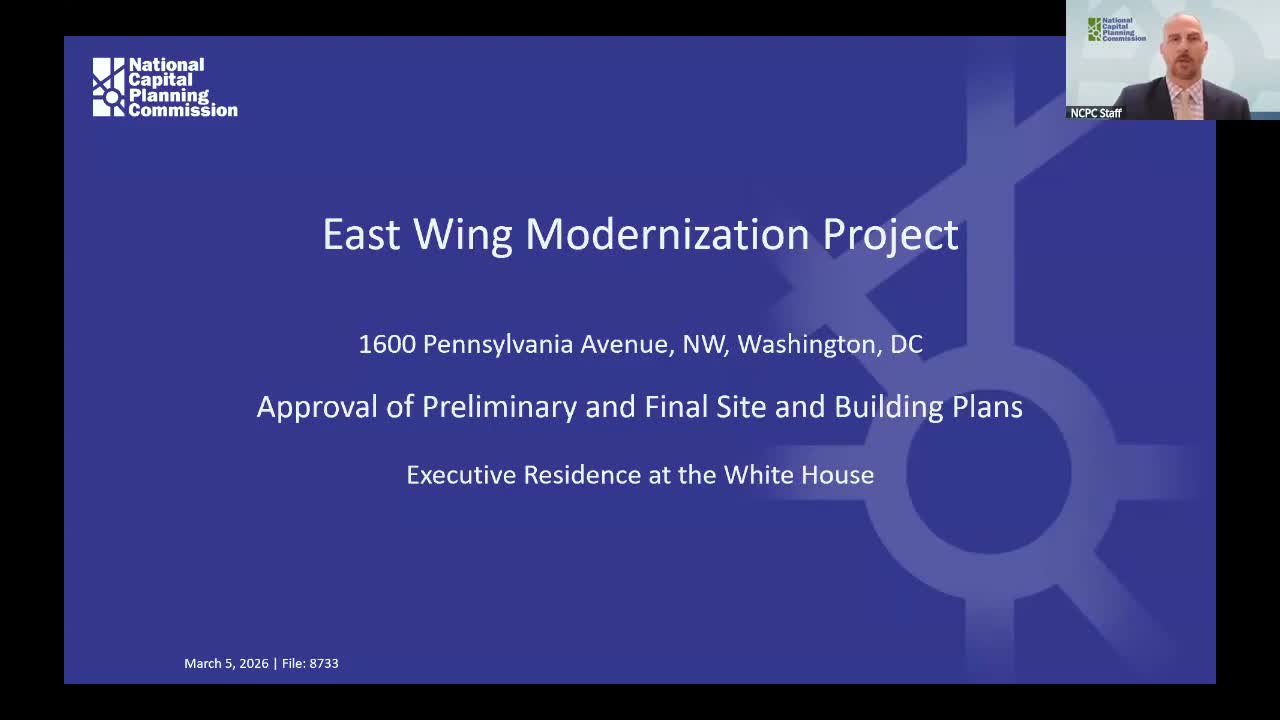
NCPC staff presented preliminary and final site and building plans for the proposed East Wing modernization (a new permanent ballroom and connecting colonnade on the White House grounds) and recommended approval with design refinements on March 5. After a sustained, hours-long public testimony period — largely opposed — the Commission voted to table final action until its April 2 meeting.
Staff framed the project as a response to a programmatic need for permanent secure event space that would reduce reliance on temporary tents. Staff noted the project program includes an approximately 22,000-square-foot ballroom (about 1,000 seated guests) and roughly 89,000 square feet of visible area including the colonnade. Staff reported a viewshed analysis concluding that key public views of the Executive Mansion would largely be retained and recommended design refinements including removal of the triangular south pediment, refinements to the south portico and colonnade detailing, and additional landscape screening and integration. Staff also recommended briefing the Commission in the future on a comprehensive security and beautification plan for the White House complex.
Project architect Shalom Baranis and the design team described changes since the January informational presentation (notably the pediment removal) and landscape design proposals (Mount Vernon brick re-use, holly and magnolia plantings). Commissioners raised questions about height, footprint, the functional rationale for the south portico and stair cascades, accessibility, the potential for solar, staging and service needs, and how the colonnade interface would alter access from the East Room.
More than a hundred public witnesses were scheduled; NCPC heard a substantial portion of them in grouped panels. Witnesses included architects, preservation groups (National Trust for Historic Preservation, Society of Architectural Historians, DC Preservation League), former White House staff, trade and professional organizations, civic groups (Common Cause, Public Citizen), and many individual citizens. Recurring themes from expert and civic testimony included: the ballroom’s size and massing (many urged reducing the ballroom toward industry norms of about 10–15 sq ft per person), the south portico and triple staircase that some described as an ‘‘aesthetic gesture’’ without internal function, concerns that the ballroom would overwhelm the Executive Mansion and interrupt key viewshed lines to the Capitol, and calls for more time, alternative concepts (including underground or smaller options) and transparency about private funding and donor influence. The National Trust urged more deliberation and said a smaller, lower ballroom could still meet program needs. Common Cause highlighted ethical concerns about private fundraising for the project.
After the testimony, Commissioner Dixon moved to hold the motion to approve preliminary and final plans over until the April 2 meeting so commissioners could deliberate further; Vice Chairman Levenbach seconded. The Commission voted by roll call to table the matter; NCPC staff stated the public comment window for this item is closed and the commission will deliberate and take a final vote on April 2.
The action in March was a procedural tabling of final approval and does not constitute approval of the East Wing plans. Commissioners and staff asked the project team to continue refining design details in response to NCPC comments and public input prior to the April 2 deliberation and vote.
Staff framed the project as a response to a programmatic need for permanent secure event space that would reduce reliance on temporary tents. Staff noted the project program includes an approximately 22,000-square-foot ballroom (about 1,000 seated guests) and roughly 89,000 square feet of visible area including the colonnade. Staff reported a viewshed analysis concluding that key public views of the Executive Mansion would largely be retained and recommended design refinements including removal of the triangular south pediment, refinements to the south portico and colonnade detailing, and additional landscape screening and integration. Staff also recommended briefing the Commission in the future on a comprehensive security and beautification plan for the White House complex.
Project architect Shalom Baranis and the design team described changes since the January informational presentation (notably the pediment removal) and landscape design proposals (Mount Vernon brick re-use, holly and magnolia plantings). Commissioners raised questions about height, footprint, the functional rationale for the south portico and stair cascades, accessibility, the potential for solar, staging and service needs, and how the colonnade interface would alter access from the East Room.
More than a hundred public witnesses were scheduled; NCPC heard a substantial portion of them in grouped panels. Witnesses included architects, preservation groups (National Trust for Historic Preservation, Society of Architectural Historians, DC Preservation League), former White House staff, trade and professional organizations, civic groups (Common Cause, Public Citizen), and many individual citizens. Recurring themes from expert and civic testimony included: the ballroom’s size and massing (many urged reducing the ballroom toward industry norms of about 10–15 sq ft per person), the south portico and triple staircase that some described as an ‘‘aesthetic gesture’’ without internal function, concerns that the ballroom would overwhelm the Executive Mansion and interrupt key viewshed lines to the Capitol, and calls for more time, alternative concepts (including underground or smaller options) and transparency about private funding and donor influence. The National Trust urged more deliberation and said a smaller, lower ballroom could still meet program needs. Common Cause highlighted ethical concerns about private fundraising for the project.
After the testimony, Commissioner Dixon moved to hold the motion to approve preliminary and final plans over until the April 2 meeting so commissioners could deliberate further; Vice Chairman Levenbach seconded. The Commission voted by roll call to table the matter; NCPC staff stated the public comment window for this item is closed and the commission will deliberate and take a final vote on April 2.
The action in March was a procedural tabling of final approval and does not constitute approval of the East Wing plans. Commissioners and staff asked the project team to continue refining design details in response to NCPC comments and public input prior to the April 2 deliberation and vote.
Don't Miss a Word: See the Full Meeting!
Go beyond summaries. Unlock every video, transcript, and key insight with a Founder Membership.
✓
Get instant access to full meeting videos
✓
Search and clip any phrase from complete transcripts
✓
Receive AI-powered summaries & custom alerts
✓
Enjoy lifetime, unrestricted access to government data
30-day money-back guarantee
