Caltrans researcher outlines road‑use charge research and privacy, equity tradeoffs at Glendale commission
March 06, 2026 | Glendale, Los Angeles County, California
This article was created by AI summarizing key points discussed. AI makes mistakes, so for full details and context, please refer to the video of the full meeting. Please report any errors so we can fix them. Report an error »
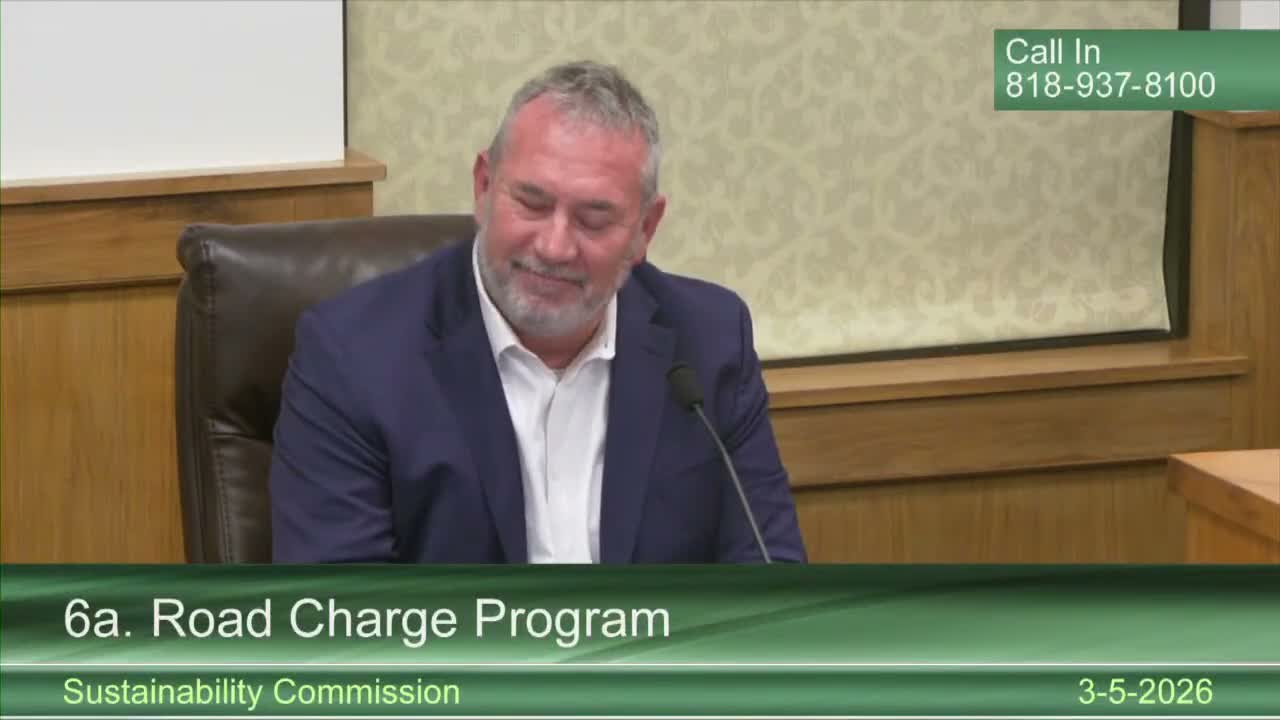
Caltrans researcher Lauren Perhota told the Glendale Sustainability Commission on March 5 that the state has spent a decade studying road‑use charging as a replacement for the gas tax and is testing reporting options that range from low‑tech odometer reads to in‑vehicle telematics.
Perhota, who heads Caltrans’ road‑use charging research program, said the research aims to make the funding mechanism revenue‑neutral for purposes of analysis and to assess impacts across communities. “We’re looking just revenue neutral, not necessarily a tax increase,” she said, adding that pilots have tested multiple reporting and rate structures and that a draft report directed by the legislature will be released for review later this year.
Perhota described privacy safeguards and participant choices as central to design. “It’ll be a critical element to this program to make sure people have choice and that they don't have to provide anything more than the number of miles. You don't have to provide your location,” she said, while also noting higher‑tech reporting options can yield savings for some participants.
Commissioners pressed for details about interstate travel, rural impacts and whether the policy would discourage electric vehicle adoption. Perhota said commercial vehicle reporting could use existing interstate systems such as IFTA and that passenger‑vehicle programs could include transition credits to account for out‑of‑state miles. She cited a pilot rate used in prior testing—2.8¢ per mile—as an example of how a road charge could be calibrated to equal the gas tax at a point in time.
On equity, Perhota said the studies show the distributional effects vary by vehicle type and geography and that some rural or disadvantaged drivers who currently pay more under the gas tax could pay less under certain road‑use charge designs. On EV effects she said UC Davis and Caltrans research suggests upfront purchase incentives and HOV‑lane access have been more influential than ongoing operating‑cost differences.
Perhota noted technological and administrative choices matter for cost and participation. She described a range of reporting options—from odometer reads performed at service shops to third‑party account managers certified by the DMV—and said privacy and data security policies would be part of design choices.
The presentation included comparisons with other jurisdictions (Hawaii’s mandatory program for EVs, voluntary programs in Oregon and Utah, and pilots in New Zealand) and reiterated that the legislature will choose any eventual policy. Perhota said Caltrans’ role is research and technical design, not setting the policy itself.
The commission followed with detailed questions about phase‑in options, weight‑based impacts on pavement, and technical limits of charging data. Perhota recommended continued stakeholder outreach and noted the draft legislative report due this summer will provide additional detail for policymakers.
Perhota, who heads Caltrans’ road‑use charging research program, said the research aims to make the funding mechanism revenue‑neutral for purposes of analysis and to assess impacts across communities. “We’re looking just revenue neutral, not necessarily a tax increase,” she said, adding that pilots have tested multiple reporting and rate structures and that a draft report directed by the legislature will be released for review later this year.
Perhota described privacy safeguards and participant choices as central to design. “It’ll be a critical element to this program to make sure people have choice and that they don't have to provide anything more than the number of miles. You don't have to provide your location,” she said, while also noting higher‑tech reporting options can yield savings for some participants.
Commissioners pressed for details about interstate travel, rural impacts and whether the policy would discourage electric vehicle adoption. Perhota said commercial vehicle reporting could use existing interstate systems such as IFTA and that passenger‑vehicle programs could include transition credits to account for out‑of‑state miles. She cited a pilot rate used in prior testing—2.8¢ per mile—as an example of how a road charge could be calibrated to equal the gas tax at a point in time.
On equity, Perhota said the studies show the distributional effects vary by vehicle type and geography and that some rural or disadvantaged drivers who currently pay more under the gas tax could pay less under certain road‑use charge designs. On EV effects she said UC Davis and Caltrans research suggests upfront purchase incentives and HOV‑lane access have been more influential than ongoing operating‑cost differences.
Perhota noted technological and administrative choices matter for cost and participation. She described a range of reporting options—from odometer reads performed at service shops to third‑party account managers certified by the DMV—and said privacy and data security policies would be part of design choices.
The presentation included comparisons with other jurisdictions (Hawaii’s mandatory program for EVs, voluntary programs in Oregon and Utah, and pilots in New Zealand) and reiterated that the legislature will choose any eventual policy. Perhota said Caltrans’ role is research and technical design, not setting the policy itself.
The commission followed with detailed questions about phase‑in options, weight‑based impacts on pavement, and technical limits of charging data. Perhota recommended continued stakeholder outreach and noted the draft legislative report due this summer will provide additional detail for policymakers.
View the Full Meeting & All Its Details
This article offers just a summary. Unlock complete video, transcripts, and insights as a Founder Member.
✓
Watch full, unedited meeting videos
✓
Search every word spoken in unlimited transcripts
✓
AI summaries & real-time alerts (all government levels)
✓
Permanent access to expanding government content
30-day money-back guarantee
