House approves amendments‑rejected Welfare Fraud Prevention Act after debate on verification and costs
March 06, 2026 | House of Representative, Committees, Legislative, Wyoming
This article was created by AI summarizing key points discussed. AI makes mistakes, so for full details and context, please refer to the video of the full meeting. Please report any errors so we can fix them. Report an error »
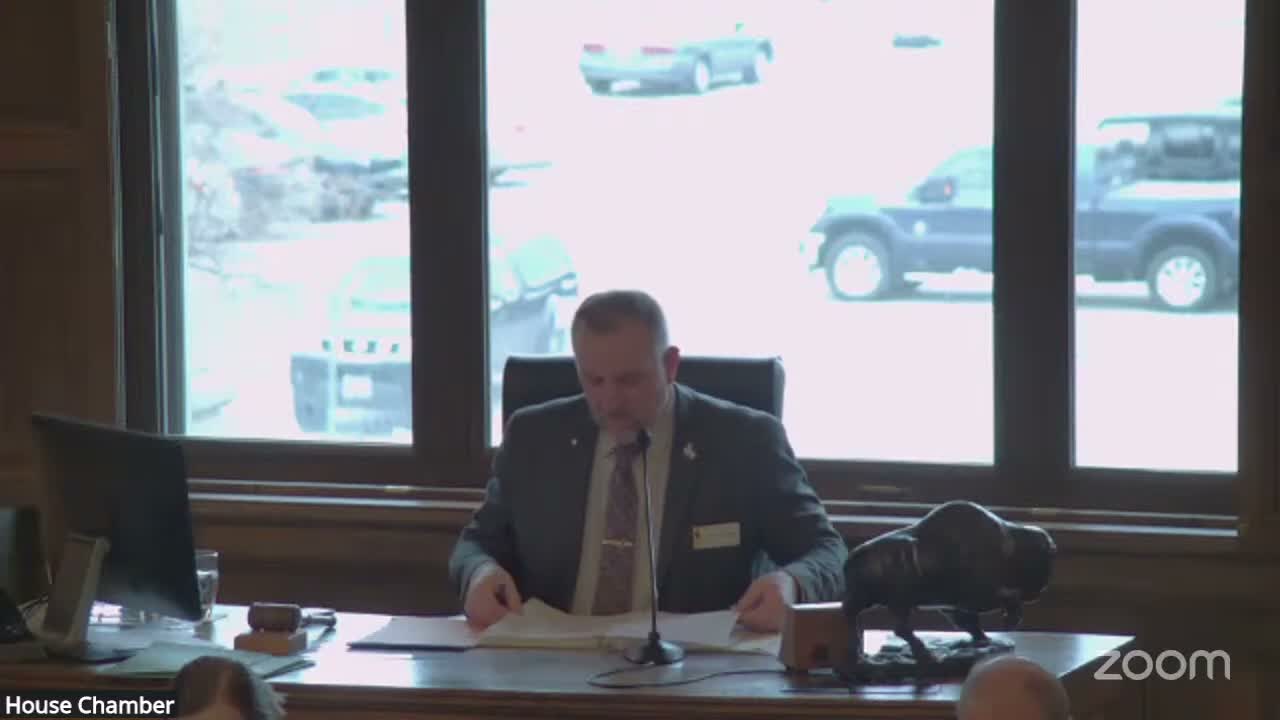
The House of Representative considered Senate File 106, titled the Welfare Fraud Prevention Act, and took extended debate on a proposed third‑reading amendment intended to strengthen fraud detection for assistance programs.
Representative Brady moved Amendment #1 to SF106 to add cross‑checks of unearned income (IRS, VA, unemployment and other state databases), require county anti‑fraud procedures and reporting, and create notification provisions. Supporters argued the measures would close gaps in eligibility verification. Opponents and several members raised legal and administrative concerns: Division 1 of the amendment would have asked county commissioners to establish investigatory procedures and was criticized as providing unprecedented authority to counties. Division 2 drew sustained scrutiny over operational costs and federal preemption—members cited agency estimates that implementing the amendment’s requirements could add roughly 166 staff-hours per month per person, require about 78 new positions statewide, and cost between $1.1 million and $3.2 million annually.
After floor debate the House voted on the divided amendment sections. Division 1 was not adopted; Division 2 also failed to pass. With the amendment defeated, the House proceeded to a final roll call on SF106. The chief clerk reported a closing tally of 55 ayes, 6 no, and 1 excused, and the Speaker announced that Senate File 106 passed the House.
The transcript records members’ repeated qualifications: several said they supported fraud prevention in principle but were wary of unfunded mandates, federal conflicts (noting veterans’ benefit records and VA access), and administrative burden on county offices. No implementing details (final agency fiscal notes or specific interagency memoranda) were recorded on the floor; staff follow‑up and committee review were discussed as possibilities.
Representative Brady moved Amendment #1 to SF106 to add cross‑checks of unearned income (IRS, VA, unemployment and other state databases), require county anti‑fraud procedures and reporting, and create notification provisions. Supporters argued the measures would close gaps in eligibility verification. Opponents and several members raised legal and administrative concerns: Division 1 of the amendment would have asked county commissioners to establish investigatory procedures and was criticized as providing unprecedented authority to counties. Division 2 drew sustained scrutiny over operational costs and federal preemption—members cited agency estimates that implementing the amendment’s requirements could add roughly 166 staff-hours per month per person, require about 78 new positions statewide, and cost between $1.1 million and $3.2 million annually.
After floor debate the House voted on the divided amendment sections. Division 1 was not adopted; Division 2 also failed to pass. With the amendment defeated, the House proceeded to a final roll call on SF106. The chief clerk reported a closing tally of 55 ayes, 6 no, and 1 excused, and the Speaker announced that Senate File 106 passed the House.
The transcript records members’ repeated qualifications: several said they supported fraud prevention in principle but were wary of unfunded mandates, federal conflicts (noting veterans’ benefit records and VA access), and administrative burden on county offices. No implementing details (final agency fiscal notes or specific interagency memoranda) were recorded on the floor; staff follow‑up and committee review were discussed as possibilities.
View the Full Meeting & All Its Details
This article offers just a summary. Unlock complete video, transcripts, and insights as a Founder Member.
✓
Watch full, unedited meeting videos
✓
Search every word spoken in unlimited transcripts
✓
AI summaries & real-time alerts (all government levels)
✓
Permanent access to expanding government content
30-day money-back guarantee
