Bangor Arts Commission debates whether grants should pay for theater equipment
March 06, 2026 | Bangor City, Penobscot County, Maine
This article was created by AI summarizing key points discussed. AI makes mistakes, so for full details and context, please refer to the video of the full meeting. Please report any errors so we can fix them. Report an error »
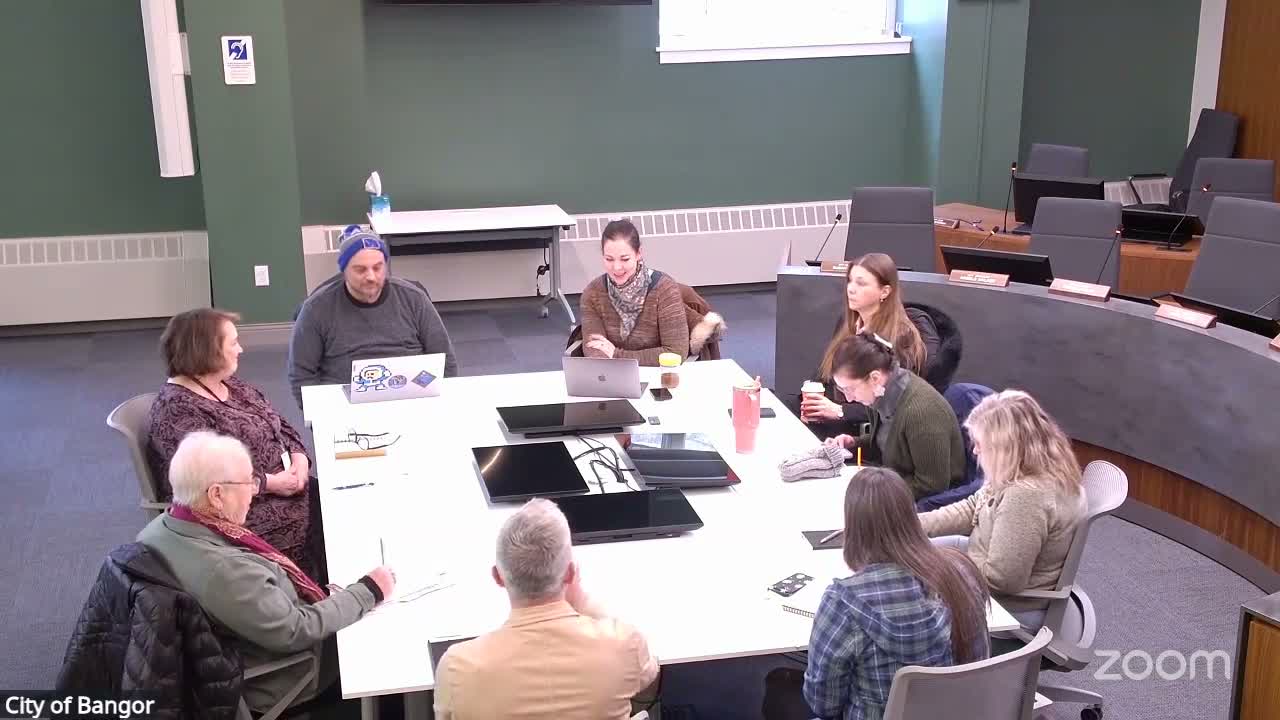
At its March meeting, the Bangor Arts Commission debated whether its open grant cycle should cover purchases of equipment such as theater lighting, with commissioners split on whether such items are programmatic or routine maintenance.
The dispute centered on last year’s recommendation to fund lights for a local theater. Commissioner (S6) said some city council members viewed that use as operations rather than program funding and questioned whether the commission should advise applicants that grants are for programs rather than equipment. Chair (S2) responded that “without lighting, a production... you can't put on a theater event without lighting,” calling lighting an intrinsic part of a theater production’s programming.
Why it matters: the commission’s guidance affects what applicants propose and how the city and potential funders view the grants. The commission’s grant pool is small — S2 noted the commission has roughly $10,000 available for the current cycle — so clarifying eligible costs can change which projects receive awards.
Commissioners agreed not to change the advertised application while the current cycle is open. Several members suggested the commission could revise eligibility language for the Fall 2026 cycle and present any recommended edits to city staff and the council. S4 and others argued that funding a concrete, durable item such as lighting may be easier for small organizations to secure and could serve multiple productions over many years; S7 noted that larger organizations have different needs than smaller groups and that equipment can be a long-term improvement.
On process: commissioners discussed establishing themes or filters for future cycles (for example, prioritizing public art or individual artists) and said the commission sometimes ranks applications by merit or impact but can also split limited funds when several strong applicants apply. A volunteer (S8) offered to draft an outreach email to notify area artists that the application is open, and Chair (S2) agreed to share the commission’s contact list so the message can be sent.
The commission emphasized it will convene the grants committee after the April 1 deadline to review applications and that any substantive eligibility changes would be proposed after this cycle ends and, if recommended, sent to the city for approval.
The commission took no formal vote during the discussion.
The dispute centered on last year’s recommendation to fund lights for a local theater. Commissioner (S6) said some city council members viewed that use as operations rather than program funding and questioned whether the commission should advise applicants that grants are for programs rather than equipment. Chair (S2) responded that “without lighting, a production... you can't put on a theater event without lighting,” calling lighting an intrinsic part of a theater production’s programming.
Why it matters: the commission’s guidance affects what applicants propose and how the city and potential funders view the grants. The commission’s grant pool is small — S2 noted the commission has roughly $10,000 available for the current cycle — so clarifying eligible costs can change which projects receive awards.
Commissioners agreed not to change the advertised application while the current cycle is open. Several members suggested the commission could revise eligibility language for the Fall 2026 cycle and present any recommended edits to city staff and the council. S4 and others argued that funding a concrete, durable item such as lighting may be easier for small organizations to secure and could serve multiple productions over many years; S7 noted that larger organizations have different needs than smaller groups and that equipment can be a long-term improvement.
On process: commissioners discussed establishing themes or filters for future cycles (for example, prioritizing public art or individual artists) and said the commission sometimes ranks applications by merit or impact but can also split limited funds when several strong applicants apply. A volunteer (S8) offered to draft an outreach email to notify area artists that the application is open, and Chair (S2) agreed to share the commission’s contact list so the message can be sent.
The commission emphasized it will convene the grants committee after the April 1 deadline to review applications and that any substantive eligibility changes would be proposed after this cycle ends and, if recommended, sent to the city for approval.
The commission took no formal vote during the discussion.
Don't Miss a Word: See the Full Meeting!
Go beyond summaries. Unlock every video, transcript, and key insight with a Founder Membership.
✓
Get instant access to full meeting videos
✓
Search and clip any phrase from complete transcripts
✓
Receive AI-powered summaries & custom alerts
✓
Enjoy lifetime, unrestricted access to government data
30-day money-back guarantee
