Budget committee reviews $2.5 million transfer from special-election surplus for 2026 elections, security and county costs
March 05, 2026 | 2026 Legislature Arizona, Arizona
This article was created by AI summarizing key points discussed. AI makes mistakes, so for full details and context, please refer to the video of the full meeting. Please report any errors so we can fix them. Report an error »
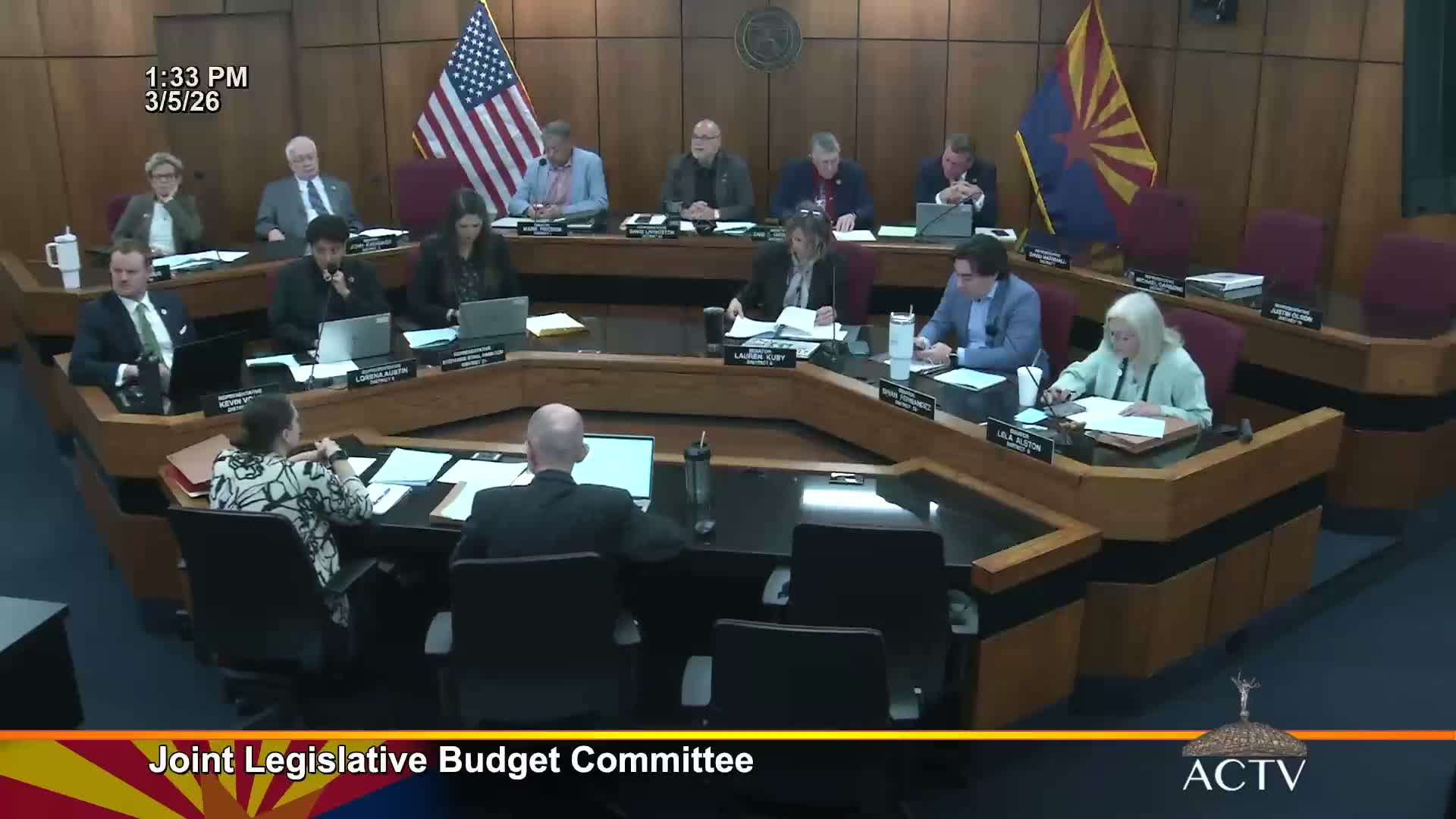
The Joint Legislative Budget Committee on an interim session reviewed a proposal to transfer $2,500,000 from a FY 2026 special-election surplus into the Secretary of State’s operating budget to pay for 2026 election operations, physical security and county-related expenses, committee members heard.
JLBC staff member Mikaela Andrews told the committee the department’s initial request was $2.9 million but the staff recommendation excludes $200,000 intended for future planning and $160,000 described as physical-security costs already incurred. Andrews said the proposed $2.5 million would fund $500,000 in state election costs for the 2026 primary and general — including logic-and-accuracy testing, election reporting updates and petition-signature verification — $240,000 for March–June 2026 physical-security expenses for the Secretary of State, and $1,700,000 for county-related expenses, of which $1,000,000 is earmarked for counties’ share of the state voter registration database.
Committee members pressed agency representatives for detail on the largest security line items. "The amount there is for cost at public events," Andrews said, and she deferred operational specifics to the Secretary of State’s office. Rex Bartlett, representing the Secretary of State’s office, told the committee that the office prefers not to disclose exact camera or deployment details for safety reasons, saying, “we wouldn't like to detail where every camera is. It just makes it easier for people to subvert that.” Bartlett also said the office has been in active communication with federal partners regarding voter-roll issues and that some conversations have occurred virtually.
A committee member asked whether transferred funds could be spent on litigation related to voter-roll disputes. Bartlett told the committee that the special-line transfer under discussion is tracked separately and "none of this monies will go towards litigation," and that broader litigation spending is part of the Secretary of State's overall budget. A different member said they wanted a running total of litigation-related expenses and how those costs intersect with shared database funds.
Vice Chair (committee member) moved that JLBC give a favorable review of item 1 with three provisions. The first two provisions read on the record: (1) beginning April 15, 2026, and on the 15th of each month through December 2026, the Secretary of State must submit reports to JLBC staff on the previous month’s expenditures and year-to-date expenditures of monies transferred from the special-election expense line; and (2) any monies transferred from that special-election expense line may not be used by the Secretary of State for contracts with individuals. The transcript excerpt provided to the committee includes the two provisions above; the text of the third provision was not specified in the excerpt.
The committee discussed the limits of JLBC review authority; staff clarified that the committee’s review is advisory and that agencies retain budget authority to spend within statutory limits, though future budgets may reflect the committee’s views. The transcript does not record a formal roll-call vote or the final outcome on the motion.
Why it matters: the transfer would shift election-operational costs and large county reimbursements within the state budget and would put monthly reporting requirements in place for funds drawn from the special-election line. That affects how counties are reimbursed for voter-registration database costs and how the Secretary of State documents security-related expenditures.
Next steps: the motion for a favorable review was made on the record with two spelled-out provisions; the transcript excerpt does not include a recorded vote or the full text of the third provision, and committee members requested further reporting and documentation from the Secretary of State’s office.
JLBC staff member Mikaela Andrews told the committee the department’s initial request was $2.9 million but the staff recommendation excludes $200,000 intended for future planning and $160,000 described as physical-security costs already incurred. Andrews said the proposed $2.5 million would fund $500,000 in state election costs for the 2026 primary and general — including logic-and-accuracy testing, election reporting updates and petition-signature verification — $240,000 for March–June 2026 physical-security expenses for the Secretary of State, and $1,700,000 for county-related expenses, of which $1,000,000 is earmarked for counties’ share of the state voter registration database.
Committee members pressed agency representatives for detail on the largest security line items. "The amount there is for cost at public events," Andrews said, and she deferred operational specifics to the Secretary of State’s office. Rex Bartlett, representing the Secretary of State’s office, told the committee that the office prefers not to disclose exact camera or deployment details for safety reasons, saying, “we wouldn't like to detail where every camera is. It just makes it easier for people to subvert that.” Bartlett also said the office has been in active communication with federal partners regarding voter-roll issues and that some conversations have occurred virtually.
A committee member asked whether transferred funds could be spent on litigation related to voter-roll disputes. Bartlett told the committee that the special-line transfer under discussion is tracked separately and "none of this monies will go towards litigation," and that broader litigation spending is part of the Secretary of State's overall budget. A different member said they wanted a running total of litigation-related expenses and how those costs intersect with shared database funds.
Vice Chair (committee member) moved that JLBC give a favorable review of item 1 with three provisions. The first two provisions read on the record: (1) beginning April 15, 2026, and on the 15th of each month through December 2026, the Secretary of State must submit reports to JLBC staff on the previous month’s expenditures and year-to-date expenditures of monies transferred from the special-election expense line; and (2) any monies transferred from that special-election expense line may not be used by the Secretary of State for contracts with individuals. The transcript excerpt provided to the committee includes the two provisions above; the text of the third provision was not specified in the excerpt.
The committee discussed the limits of JLBC review authority; staff clarified that the committee’s review is advisory and that agencies retain budget authority to spend within statutory limits, though future budgets may reflect the committee’s views. The transcript does not record a formal roll-call vote or the final outcome on the motion.
Why it matters: the transfer would shift election-operational costs and large county reimbursements within the state budget and would put monthly reporting requirements in place for funds drawn from the special-election line. That affects how counties are reimbursed for voter-registration database costs and how the Secretary of State documents security-related expenditures.
Next steps: the motion for a favorable review was made on the record with two spelled-out provisions; the transcript excerpt does not include a recorded vote or the full text of the third provision, and committee members requested further reporting and documentation from the Secretary of State’s office.
Don't Miss a Word: See the Full Meeting!
Go beyond summaries. Unlock every video, transcript, and key insight with a Founder Membership.
✓
Get instant access to full meeting videos
✓
Search and clip any phrase from complete transcripts
✓
Receive AI-powered summaries & custom alerts
✓
Enjoy lifetime, unrestricted access to government data
30-day money-back guarantee
