University of Arizona’s Vishnu Reddy frames Biosphere 2 and space-defense research as local economic engines
March 05, 2026 | 2026 Legislature Arizona, Arizona
This article was created by AI summarizing key points discussed. AI makes mistakes, so for full details and context, please refer to the video of the full meeting. Please report any errors so we can fix them. Report an error »
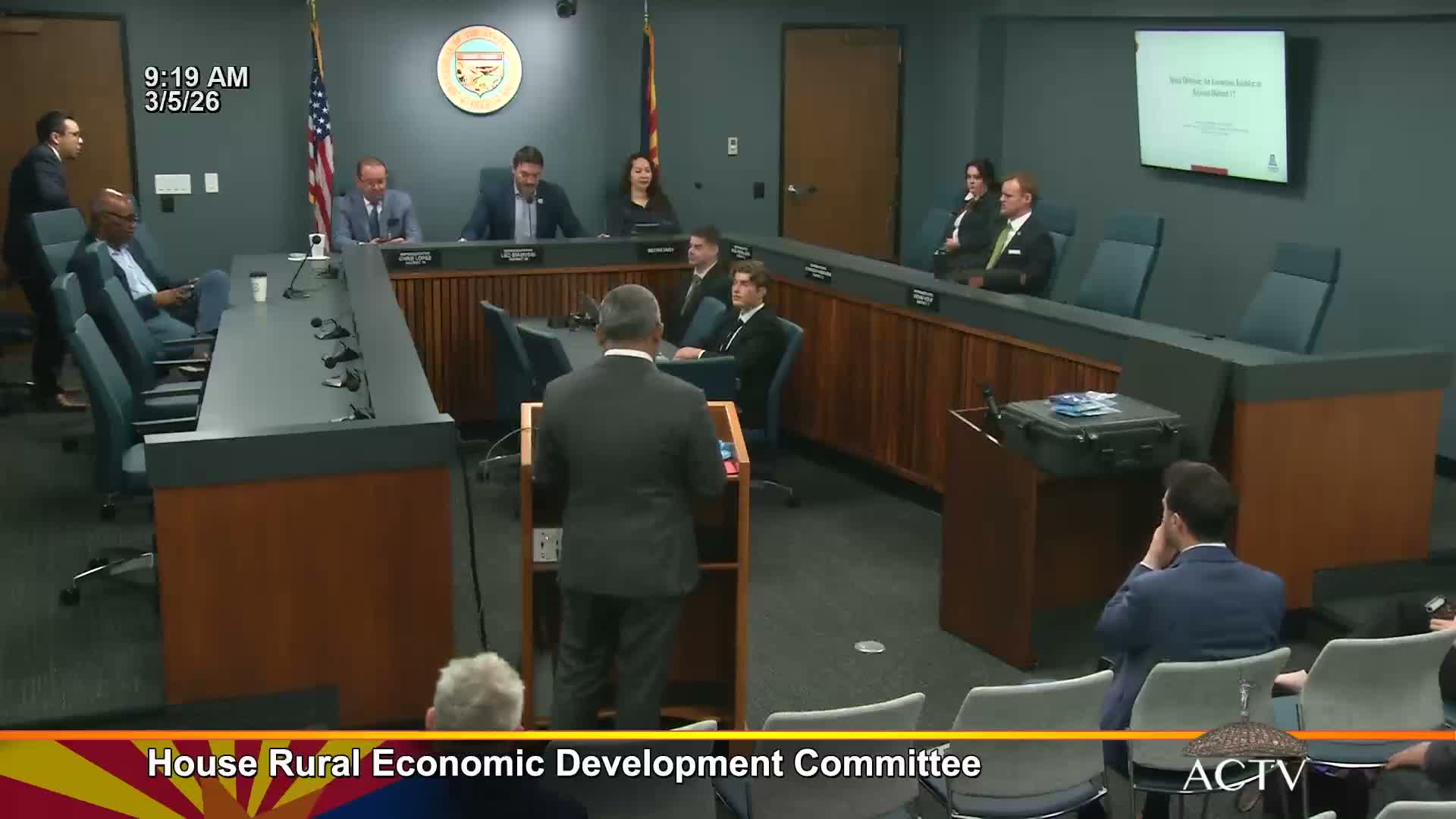
Dr. Vishnu Reddy, professor of planetary sciences and director of the Space Safety, Security, and Sustainability Center at the University of Arizona, told the rural economic development committee that Biosphere 2 supports multiple research programs while also generating local economic activity.
"Today I'm gonna talk about space defense as an economic enabler in District 17 And 7," Reddy said, introducing the facility’s multiple laboratories including the Landscape Evolution Observatory (LEO), a rainforest biome and a 700,000-gallon ocean tank. He said LEO uses roughly 15,000 probes to study water flow and erosion and that the site hosts experiments on food production and energy innovation.
Reddy described agrivoltaics—growing crops beneath solar panels—and "freight farms" (containerized vertical farms) as water-efficient food production methods that are energy intensive and thus pair naturally with local solar generation. "You not only produce the solar power from solar panels, but also you can do agriculture below it," he said, arguing the systems can support rural communities and deployed forces in austere conditions.
On economic impact, Reddy gave figures: about 75,000 paid visitors annually, roughly $2.1 million in visitor revenue, approximately $7 million in total expenditures and more than $68 million in philanthropic support over the last decade (primarily from the Bass Foundation). He also said the University’s space-defense work has attracted more than $25 million in federal and state funding.
Reddy outlined the university’s space situational awareness network—telescopes, sensors and student-built equipment—and stressed partnerships with small businesses (including contracting work to firms such as Starzona) to keep operational costs down while supporting workforce development. "We partner with small businesses and we provide the students so that we bring the academia and the small business to train our students," he said.
During Q&A, members asked how near-Earth asteroids are tracked and what responses are possible. Reddy explained orbit calculation and international coordination through the International Asteroid Warning Network, and described kinetic impact as a practical mitigation method, citing NASA’s DART mission as an example: "The easiest thing would be to... fire some kind of a kinetic source like, you know, to push it off course," he said.
Reddy concluded with a hands-on demonstration of meteorite and lunar/Martian samples for committee members and adjourned the meeting.
No formal committee votes or directives on funding or program changes were recorded during the session.
"Today I'm gonna talk about space defense as an economic enabler in District 17 And 7," Reddy said, introducing the facility’s multiple laboratories including the Landscape Evolution Observatory (LEO), a rainforest biome and a 700,000-gallon ocean tank. He said LEO uses roughly 15,000 probes to study water flow and erosion and that the site hosts experiments on food production and energy innovation.
Reddy described agrivoltaics—growing crops beneath solar panels—and "freight farms" (containerized vertical farms) as water-efficient food production methods that are energy intensive and thus pair naturally with local solar generation. "You not only produce the solar power from solar panels, but also you can do agriculture below it," he said, arguing the systems can support rural communities and deployed forces in austere conditions.
On economic impact, Reddy gave figures: about 75,000 paid visitors annually, roughly $2.1 million in visitor revenue, approximately $7 million in total expenditures and more than $68 million in philanthropic support over the last decade (primarily from the Bass Foundation). He also said the University’s space-defense work has attracted more than $25 million in federal and state funding.
Reddy outlined the university’s space situational awareness network—telescopes, sensors and student-built equipment—and stressed partnerships with small businesses (including contracting work to firms such as Starzona) to keep operational costs down while supporting workforce development. "We partner with small businesses and we provide the students so that we bring the academia and the small business to train our students," he said.
During Q&A, members asked how near-Earth asteroids are tracked and what responses are possible. Reddy explained orbit calculation and international coordination through the International Asteroid Warning Network, and described kinetic impact as a practical mitigation method, citing NASA’s DART mission as an example: "The easiest thing would be to... fire some kind of a kinetic source like, you know, to push it off course," he said.
Reddy concluded with a hands-on demonstration of meteorite and lunar/Martian samples for committee members and adjourned the meeting.
No formal committee votes or directives on funding or program changes were recorded during the session.
Don't Miss a Word: See the Full Meeting!
Go beyond summaries. Unlock every video, transcript, and key insight with a Founder Membership.
✓
Get instant access to full meeting videos
✓
Search and clip any phrase from complete transcripts
✓
Receive AI-powered summaries & custom alerts
✓
Enjoy lifetime, unrestricted access to government data
30-day money-back guarantee
